Keystone Edition
Immigration in NEPA: American Dream or Nightmare?
5/11/2026 | 57m 49sVideo has Closed Captions
WVIA News will examine what’s happening in the region and public reaction to it.
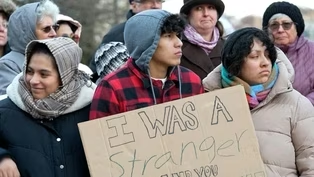
With ICE agents widely cracking down on immigration enforcement nationwide at unprecedented levels, they’re making their presence felt in Northeast and Northcentral Pennsylvania, too. With this episode of Keystone Edition, WVIA News will examine what’s happening in the region and public reaction to it.
Problems playing video? | Closed Captioning Feedback
Problems playing video? | Closed Captioning Feedback
Keystone Edition is a local public television program presented by WVIA
Keystone Edition
Immigration in NEPA: American Dream or Nightmare?
5/11/2026 | 57m 49sVideo has Closed Captions
With ICE agents widely cracking down on immigration enforcement nationwide at unprecedented levels, they’re making their presence felt in Northeast and Northcentral Pennsylvania, too. With this episode of Keystone Edition, WVIA News will examine what’s happening in the region and public reaction to it.
Problems playing video? | Closed Captioning Feedback
Where to Watch Keystone Edition
Keystone Edition is available to stream on pbs.org and the PBS app.
Providing Support for PBS.org
Learn Moreabout PBS online sponsorship- [Announcer] From your Public Media Studios, WVIA presents "Keystone Edition," a news and public affairs program that goes beyond the headlines to address issues in northeastern and central Pennsylvania.
This is "Keystone Edition."
And now moderator, Julie Sidoni.
(gentle upbeat music) - Thank you for being here with us at WVIA for this important episode of "Keystone Edition."
We're calling it "Immigration in NEPA: "American Dream or Nightmare."
And indeed there seem to be a lot of recent developments about immigration topics here in the region, on county, on state, and on federal levels.
Immigration reform, of course, is a complicated topic.
It is one that we will not exhaust over the next hour, but we have assembled a panel of experts to help us present an informational and civil conversation about this topic.
Let's get to them right now.
Beginning with my colleague Borys Krawczeniuk on who's reporting the show was based.
Borys, if we could have you and everyone else here, just introduce yourself and tell us who you are.
And I guess we'll start with you.
Go ahead.
- As you said, I'm Borys Krawczeniuk.
I cover politics and government around here, but for the last four or five months I've been working hard on the issue of immigration.
And we are planning a series of stories that start on Saturday and this is part of that, this show is part of that.
- I'm looking forward to hearing more about that.
Congressman, welcome.
- Thanks, Julie.
Thanks Borys for inviting me.
Thanks to WVIA, I appreciate it.
My name is Dan Meuser.
I represent Pennsylvania's Ninth Congressional.
I live in the Back Mountain in Luzerne County.
I'm in my fourth term.
It's certainly an honor to serve.
It's fascinating work, but it's a lot.
Me and my team stay focused on delivering the best constituent services possible, legislation that's in line with what the people wanna see, and strengthens our country, trying to deliver regular communications and taking a lot of information in so we get things right.
And the project management that takes place throughout my 12 counties in trying to bring funding and economic development throughout Pennsylvania's Ninth Congressional.
Very nice to be here.
- Thank you.
Attorney Hubbard.
- Good evening.
My name is Tracey Hubbard Rentas.
I am an immigration attorney.
I have been practicing exclusively immigration law for 20 years, and my office is located in Scranton.
My practice focuses on removal defense, also known as deportation defense.
So I deal with the legal issues and the immigration policy changes on the daily basis.
- Thank you for being here.
Commissioner Gaughan.
- Hi, how are you?
My name is Bill Gaughan.
I'm a Democratic Lackawanna County commissioner and I'm really pleased to be here.
I'm very passionate about the topic of immigration and as I was telling all of you in the green room, my wife Kelly and I live in Scranton, we have six children, so I'm gonna savor the next hour in a nice quiet studio - One of them - with all of you.
- is two weeks old.
- That's correct, yes.
- Right.
If you just wanna sleep here tonight, you certainly can.
- That's right.
Thank you.
- All right, thank you all for being here.
I'd like to start with Borys, with just an overview of, and I realize you can't be pithy about this topic, but an overview on why are we here?
- Well, it's been 40 years since the nation last passed an immigration reform bill.
It was 1986, and Ronald Reagan was president and there've been multiple tries at that since.
And that bill granted amnesty to about 2.7 million people who were here and had questionable legal status.
And since then, the problem has reoccurred and I think a lot of people who believe in strict immigration enforcement will tell you that the reason is that we haven't been enforcing our immigration laws.
And so, you know, on multiple occasions, 2007, 2013, 2024, there were attempts at bipartisan immigration reform and they failed.
During that time, you know, the numbers of people coming here unauthorized have fluctuated.
It got pretty bad under President Biden.
You know, I think a lot of people who were supporters of his would say that that wasn't so bad.
But, you know, on the Republican side, you know, it obviously became a large number of people.
And so we've arrived at this point where now the emphasis is on immigration and tracking down people who are here and who should be or shouldn't be, depends on, you know, which position you take.
- Congressman, what has happened in the last year or two?
It's kinda the same question here, but explain what we're doing here tonight.
It seems as though we're in a different era than we were even two, three, four, five years ago, where immigration reform is concerned.
- Well, I mean, immigration reform and issue has been going on for a while.
I mean, President Obama addressed it as well.
He, during his term, deported over 3 million illegals, stated clearly our borders need to be secure.
When President Trump came into office the first time the border was not secure.
They worked on securing it over time.
And, you know, one of my first months into Congress, I'll never forget, and again, we're gonna have a spirited conversation here, and I promise to deliver the facts as best I know them, might be some hard truths, but in that January when we had one of the longest shutdowns ever, President Trump said, "Okay, "let's give the dreamers legal status, "but what I want in return is $5.6 billion "for border security."
And the speaker at the time, Nancy Pelosi, said no.
So we continue to have the longest shutdown at that time in history.
So this has been somewhat of a serious debate through that time period.
We then, during the first term of Trump, when I was there, 'cause I was there for his second two years, he engaged the Mexican government, assisted.
I went to the border four different times, spent a couple days there, and the Mexican military helped secure the border at the time.
And that was a pretty big deal because they were fighting against cartels, they were fighting against a lot of people.
And, you know, our customs and border patrol agents were literally beside themselves dealing with... I once had a CBP agent say to me as he was working at his desk, he turned to me and looked at me and he said, "Sometimes I feel like the last link "in the chain of human trafficking."
'Cause he was just trying to get a young person to a sponsor because he had a name of the individual written on his arm.
I mean, he honestly didn't know who he was sending it to, and they would track it and do everything they possibly could, but that's how bad it was.
For the last year and a half, we've been doing everything we can to correct the situation.
And, you know, the border got closed, no legislation necessary, right?
Voila, the border was closed because that was the order that was given by DHS, Department of Homeland Security and as well as the White House.
Congress, you know, we almost can't even take any credit for it.
We were favorable to that.
And now the promise was that, okay, now we're also going to engage in deportations, it was supposed to start with criminals and work our way through.
And, you know, since Trump's been back in office, 2.3 million illegals, undocumented workers, however you wanna call them, but they're here illegally, returned voluntarily so far.
And thus far we've also deported about 600,000 other individuals.
And do we like how it's all occurring?
No.
Did I like what happened in... You know, most cities worked out just fine because they had some cooperation.
But certainly I know we're gonna end up talking about Minneapolis and the tragedies that occurred there.
They did.
But also the riots, the incitement, the craziness that took place, which, one could say, you know, created a very frenzy environment.
So we just got to get this right.
We do need some real comprehensive... Now that the border's secure, I'm all for a comprehensive immigration approach.
But, you know, sanctuary cities and no cooperation with ICE.
I mean, ICE has become, you know.
You got Democrat leaders referring to them as Gestapo, and Nazis, and everything else.
But once again, I still believe, and I think in a realistic manner, there are solutions to this.
And that's what I hope to discuss and share with the audience tonight.
- Are you for mass deportation, is that something that you want to see?
- Well, I wouldn't say I'm for mass deportations.
What I am for though is following the laws.
I am for encouraging voluntary deportation.
So as they can maybe get in line for citizenship.
I'm for a better, more comprehensive plan.
I've actually said this to the president, "Where's the pivot?
"When are we going to?"
And I even use the expression kinder and gentler on handling those that came here that shouldn't have.
They still came here illegally, but it was really, frankly, the Biden Administration's fault that they came because they were informed that they're gonna get here and they're gonna be welcomed with open arms, and they're going to receive all kinds of free things along the way.
Which, in many cases, they did.
Which, by the way, along with the illegal immigration, along with the drugs, along with the deaths, by the way, during the Biden administration, fentanyl deaths went up by 40,000 from 67 to 107,000 Americans a year.
So when I say catastrophe, those are the catastrophes I'm talking about.
- You brought up ICE though, and I would like to pivot here to Commissioner Gaughan for a second.
I know you have successfully led Lackawanna County to not cooperate, Lackawanna County employees, I should say, not to cooperate with ICE.
And I would like to know a little bit about why you felt so strongly about that decision.
- Yeah, I think, well, first of all, the real catastrophe here is the rhetoric and the way that immigrants have been treated under the Trump administration.
I look back to when Donald Trump first came down the elevator, not the elevator, the escalator in 2015, and basically said that all Mexicans were rapists and drug dealers.
I think that's wrong.
I think that every American should reject that.
When we look at ICE and the effect that they've had on the American people, immigrants, and the trauma that they've induced into families throughout Lackawanna County.
I talk to them.
I live in South Scranton.
I see these people, my kids go to school with them.
I think we should be ashamed of that as a country.
And it troubles me, all of the things that are going on that ICE as an organization, 10 years ago, had a $6 billion budget.
Today it has an $85 billion budget.
That is so extreme.
(Dan speaking faintly) - $45 billion of that is for these detention centers.
So we're focused on demonizing an entire group.
We're focused on tearing them down, and my strong belief is that this country was built on immigration.
Those throughout the world, throughout our history who had the least always gave this country the most.
And I think that we have to say that as loud as we can and as strong as we can because, you know, I get a kick out of Donald Trump and these MAGA Republicans, they're the first ones in the pews on Sunday, they're the first ones to beat the Bible, but yet they call immigrants animals.
They say that they come from filthy countries.
That's wrong.
I have six children.
My children know that that's wrong.
There's a difference between right and wrong.
And our children know it and we should really stand up for these people.
And in terms of cooperating with ICE, I think we have a moral obligation to protect the people who live in Lackawanna County whether they're white, whether they're Hispanic, whether they're an immigrant, whether they're an illegal immigrant, whether we saw in Minneapolis and other cities throughout the country was a disgrace.
It lowered our status, not only here, but around the world that we're willing to treat people like that, that we're willing to send masked agents in after people, rip them out of their houses, go in without warrants.
And it's just a disgrace and a shame.
And just as an American and as a leader in the community, I felt it was important to stand up.
- Attorney Hubbard, you've been taking some notes here and I would like to know what you're writing, but I also am curious about the argument of starting with criminals first, violent immigrants first, I hear that a lot, but a lot of people have said it doesn't really matter, they're here illegal anyway, that the very fact that they are here is the crime.
And I wonder in your work with people who come to you for help, do you see that?
- Well, the key thing to understand is that immigration is civil enforcement.
It is not criminal.
Everyone wants to equate it to criminal.
And it's not, it is civil enforcement.
Immigration court is civil court, and the detention aspect of it is supposed to be only to detain those immigrants that are a flight risk, meaning that they wouldn't come to court or they wouldn't leave the United States if they had to and/or that they are a danger to the community.
Those are the only people that are supposed to be detained.
I mean, that is the law.
That is the established law, that those are the only people that are supposed to be detained.
That's not what we're seeing.
I mean, that's not what's happening right now.
And there was so much when Congressman Meuser was speaking that, you know, topics that came to my mind and responses, and one of the places that I'd like to start is that immigration wasn't always a Republican versus Democrat issue.
It wasn't that at all.
Amnesty, the dreaded amnesty, like, Republicans have bashed on amnesty, amnesty.
Amnesty was signed into law by a Republican president, the darling Republican president, which was Ronald Reagan.
That's who signed amnesty.
That's where it came from.
And it came from his understanding of being the governor of California.
That special agricultural workers were necessary in the United States because we did not have American citizens willing to do those jobs.
So we needed special agricultural worker.
It also came from the idea that if you paid a fine of $1,000, if you did not enter the United States with a visa, you entered without inspection or illegally as the term is tossed around, you could cure that if you now had a way of obtaining lawful status in the United States.
You're married to a U.S.
citizen, you had an employer who wanted to sponsor you, by paying $1,000.
Now this was back in the 1980s, $1,000, you know, per person applying for an adjustment of status to get a green card in the United States.
That was, you know, big money back then.
So there was a definite financial benefit, but it was also a benefit to the immigrant because he was able to regularize his status.
What we have happening now.
Obama.
President Obama, and I've practiced through, I started with George W., and you know, all the way through Trump 1.0, Trump 2.0.
- Five administrations.
- Exactly.
And I've seen the different enforcement priorities.
I've seen and experienced them.
And what is remarkable is that President Obama is the deporter in chief, right?
That was his title and that title, people have tried to demonize or say, you know, that there was a problem.
Here's what I can tell you from my time practicing during the eight years that Obama was in office, the vast majority of my clients were permanent residents who had committed, you know, bad offenses, you know, they were lawfully in this country, they had, you know, status in this country.
They were not undocumented, right?
These were the criminal aliens.
These were, you know, domestic violence, you know, multiple DUI offenders.
So a danger to the public with DUIs, drugs, you know, sex offense, offense against children, any of those type of offenses, that is what the focus was.
Everyone assumes that DACA, Deferred Action for Childhood Arrivals, that the reason that President Obama instituted that was because he was a softie.
He was a softie on immigration.
No, he was intelligent.
And the reason was, is 'cause he said, "We need to get all of these dolphins "that are caught in the tuna net out "because have limited resources.
"We cannot deport 11 million undocumented immigrants.
"We cannot do it," right?
"We don't have the resources, "we don't have the flights, "we don't have the courts.
"And there's no way of actually a accomplishing that."
So what he said, and this was what DACA did, is it said, "Leave the kids alone "that have grown up in this country, "that are brought here as children, "you know, who've gone to school here, "who've graduated from schools here, "allow them to have a life here.
"They have committed no crime in this country.
"Stop worrying about these folks.
"I want you to laser focus, ICE, "I want you to laser focus on any criminal alien," right?
And that is when the practice shifted.
And what that did was it allowed, you know, the undocumented immigrants that were in the country raising U.S.
citizen children, married to U.S.
citizen spouses, some of them, you know, working for U.S.
employers, paying their taxes, not having crimes in this country, it allowed them to not worry because the message was you lead a good life, you contribute to your community, you don't have to be in fear, right?
So it reinforced being responsible and living the good life, rather than saying we want to pick the individuals that are bringing crime.
And you've heard the rhetoric about that, that are real problems in our communities and we want to extract that and get it out.
That's not what's happening.
What's happening is it is what I call the lowest-hanging fruit.
And the lowest-hanging fruit is the easiest undocumented or semi-documented immigrant to detain.
And the problem with that is that a lot of these numbers that you're talking about are people that we allowed into the United States because that was the policy.
Venezuelans is a huge number.
Venezuelans are being rounded up, detained, put in jail cells, told they're subject to mandatory detention.
And is it a surprise that 2.3 million requested a voluntary return?
It's not voluntary.
They are jailed.
They were given permission at the border to enter, they were paroled into the United States, which means they had permission.
They have work authorizations, valid U.S.-issued work authorizations to be in this country.
They have affirmative applications for asylum pending, right?
Which in order to get allowed into the country, you have to have a credible fear of return.
Credible fear of return means that you have to have a legally cognizable fear of return.
- Attorney Hubbard, I don't mean to cut you off, but we do have to move on here with some other topics, including, I wanna bring this a little bit back to local, what we're doing here locally.
- Right.
- And to that end, we're gonna tell you a little bit about the Lackawanna County Commissioners meeting last month that we were discussing here just a bit ago.
Officials were trying to restrict how county residents were interacting with ICE.
This was before the county voted in favor of that restriction.
There's nothing illegal that a local law enforcement have to work with, I mean, I thought that this happened all the time in criminal investigations.
- It has historically, when you're talking about, you know, state and local police and work working with federal agents to crack down on drugs and things like that.
But that has not been common practice when it comes to immigration.
In federal law, there's been something called the 287g program that's gone on for, that's 30 years old now, right?
The use of it has accelerated in the last year.
The number of agreements, and these are agreements between local municipalities, local police departments and ICE to have local police officers help enforce federal immigration laws.
And there's an increase of these agreements in the last year because part of the One Big Beautiful Bill Act last year provided some money, if departments start cooperating, that they can get money for equipment and things like that.
And there are communities that, you know, want to crack down on this issue.
So that's been where the cooperation has increased.
And that's part of the debate that happened in Lackawanna County.
How much should local municipalities cooperate with ICE?
- Is it impeding a federal investigation if you don't cooperate?
- Not at all.
I mean, this isn't about not cooperating, this is about putting guardrails in place because we've seen what's happened in other parts of the country.
Lackawanna County, just like every other county government throughout Pennsylvania, is basically a large social service agency.
We help people from the youngest parts of our community in Office of Youth and Family Services to the oldest parts of our community in the Area Agency on Aging.
And we wanna make sure that the people in our community, our immigrant community, know that they can come into our county building and use those services.
Because as I said before, I live in South Scranton, people are afraid to come outta their houses.
And these are American citizens.
These are people who are afraid they're gonna be stopped by an ICE agent because of the color of their skin or their accent.
And the other reason that I brought that Protect Our Neighbors act forward, is because our 911 director, actually in a conversation that I had with him, told me that an ICE agent was trying to reach out to him informally, basically through the back door, to get information on somebody.
That is not right.
We wanna protect our neighbors.
We will work with any law enforcement agency as long as what they're doing is within the law.
And I think what we've seen over the last few months is that they're an agency that is completely outta control, completely outta control.
And they need to be stopped.
- And if there weren't such things as sanctuary cities, counties, et cetera, do you think this would be more easily solvable?
- Well, there was no incidences, such as in Minneapolis, in Houston, in Miami, in Atlanta, throughout the entire country.
What occurred in Minneapolis, first of all, Minneapolis had $18 billion or so in fraud that was being protected.
So for 97% of the country where ICE was engaged, there was reasonable cooperation.
And when there's reasonable cooperation, they can target the criminal elements and work from there.
You know, and as well, regarding these administrative warrants, administrative warrants have existed for a long time, not just with ICE, they exist with OSHA, they exist with the EPA.
So what?
So locally, you're not gonna abide by a federal administrative warrant when there's an EPA violation?
You know, you can't pick and choose your warrants.
And by the way, before a deportation takes place, and Attorney Hubbard, you know, you're the lawyer here, but you need a judicial warrant and you need a judge to engage in due process and adjudication before they actually get deported.
We have a very complex system that is there to help.
Now, were there big problems?
Yeah, we saw them.
Did we have 15 million?
See, if we didn't have over a four-year period, if we had sort of the status quo or the same number of illegals that come through, we wouldn't have this national crisis that's being dealt with.
Where by the way we had 203 illegals, and by no means are all, thank God, far and away, they're good people, but we had 203 illegals convicted of murder in the last two years, of Americans in the United States.
5,362 were convicted of assault just in the last two years.
So look, these are just numbers that are going to be dealt with.
You know, and when you bring up, like, the masks, look, there's only one reason that the ICE agents are wearing masks.
And I don't like it, you don't like seeing a law enforcement wearing a mask, that's protect themselves and their family after they leave.
Okay?
Their bosses, their colleagues, everybody knows who they are.
They're not trying to hide their identity.
They're trying to hide their identity from those who are, a new word, doxing them, you know, attacking their houses, throwing rocks through their windows, things of that nature.
So if we're going to remove the masks, I want those doxing penalties to go way up.
And as well, you know, the roaming that took place, oh, you know, we had a bill that included the masks, that included the body cams, that included no roaming, you know, knocking on doors.
And by the way, there was no entry, even with an administrative warrant, into a home.
If that occurred, they broke the law.
'Cause that does not occur.
The Fourth Amendment does not supersede administrative warrants.
You can't walk in without probable cause.
And again, if they did, Attorney, then those ICE agents broke the law.
I don't think there's one evidence that has occurred without probable cause.
But I'll leave it at that.
Look, again, were there issues?
Yes.
Did, from our standpoint, we try to compromise and work things out?
We fired the homeland secretary, right?
Because it wasn't working right.
Tom Holman, I met with him that day and he said, "We gotta do this in a humane way."
And he said a lot of other things that I won't add.
He said that we need to do things right.
Now on the same note, we have millions and millions that entered our country illegally.
And it is the law, and I mentioned earlier, before we got here, I'm interested in proving the law.
But it is the law to deport those that are here illegally, or give them their asylum adjudication, or give them their other rights, and there's a multitude of 'em, there's layers of them that they could apply for, which would, in some cases, require them to leave temporarily.
But many of them allow them to stay here with green cards and such.
So anyway.
- You both wanted to respond.
- Yeah, I just wanna respond briefly to it.
- Quickly, please.
Yes.
- Yes, so, in terms of inflammatory language, what are people supposed to think when Dan Bovino is walking around from ICE in, like, Nazi costumes and is parading around Minneapolis and other cities in the United States?
What are we supposed to think when the president of the United States says, "Immigrants are infesting our country.
"They're not humans, they're animals"?
Are people supposed to just ignore that and say, "Well, he doesn't mean that.
"He's just kidding."
I mean, never at any point in the history of the United States have we attacked immigrants in this way from the very top.
We have had a lot of periods in American history where there have been nativist feelings throughout the country.
This is one of the worst periods in American history.
Immigrants do nothing more than improve the country.
They improve the economy.
And this false narrative that there's so many criminals, like we're supposed to be scared that when we come out of our house at night, there's gonna be an illegal alien hiding in the bushes ready to attack us.
We have a better chance of getting hit by lightning.
70% of the people who are currently detained by ICE have no criminal record.
So in my opinion, this isn't about immigration, it's about white nationalism.
It's about making America white again.
And it's this feeling from Trump all the way down through the MAGA movement that these people are less than.
And I didn't make that up.
Those are his quotes.
And what are we supposed to think when these people walk around with masks on and start ripping people out of cars and out of their homes?
It's an embarrassment to the country.
- Attorney.
- I've been a practicing immigration attorney for 20 years, as I've said before.
And I know of not one case in this area, not one, where an immigrant tracked down an ICE officer.
I have never seen ever, prior to the current administration, immigration officers wearing masks to protect their identity.
We know their identity, their identity is not a secret.
It is on the notice to appear as to who signed this document.
So I've worked with many of the same ICE officers for the 20-year period.
They're following the rules that are being put in place by this administration.
They're under significant stress and pressure because the issue is not public safety.
They don't care about public safety.
This is why you have so many non-criminal immigrants that are being detained and not given bond.
Their issue is numbers.
"I wanna be a deporter in chief."
That's what is going on here.
It is the title of deporter in chief that is so severely wanted that it's basically "You'll go out "and you will arrest anyone."
And when you allow them to arrest anyone, they're arresting the wrong people.
One more second, 'cause I just wanna get.
An administrative warrant, you need to understand what an administrative warrant is.
It means I am an ICE officer, I believe this person is undocumented.
"Hey, George in my office," my same ICE office, "signed this warrant."
That's what an administrative warrant is.
There is no judge saying that this information is sound.
That's the problem with administrative warrants.
And violations of the Fourth Amendment happen constantly because under immigration law violating the Fourth Amendment that will not get the evidence or the arrest kicked.
It has to be egregious violation of the Fourth Amendment.
So if it's not egregious and just a little violation of the Fourth Amendment, it's okay.
And that's the problem, so it's the way it's being enforced right now.
There's so many shortcuts being taken.
And rhetoric.
One example, one example of a deport officer- - Attorney Hubbard, I'm going to cut you off one more time.
I'm very sorry to say, but there is a perspective - Right.
- that is missing on this panel that we knew would be missing from this panel.
It's of a young mother who now has no idea what to do next now that her husband has been deported, leaving her alone with two very young children.
Borys spoke with a woman named Aida who agreed to tell us what scares her the most right now.
(birds chirping) - I was barely postpartum there.
And he got my phone and he took photos of me.
He was taking care of our baby while I slept.
I believe this was like at six o'clock at night.
And I was sleeping 'cause I just had a newborn.
But look at him.
(laughs) (birds chirping) I just remember him coming towards us and he kisses me, he kissed my two daughters on their cheek.
He was like, "Okay, I see you later."
I seen my phone ringing and it says my husband.
And then I answer.
And when I answered was him saying, "Aida, come get the van.
"Immigration got me."
And then I was so in shock that when he said that, I was like, "What?"
That's all I said was like, "What?"
He had chains here, he had chains on his legs.
(sniffles) And my husband's never done anything here in the United States ever.
And for him to be walking out like he's a criminal.
And he told my dad, "Take care of my girls, take care of my wife."
He was deported.
In 2016 when he entered, he was given a court in 2017, in September- - A court date to show up.
- Yeah, and he didn't.
- Why?
- He was 17.
He wanted to make money.
Everyone that comes here migrating, wants to make money, has to pay all that debt that cost them to come over here.
When you come over here through the border, it's not free.
You have to pay like $40,000.
Back then I think when he came- - To who?
- Like, to the guides.
- [Borys] What do they call 'em?
The coyotes?
- Yeah, those people.
I didn't know fully the story.
Like, he missed the court.
Maybe he was scared, like, they were gonna take him that day or something.
So he preferred to go out on the roof and work.
You understand I was pregnant and big.
I felt insecure 'cause I felt so big and he just looked at me.
I didn't know that somebody catch this photo.
He was looking at me like he admired me.
(laughs) Once I figured out that he was getting deported over there, I was like, "How do I get him back?"
And then I told the ICE, "How do I get him back?"
And he was like, "You could file an I-130."
The I-130 was basically just confirming that we're together.
And after that we had to file what's called the I-160.
The I-160 is basically me telling hardship, that I'm, like, going through really difficult times without my husband here.
I thought that my case would be approved once away because I have two kids, you know.
I mean, I know he didn't come the legal way, but still it's the most inhumane way to do this, to separate families.
Especially when one has a family.
That's just not... He tries to act tough and strong, but he does miss them.
(relative speaking in foreign language) - My youngest is already taking her first steps.
It's really not okay for either one of us.
He's not okay.
I'm not okay.
- [Borys] Oh, yeah, I've been waiting to tell (speaks faintly).
- So I just decided I have to stay here with my parents and my kids are going to daycare now.
They're learning something every day.
I mean, over there, if I would've gone to live in Ecuador, they would not have right now what they have.
And now I just see my daughters and I see him.
Ana looks a lot like him.
That's what a lot of our family members say that Ana, like, looks identical to him.
So when I hug my daughters, it's like I'm hugging him.
- And Borys, I know you wanted to say a bit about Aida.
- Yeah, it was a very difficult interview.
It's complicated by the fact that her husband came here illegally, had an appointment, you know, an immigration appointment and skipped it and then lived here illegally, you know, for nine years.
And I know that when I was talking to Tracey in preparation for the series, we said, that's the one thing you don't do.
The whole issue boils down here to, you know, okay, he's not a criminal, you know, do wanna deport people like that, like her husband.
And that's kind of where the crux of it.
And I know that the congressman has been, you know, talking to Tom Holman about the reform.
And it'd be interesting to hear a little bit more about how that might work.
- Yeah, go ahead.
- Well, there's a number of bills and the one I'm referencing is the Dignity Act.
(Dan clears throat) Excuse me, in my view, it's not perfect, can be perceived that it is amnesty.
And I'm not for amnesty because we have a very welcoming immigration policy.
The most welcoming in the world, by the way, by far.
We allow, I think I mentioned earlier, 2 million people a year into our country legally between green cards and citizenship where no other country comes even close.
Now that scene is terrible.
I mean, anybody who doesn't think it's terrible, doesn't have a heart.
Now on the same note, and this might sound a little rough, talk to some of those who also experienced a crime, like Laken Riley and her parents and others who were murdered along the way because the Biden administration did not vet any individuals coming through our country.
We're sending 'em through.
And basically, the got-aways came through.
And look, so we could come up with sadly a number of those stories, and we come up with sadly, a number of ours.
We have the law now, we had this wild excess of illegals coming in.
The Trump administration said they were going to confront it and deal with it and create deportations.
I firmly believe and many do that the so-called shock and awe of it, like I mentioned, we had a lot of voluntary deportations and people, they stopped coming over 'cause they know that they're no longer going to be able to stay.
So that had a lot to do with it.
That level of deterrence.
Obama did the exact same thing.
As soon as Obama started sending people back on airplanes, people stopped coming because, you know why?
'Cause they were spending their life savings on giving it to coyotes, coyotes to take them across.
And you know what the coyotes required them to do, carry drugs across as well, okay?
Billions of dollars of drug trafficking increase during the course.
Not to mention, as I mentioned earlier, 40 to 50,000 more Americans dying from these drugs coming across.
So yes, we need some new laws.
We currently have these laws.
I'd like to see what I could do from my office to help that individual.
There are many in my district that we do everything possible.
And there are ways.
We have asylum, we have TPS, there are certain countries, Haiti, for instance, and Venezuela, I know that was recently overturned.
But that needs to be probably be reinstated as long as someone's not a criminal.
So there are improvements that need to be done, but over the last 18 months we've been, I'm not gonna say we, this administration has decided and Republicans, and I get it, to correct some significant wrongs that took place during that four-year period.
And hopefully, from here and soon we can pivot and improve some of these situations so even one instance like that doesn't occur.
- Again a quick.
- Okay, if I could, the border is not secure, right?
The southern border is not secure.
There are still immigrants crossing the southern border.
There will always be immigrants crossing the southern border.
And the issue is, is that you can't focus on the southern border because border policy is not the same as interior enforcement policy.
We need to focus on, it doesn't change someone's motivation to come to the United States when they're fleeing exceptional poverty, gangs controlling the government in Central and South America.
It's not gonna affect the policy for you to take someone who's been here 20 years, I have two people in custody right now, 25 years in the United States, no criminal history.
Four U.S.
citizen children.
They work, they pay their taxes.
Why are they detained?
- Commissioner.
- Watching that clip, we should all be ashamed.
I mean that is heartbreaking and that's just one story.
Obviously, there's many more of them.
But I think to the congressman's point before that, we're a very welcoming country.
I don't know how you're thinking about coming to the United States and turning on the TV and watching masked agents invade American cities, pulling people out of their homes in the middle of the night.
I don't know how we're a welcoming country when we were gonna spend $45 billion to detained people in detention centers when we could be using that money on actually helping people with education.
The brain drain that's going on in this country is also very concerning because of the policies of the Trump administration, we are losing some of the smartest people from around the world who wanna become American citizens.
I think, just to close here, this is about fear.
They want us to fear people because when they have us fearing everyone, they get to go in the Trump administration and rob this country blind.
And it's a disgrace.
You saw that clip, there's many more stories like it.
I know people in South Scranton who have similar stories to that woman that was just on the program here.
And we need to do everything in our power to fight against that.
It's just not who we are as a country.
- One more time, we're gonna bring this back to somewhat locally.
We talked a little bit about the 287g agreements earlier in the show.
That is a section from the 1996 Reform and Immigrant Responsibility Act.
The city of Hazleton is deciding that they are going to sign that agreement.
And WVIA News's Robert Collado has more from that part of Luzerne County.
(graphics whooshing) (birds chirping) (car whooshing) (asylum seeker speaking in foreign language) - Hazleton has entered a partnership agreement called the 287g program that allows police officers to work with ICE.
Today, we hear from residents on both sides.
(car engine roaring) (cars whooshing) - If I could summarize it, it's protect the citizens.
It really is a protection of citizens, and doing it safely, and legally, and without worrying about litigation.
(cars whooshing) (asylum seeker speaking faintly) (cars whooshing) - My main concern is that there are going to be situations where people will be afraid to contact the local police force because they're associated with ICE.
So if someone is having an issue and there's need for assistance, they might resist because they have a family member who is an immigrant or they're not sure of their own status.
I just see that as a challenge.
- Why?
Why to sign thinking about criminal action.
If we have a lot of criminal action in the city, please bring more police to work with the criminal situations, but now we are putting together criminal action with immigrants and that is not a good opinion for the people.
I hear opinion now that I never heard before.
- 287g program has been around for a long time.
They're not coming door to door, we're not racial profiling.
We have not done that in the past, we don't intend to do that.
It's just a tool.
And our goal as council is the protection and safety of the citizens.
That's ultimately what it is.
regardless of anything else, we wanna make sure they're safe.
(cars whooshing) (birds whooshing) - The reason that I support them signing the contract is they were already doing it.
They were already cooperating.
Now they just get better training.
The officers get better training and we made 100,000 bucks or whatever it is in the coffers at the city, which they need desperately.
My grandparents came here from Italy.
They did it the right way.
They waited in line, they did everything they were supposed to do.
They followed the rules.
(cars whooshing) (Alexandra speaking in foreign language) (cars whooshing) - I would say don't be fearful at all.
Again, we're looking at solving the crime, not asking if you are illegal or not.
That's not our goal, we've never done that before.
We're looking at safety for everybody involved.
(asylum seeker speaking in foreign language) - The 287g partnership program is active in Hazleton.
There is a pending legal challenge, as conversation continues from WVIA News and Robert Collado.
(graphics whooshing) - And Robert joins us now here from the audience.
Robert, thank you for your reporting there.
What are you hearing in Hazleton?
- Absolutely.
Thank you for having me tonight.
And definitely, you know, it's a difficult situation for the whole community.
Not only for the immigrants but also for the people that currently leave there.
And also, you know, for the community leadership.
The city is definitely saying that they are trying their best to protect the citizens.
But obviously, in the other side people still think that this can obviously damage, you know, their life.
People that already have businesses in Hazleton, people that have their houses there, their family there.
You know, they definitely feel that it's not something, you know, that should be done in this situation.
But you know, there is a lot of mixed opinions.
There is also people in favor of the agreement.
You know, Hispanic people that feel that it's the right way to do it because they don't want criminals in their community.
But they also say, you know, that definitely this is only applicable when people are, you know, doing crimes.
But you know, is there good people?
Just like the example we saw from Scranton, you know, they don't believe it's something that have to be done.
Deport them or do something against this kind of families that are just, you know, living their life and trying their best to raise their family here.
- Thank you, Robert.
And we know you will keep us - Absolutely.
- in the loop about the happenings there in Hazleton.
- Will do.
- One last topic to get to, we'd be remiss if we did not, would be the detention centers that we are now seeing or talking about anyway here in this area.
And Borys, I know you've done a lot of reporting on that.
- They're proposed for Schuylkill and Berks counties and they're part of the congressman's district.
So I kind of wanted to ask of him, are you in favor of that, you know, them being in your district?
And you know, I know that you do have some concerns.
- Oh, I think I'd much rather see them be manufacturing facilities, Borys.
(clears throat) Nevertheless.
Sorry.
They chose, I didn't invite them, meaning DHS, two locations, one in Schuylkill County as you mentioned, and one in northern right outside of Hamburg in Berks County.
Now one is the detention center.
The other is a processing center.
But they're significantly large.
One would have as many as 2,500, even more than that, detainees at any given time.
1,000 employees they're looking to bring in, they paid a lot of money for these locations.
They're very remote.
But my initial conversations, this came about in February, my next eight weeks, 'cause the commissioners there and everybody was very much on top of it.
All right, what does this mean?
How's this gonna work?
You know, we've made sure that the police were gonna be fortified, that emergency services was going to be there, that there'd be community outreach that would be able, the commissioners would be able to do inspections to make sure, just as we do in federal prisons, that the economic impact would be made up for.
And anyway, I did get basically an MOU from them, not too long after that, stating that these are all the things that we'd agreed to and I'd certainly share that with you.
However, since the change in leadership at the DHS, everything's been on hold.
So they're not moving forward.
They're not even really renovating right now.
So we shall see.
And not to segue too quick, 'cause I know they want to comment on that, but this Dignity act - Yes.
- I mentioned, it's got a lot of very good points to it and I'm going to share those with Attorney Hubbard and you all.
I'm not there yet.
I think there are some other aspects that it needs to include, but I think the Trump administration will be looking to, as I said, make a pivot, if you will, to create comprehensive illegal immigration reform.
And of course, it's not gonna be perfect.
Everybody's not going to love it.
But I plan on advocating for it once it's set up in a manner that is proper, not voting rights, not easier steps to citizenship, but legal status and to keep situations like we just saw from occurring.
- I would love more information about that.
Yes, go ahead for a final comment here.
- Yeah, I think that this entire premise is like something out of a scary movie.
This is a false narrative.
They talk about crime, they talk about mass deportations, they talk about detaining people.
They have detained people that have no criminal record.
They're gonna spend $45 billion on detention centers.
They're buying up these supersized old Walmarts that went out of business.
I mean, this is like we live in a third-world country and that's how we're treating people.
It's enraged me to watch this happen because I just don't think that that is the United States of America that I grew up in and that I knew and that my grandparents came into from Ireland in the early 1900s.
That we are gonna spend that amount of money to detain people and let them languish there in substandard conditions as if we're in some kind of third-world country.
We're the United States of America.
Look at the Statue of Liberty.
Look at what it says on the base and the pedestal of the Statue of Liberty, "Send me your tired, your poor, your hungry, "your huddled masses yearning to breathe free."
When did we get away from that in this country?
Let's stop trying to scare people and let's attack the real problem.
Put that $45 billion into education, into increasing the literacy rates, our math scores, our reading scores and everything else, instead of vilifying an entire group of people because it's some sick obsession in terms of them just being racist and wanting to- - Nobody's racist.
Nobody's vilifying.
- In terms of trying to- - Every country has immigration laws and they're laws.
- Just let me finish.
In terms of rounding people up and scaring people into believing that all of these people are criminals when they are not.
They provide more in terms of the economy to the United States.
And that is from the beginning of this country.
We all came from someplace.
We are all from immigrant families.
And if we had these policies back in the 1700s, we wouldn't be the United States of America.
- Borys, final thought.
- This is one of the most complicated issues.
I hope that this proposal that that's there, you know, really has gained some traction.
I think it's pretty clear that when 70% of the people that you're trying to deport are living productive lives, that maybe it's not necessary to, you know, deport them all.
Like, that's where I hope this gets to.
- Well, I really wish.
Oh, go ahead.
Go ahead, Congressman.
- No, no, no.
Just agreeing with what Borys said.
- I'll leave it with this.
If you have 70% of the people that are now detained have no criminal record, what do you think is gonna happen?
Who do you think is gonna fill these new detention facilities?
Public safety isn't achieved by how many people you detain.
It's by the particular risk factor of the particular person.
You have to individualize this and separate contributing positive members of society from, you know, criminal aliens.
And it's not the same.
And the last thing I wanna leave everyone's mind with is immigration law is civil.
Hear me when I say that.
It's civil law, this attempting to make it into criminal law is all politics.
And it's sad, but I've seen that woman's story so many times, so many times.
One law changed that was changed in 1996, effective in '97, that wouldn't be occurring.
But that's too long to go into.
- If we had two more hours, I feel as though we could keep it.
- I just have to say that you wanna see cruelty go down to the border when I went four times and Secretary Mayorkas never went, and Vice President Kamala Harris did a drive-by.
Okay, you wanna see cruelty, you wanna see women raped and tortured and kids thrown into the Rio Grande just so the CBP would go after the kids rather than go after the drugs.
You wanna go to the funerals that I've gone to of the fentanyl that came across, okay?
That is what's been stopped.
And now we're trying to deal with the situation that was created, perhaps one of the worst catastrophes our country has faced during that four years.
And we're just trying to, it's trying to be managed.
It's not being managed perfectly, but we're working on it.
- We are out of time here for this episode of "Keystone Edition."
Be sure to check out Borys's extensive reporting on this topic at wvia.org.
Thank you again for being here.
I'm Julie Sidoni, and for all of us here at WVIA, we'll see you next time.
(gentle upbeat music) (audience applauding)
Providing Support for PBS.org
Learn Moreabout PBS online sponsorship New Episode
- News and Public Affairs

Top journalists deliver compelling original analysis of the hour's headlines.
 New Episode
- News and Public Affairs

Today's top journalists discuss Washington's current political events and public affairs.

 New Episode
 New Episode
 New Episode
 New Season
 New Episode
 New Episode

 New Episode
 New Episode
Support for PBS provided by:
Keystone Edition is a local public television program presented by WVIA