Keystone Edition
Online Betting: Gambling with Our Future?
3/23/2026 | 54m 49sVideo has Closed Captions
The rise of sports betting in the U.S. fueled significant increases in gambling addiction.
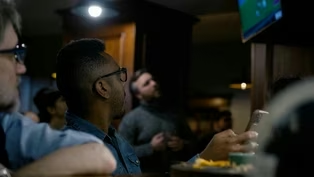
The rise of sports betting in the U.S. following a landmark 2018 Supreme Court ruling fueled significant increases in gambling addiction. The growth of online sports gambling further accelerated that trend, which disproportionately affects males, some starting as juveniles. Are there safeguards in place online for juveniles? Are parents aware? What is the path to recovery for people suffering from
Problems playing video? | Closed Captioning Feedback
Problems playing video? | Closed Captioning Feedback
Keystone Edition is a local public television program presented by WVIA
Keystone Edition
Online Betting: Gambling with Our Future?
3/23/2026 | 54m 49sVideo has Closed Captions
The rise of sports betting in the U.S. following a landmark 2018 Supreme Court ruling fueled significant increases in gambling addiction. The growth of online sports gambling further accelerated that trend, which disproportionately affects males, some starting as juveniles. Are there safeguards in place online for juveniles? Are parents aware? What is the path to recovery for people suffering from
Problems playing video? | Closed Captioning Feedback
How to Watch Keystone Edition
Keystone Edition is available to stream on pbs.org and the free PBS App, available on iPhone, Apple TV, Android TV, Android smartphones, Amazon Fire TV, Amazon Fire Tablet, Roku, Samsung Smart TV, and Vizio.
Providing Support for PBS.org
Learn Moreabout PBS online sponsorship- [Announcer] From your Public Media Studios, WVIA presents "Keystone Edition," a news and public affairs program that goes beyond the headlines to address issues in Northeastern and Central Pennsylvania.
This is "Keystone Edition."
And now moderator Julie Sidoni.
- Think about what the word "gambling" meant, say, 25 or 30 years ago.
You could go to a casino out of state, you could buy a lottery ticket, maybe play church bingo, or bet on a horse during a race.
Think about what gambling means now.
You don't have to go anywhere to place a bet.
That industry has exploded.
The options are endless.
And in many cases, the gamblers themselves are getting younger and younger, not to mention more and more addicted.
(graphic whooshes) - Thanks for calling NextGen Counseling.
This is John.
How can I help you?
We're an outpatient addiction treatment provider for teens, adolescents.
We do substance use disorders, and we also do gambling addiction as well.
One in 10 kids on average would meet the criteria for problem gambling, problem gaming.
The age of onset for gambling is typically eight years old.
The first time somebody is given a scratch off lottery ticket, you know, is probably around that age, whether it's sports betting apps on their phones, or loot box behavior in-game activity.
Loot boxes are things that kids can buy with real money, with a chance of getting something of greater value to them.
You think about what happens when you do an in-app purchase, there's lots of activity that's on your screen, bright colors, flashes, lots of things that pleasure us.
They reward us, right?
So we see that and we want to replicate that behavior again.
And if it costs us a buck, 50 to do it, we'll keep doing it.
It becomes a problem when it starts to interfere with your daily living, not taking care of yourself, not doing the things that brought you value in the past or brought you, you know, a satisfaction in the past.
Because with kids, the problem gaming is, it's the same behaviors, right?
It's the same behavior, same reinforcements, same predecessors as what you would see in problem gambling.
And so we look at those things.
And then we develop treatment plans around that.
First is, you know, it may be minimizing the activity, the amount of use that they have, right?
If they're using a cell phone, if that's one of the ways they do it, creating proper parameters for doing that.
It's about using real skills and activities in the real world and trying to change the pattern of behavior.
Lawmakers can definitely make it a point to try to understand how kids access this information, what normalization is.
But if it's as easy as changing your birth date to access online vetting platforms, there's probably more work for us to do around, you know, legislating requirements that prevent that from happening.
So I think that that's critically important.
I think the other thing is too, is, you know, we've normalized gambling behavior in lots of settings.
When you think about it, a wheel of chance is, you know, reinforcing gambling behavior, scratch off lottery tickets, reinforced gambling behavior.
The other thing is, too, it's not just about legislation, but I think it's also about, you know, a common sense approach to evaluating, are we encouraging people to engage in behavior that could be problematic for them?
If the answer to that's yes, we should probably make a change there.
- And that's Jon Wasp, and you are about to meet him.
We have assembled a panel to talk about this topic.
And I would love to introduce them to you now.
Jon, thank you so much for being here.
We're gonna start with my colleague Roger DuPuis.
Roger, go ahead and tell people who you are and some of the work that you've been doing on this topic.
- Hi Julie.
So I am a deputy editor here and I'm a reporter.
And so I've been reporting on this issue, researching it for the last month or so, and there is a digital story, which you will be able to read at wvia.org.
In fact, three days worth of coverage on this topic.
Got to interview about a dozen people, give or take, including these two fine gentlemen sitting here.
And learned a lot more than I ever expected too about problem gambling, - As did I.
- Yes.
- Jon, welcome.
- Thank you.
- Tell people a little bit about who you are and what you do.
- Yeah, thanks for having me.
My name is Jon Wasp.
I am the founder and project director of NextGen Counseling.
We're an teen and adolescent addiction treatment program, as you heard in the piece.
- Okay.
And Roy, welcome, welcome to WVIA.
- Welcome Julie.
Thanks for having me.
- [Julie] Sure.
- I'm Roy Gilgallon.
I'm the executive director and clinical project manager of TPALS.
We're an outpatient drug and alcohol gambling facility, and we're located in Wilkes-Barre and Scranton.
- So let's get right in that 1 in 10 kids.
When I heard that, I thought, my goodness, how many kids do you know, you know, how many children do you know who are falling into this territory?
1 in 10 kids.
How did we get here?
- Yeah, that's a great question.
So I think, you know, one of the things that parents don't think often about is six years ago our world was flipped upside down.
Our access to communication with other people was in many ways limited.
And it wasn't abnormal for parents to say to their kids, we want you to stay in touch with your friends and peers.
We want you to be connected in a certain way outside of our homes.
- [Julie] You're talking about COVID.
- Right.
And so at that time there was a lot of movement that was happening towards normalizing the use of devices for regular communication.
What did that mean?
You know, you heard me say in the piece there that sometimes it's as simple as changing birth dates, right?
Access to social media accounts, access to different permissions on phones is as simple as changing a birth date sometimes.
And if that's all it takes to do it, it's really easy to get access to platforms that maybe you shouldn't.
It also means that you're exposed to more advertising that you otherwise probably wouldn't have, even if there were age restrictions around that advertising.
And then we also have the proliferation of other things.
You know, offshore unregulated betting is something that's available through the internet.
And so we see an increase in that as well.
Where exclusion criteria, age requirements, those kinds of things don't exist the same way they do with regulated behaviors here in Pennsylvania.
- How big is this jump, Roger?
I know you found some statistics that were pretty chilling.
- Right.
Can we go back to 2017 quickly?
- Absolutely.
- Just to tell you how these, how this all came together.
So Governor Tom Wolf signed Act 42 at the end of October, 2017, legalizing online gambling, expanding casino gambling, permitting video gambling terminals at truck stops and airports.
But the general assembly knew when they were kind of, they were predicting this, that before too long the Supreme Court was probably gonna rule on sports betting.
And within eight months they did.
And so that opened the door and the General assembly said, "As soon as they do that, we are open to it."
So within a year you had brick and mortar sports gambling in Pennsylvania, six months after that.
May, 2019, you have online sports gambling.
And in the first year of sports gambling in Pennsylvania, the industry generated a billion dollars worth of bets.
- [Julie] A billion with a B.
- A billion with a B in one year.
- So you've got changing legislation, plus now people are home and they are stuck at home with their phones in their pockets.
And this is what kicked off this entire run.
- Right.
- I'm interested in why it's so easy to fall into this?
And Roy, we were talking about this a little bit, why is it so easy?
You called us an easily manipulated group, just people.
Why is that?
Why are we so eager to fall into whatever the advertisers want us to do?
- Well, what I was saying, Julie, was that more money is spent on gambling than all other forms of entertainment combined in the US.
- That's movies, concerts, everything, - Everything.
Sports.
- Gambling.
- Sports, everything.
So what does that say about our society?
Well, obviously that we prioritize gambling, but it also says, as Jonathan alluded to, that easily manipulated through advertisement, through... A lot of it has to do with the chemistry of our brain.
And that's what the advertisement is about.
They glamorize gambling and it's legalized, obviously.
So they're not showing us pictures of people that are going bankrupt.
They're spending their money for their medications.
They're showing you movie stars in evening gowns and beautiful background scenarios.
- You call yourself a recovering gambler, correct?
- Recovered.
- Recovered.
- One of the few.
(chuckles) - So can you explain a little bit about that mindset for people who might not get it?
- I think that... Can I tell you a little history about... - Absolutely.
- How I developed the risk factors that I experienced early in life.
- Yeah.
- So I experienced the negative effects of gambling long before I placed my first bet.
My grandmother was a problem gambler.
She re-mortgaged her house twice because of bingo and eventually had it repossessed.
And my father was a problem gambler and a drinker.
And he didn't work much.
I think it was the winter of 69, he had a temporary job as a custodian.
And he took me to work with him on the weekends and after school.
And he promised me to get a bike on my 13th birthday.
So the day of my birthday came and we went to Lydia's Bar on Linden Street, and I watched him drink beers, take shots, and play the six card machine.
So when we got home, my mother thought we're at American Auto looking for bikes.
And when we got home, I could tell by the look on her face, there was no bike.
I was in the bar thinking that, you know, there's gonna be a bowl of spaghetti and a Duncan Hines chocolate cake and a bike.
Much to my dismay, I walked in the door and I could tell by my mother's.
So I went and I hugged my mother and said it was okay.
I kind of got used to this kind of thing.
So I knew... That's a risk factor, by the way.
- [Julie] To have to see gambling a parent in particular.
- To have a parent.
- So you have the environment and you have the genetics.
Two risk factors we have there.
- But it led you down that same path.
You didn't say, "I'm never doing that."
No, you went right down that same path.
- I was 13.
I didn't grasp the concept of only of getting ripped off and lied to, but I couldn't associate gambling as the problem.
You understand?
I know that now.
- Yeah.
- Or drinking for that matter.
- Which kind of brings me back a little bit to something that I was interested to talk to you about.
You had said, you've used gaming separately from gambling, and as the mom of a 10-year-old, you know, I see what happens when you're playing video games.
Do you think this is a gateway so to speak?
Is that what you were referring to in the piece?
- Yeah, it's absolutely a gateway.
You know, I want you to think about whether it's Roblox or Minecraft or any of those games, loot box behavior that I was talking about there, loot boxes are basically a small dollar investment that you do to basically get something that is a reward that's based off of chance, right?
You invest a dollar or two or three to get a skin for your character or to open up or unlock new levels.
But it's all random, right?
But when you think about it, the bells and whistles go off.
I mean, when you open up those boxes, there's confetti, there's bright colors, there's the loud dinging, sounds an awful lot like a slot machine, right?
And what we know is, is that actually, if you apply the same criteria that we use for problem gambling adults against gaming behavior where they're demonstrating the same or substantially the same behaviors, same or substantially the same risk factors, we tend to find that they score the same when it comes to problem, right?
So creating interventions around that is definitely something that's very different.
You know, I think in Roy's case, you know, as he was talking about, he's 13 years old, there weren't outlets for behavioral health considerations or for somebody to talk to about that, or somebody who focused on working with teens, certainly at that time around what's happening at home.
And I think with some of the changes that we've had as a community, I think we've gotten a little bit better about having real, you know, in the media and in the culture we have better examples that are closer and real to life, in movies we watch and in those kinds of things where we can see this and that.
It's not an other than problem.
You know, I think 'cause that's something that historically people have looked at, you know, it's somebody else's province, in somebody else's house.
And this is now we've got a different realization that it's, you know, the, the people who are very close to us.
That one in 10 statistic that I gave you means that in the typical high school classroom, you know three kids are meeting the criteria for problem gambling.
That's three kids in every single classroom.
It's a bigger issue than people are giving an attention for.
- And statistically, how many of those kids will go on to become problem gamblers?
Is there any way to tell?
- Well, it's hard to say.
And I think it's hard to say because... You know, Roy and I were talking about the statistics about how many people actually gamble as we were on our way over here.
And we talked about how there are lots of different studies that will show different things, right?
And Roger, I'm sure probably experience this, too, as you go down the rabbit hole of looking at the data.
There's lots of reasons for that because the definitions change, right?
Different people view different things.
As I said before, you know, is a scratch off lottery ticket gambling?
Is loot box behavior gambling?
Is bingo?
- A March madness bracket.
- Right.
It's not coincidental that, you know, March is gambling awareness month, it happens to be when a substantial amount of betting activity happens for adults and teens, right?
So this is a big month for bets.
- Julie, you mind if I piggyback off of what he said.
- Not at all.
- So the way I see it is the gambling's doing a lot of what the tobacco industry did with Joe Camel and Marlboro commercializing cartoon, cartoon promoting, reaching out to the younger generation through cartoon-like venues.
And that's what this stuff is.
- A targeted- - They're grooming kids.
They're grooming kids for gambling.
And let me say, I think I could speak for everybody on the panel.
This is not about anti-gambling.
This is about prevention and awareness.
So I wanna make myself clear on my stances with gambling.
I'm not an anti gambler by any means.
- We're gonna get into that 'cause I have a couple more questions about that.
But I'd like to get into Roger, what you have found when it comes to drug and alcohol and whether these happen a lot within one another.
I know you spoke with an expert on this topic.
- Yes, I did.
And what I heard from some folks is that they can absolutely be separate, but it's not uncommon for there to be an overlap, right?
So if folks are trying to put out the fire to kill the pain of some other issue they're dealing with, whether, you know, typically a substance abuse issue or a mental health issue, gambling is another one of the ways in which they escape from the issues they're dealing with.
- I say we listen to Jason Harlen, I believe is who you spoke with.
- From Wyoming Valley Drug and Alcohol.
Yes.
- All right, we'll listen in on that.
(graphic whooshes) - Treatment for problem gambling can differ from treatment for drug and alcohol addiction, but the issues also can overlap.
Jason Harlen, CEO of Wyoming Valley Alcohol and Drug Services explains.
- We're a private nonprofit organization that was established back in 1973.
We do drug and alcohol counseling, we do gambling counseling, and we do mental health counseling now as well.
So, you know, problem gambling is a very broad definition.
How are they affected when they gamble?
Do they spend too much?
Do they spend their mortgage money?
Do they spend their college, you know, their kids' college funds?
Are they missing work?
Is their marital or relationship issues because of the gambling?
Is there a disconnection when they can't gamble?
Are they preoccupied?
There's so many things that define problem gambling.
And I think those are just a couple examples of what they can be.
We do find that in a lot of cases, you know, there's a lot of people who might've started gambling and it wasn't a problem for them, but they have those underlying issues, maybe an untreated mental health issue.
And you combine those two, that's a major problem.
On the other side of the coin, we see people who didn't have a drug or alcohol issue when they started having a gambling problem.
Man, I just blew all my kids college funds, and they cope with it by drinking or taking a substance to numb it temporarily.
We know that using a substance or alcohol in these cases, it doesn't help the situation.
It makes it worse.
So yeah, we see that a lot, unfortunately, where one does develop because of the other together.
- So to your point, you were making before we got to that interview, just about how you aren't anti-gambling.
I think that goes to my next question, and I'm gonna give it to you, Roy, I'm staring right at you.
Is it always problematic?
And I'd like your thoughts on this too.
When is gambling problematic and when is it something that you can do for fun?
And I understand there's probably a whole range of answers there.
- Yeah.
- But basically, is there something you look for as therapists?
- Well, the criteria.
You know, Jason covered a lot of it there.
Is it interfering with your interpersonal relationships, with your finances, with your career, your mood, your attitude, time?
You know, most people think that, most individuals enter treatment because they're poked by a significant other, or they're in bad financial straits.
But the money isn't the major problem.
The time spent gambling is the problem because that has to do with the conditioning of the brain.
So somebody that's spent one year and blew $500,000 versus somebody that blew $500,000 over a 10 year period, or even 100,000, but gambled for 10 years, so they've really done damage to their striatum area of the brain or the limbic system in the dopamine RDD2 receptor.
So we as therapists have to counter condition that reward, those rewards.
So I don't know if that answers your question.
- That's the receptor responsible for- - Dopamine release.
RDD2.
- Anything we do that give- - Pleasurable.
- We were talking about this a little bit earlier, right?
- Pleasure.
Yeah.
- It's a pleasure center.
- [Julie] What else falls within that category?
- So we see dopamine as a neurotransmitter that is indicative of other addictions, right?
So to Jason's point and to Roy's point, we do see individuals who have substance use disorders, whether it's internet addiction, social media addictions, all of those things involve the release of serotonin as a neurotransmitter, right?
It's the neurotransmitter that's responsible to say to us, "Hey, that is something I like and it's something I want more of."
And so the more we get that reward as we experience it, as we expose ourself to that stimuli, the more likely we are to repeat that activity.
And so that's true when it comes to all addictions.
And so it's something that we definitely focus on.
- Is that reaction different in a child's brain or a teenager's brain that it is in an adult's brain?
- It's a great question.
So one of the things that I try to get people to understand is when we look at behavioral health, we need to think of behavioral health in a way that's similar to how we think of physical health.
If you have a child who had a physical health condition, you would see a specialist who focuses on child health, right?
If your child had a kidney problem, you would look to see a pediatric nephrologist, right?
You would go to a kidney doctor who specializes in children.
And the reason for that is because their kidneys are developing and changing and growing.
And what we know is, is that just because they're smaller doesn't just mean that they have a smaller function.
It means that they're growing and they're changing and they're modifying.
That's true of our brains.
So when you want to think about how the brain works for teens and adolescents, the thing that we most often talk about is the prefrontal cortex, the area that's right behind your forehead.
And the reason why we talk about that is because it typically, because it's responsible for things like our decision making, advanced executive logic, those kinds of things.
It doesn't really develop fully until most people are in their mid twenties, maybe even as late as their early thirties.
So I'm saying that to say that if our executive functioning isn't there and we have this repeated exposure to something that makes us feel good, why wouldn't we continue to do it?
And so that's what makes it a little bit different, I think, when we're focusing on teens and adolescents, because if that stimulus that they're experiencing is something like in games as opposed to, you know... Kids who are under 21 can't walk on a casino floor.
There are people whose job it is to prevent that from happening.
But there is nobody whose job it is right now to prevent, you know, me from taking out my phone or kids from taking out their phones and engaging in gaming.
So there's no executive function there, a lack of executive functioning and a continuous reward.
- You and I Roger, in doing some research, what did you learn in your reporting of this?
I know you spoke with a lot of people about how gambling just seems to be everywhere these days and everybody's okay with it.
- Right, let me answer that question with some more statistics that I think you might find of interest.
- I love.
Yes.
- So the Pennsylvania Gaming Control Board, they pulled these from a number of different places, but between 17 and 30% of adult Pennsylvanians engaged in some form of online gambling last year of the calls to the Council of Compulsive Gambling in Pennsylvania's 1-800-GAMBLER hotline, over 50% of them mentioned online gambling as their most problematic issue.
And sports betting was the most popular online gambling format.
And I think it's the sports betting that really in the online realm has become so popular, right?
I mean, who's not a football fan?
Who's not watching on Sunday?
And I think we all know a lot of people from, you know, teenagers up to in their fifties and sixties and beyond who are betting on these games now.
And it's part of the ritual as much as cheering on your team.
And in fact, what I've learned is you've got a lot of people who don't even have all that much invested in the particular game or the particular team, they're worried about the spread, right?
They're worried about the odds, they're worried about who performs how well, and whether or not they win a bet based off this.
And it's become kind of insidious, really.
- Roger, did you find in your research that women are increasing in their sports betting?
- The numbers tend to favor the men.
It tends to be more men.
Now, I did talk with a woman for the story who asked to remain anonymous, and we granted her that privilege, she was gambling on one of the casino apps.
So what I'm hearing from a lot of people is that the sports betting tends to be more men.
Women tend to be more the casino apps.
Although none of these are, you know, these are not ironclad categories, But yeah, it's, yeah... - No, pretty much you're right.
There's basically two types of gamblers, the action gambler, and the escape gambler.
And the action gambler is generally a man.
The men start gambling at a younger age, and the venue is a gambling.
They're interacting in terms of handicapping.
And that would be cards, roulette, dice and sports betting.
And the women start later in life.
Empty nest syndrome, things of that nature.
And they do escape through the machines lottery and bingo.
- A couple more stats I think that are relevant to all of this.
So the Pennsylvania Gaming Control Board pulled together some numbers.
75% of US college students have gambled in the past year.
- 75%.
- 75%.
18% of them gambled at least weekly.
And 6% of those folks, 6% of those students meet the criteria that we've talked about for having a serious gambling problem.
There's more.
58% of 18 to 22 year olds engaged in sports betting.
And I want you to bear in mind, and we've talked about this, that the threshold in Pennsylvania is 21.
The system is set up so that these apps are only supposed to accept people who are 21.
But as you've pointed out, John... - How easy it is.
- It's easy around it.
So of those 18 to 22 year olds, 6% of them reported losing over $500 in a single day.
I know how long it takes me to earn $500 at work.
- $500 is not nothing.
- Right.
Right.
And 33% of youth under 18 in Pennsylvania gambled in a year period.
- So anecdotally, what is this doing to people's worlds, their finances, their credit scores?
How much they're able to buy, you know, whatever it is that they wanna do when they... And this is to anybody?
I mean, obviously you've heard some examples.
What's happening here?
- I think I'll kick to Roy first on that one because I think adults experience the most significant.
- It varies in gender and age group.
I mean I would say that my statistics here is 91% of male college students are gambling.
That's the biggest growing population right now is male college students.
But your stats are a little different.
But, you know, elderly people are not paying their medication.
They can't afford their medication.
Some of them are spending, their significant other doesn't know it, and they remortgage a house, or they take out a loan to put a roof on and don't get it.
- [Julie] Wow.
- Embezzling A lot of the embezzler that we see on TV.
They're doing it from their work.
They're losing their jobs.
We have, you know, 1 million, 1.2 million, one person embezzled.
And when they embezzle, some of them have the money to give back, but they don't have the money to pay the taxes.
So they have to go to jail because the federal government wants their money.
You know, the family, like the people with children, they're using their college funds, as he said, but they're borrowing from the household account.
They're not paying their taxes, they're not paying their car insurance, they're not getting tires on their car.
They're putting their family at risk.
But one thing we haven't addressed here, we talk a lot about the gambler, but we don't talk about the significant others.
- The families.
- At our clinic, we work a lot with the family.
We try to get the families in, because the gamblers need support.
And the family members go between beating the gambler up.
Once they enter treatment, they already filled with guilt and shame and remorse.
And they could be manipulative still.
So the family members go between trying to be supportive to the point of enabling, to walking on eggshells and then condemning them and throwing up their paths.
So the family, it's imperative to get the... Actually, I would like to have the family members come in first for a month and then bring the gambler in.
- Julie, the individual I talked to the anonymous person who was in my story at wvia.org, she was in her thirties, she was pregnant, her fiance was working another shift, and she was sort of bored and lonely, and she started gambling on the app.
She admitted to me that she started to realize she had a problem when she spent an entire week's paycheck.
And I asked her was this rock bottom?
And she said, "Oh, no, no, no."
She kept going.
And when her fiance finally said to her, "The credit cards are rolling up, the debts are rolling up, what are you doing here?"
And she explained it.
He said, "You need to stop this or I will leave you."
And she said to me, "You know, I came to this realization that, yeah, relationships break up over this, people get divorced over this.
And that's where I was headed."
- She was just about there.
- Yes.
- I wanna say one more thing, and I think it's very important for us all to realize that suicide ideation is about 14% higher among gamblers than the general population.
And self-harm is common a amongst problem gamblers of all age groups and different genders.
So we wanna keep that kinda stuff in mind.
- Yeah, of course.
- Yeah, you know, Julie, I won't read 'em all, but Gamblers' Anonymous has a 20 question list, which is all about the signs that you may have a problem.
And I was sort of stunned when I got to the end of the list and it asks if you have ever considered, I believe it called it self-destruction or something like that.
- And Pennsylvania Council on problem gambling, Josh, they have I think 10 questionnaire on responsible gambling, which is a more positive way of looking at your gambling.
- You've perfectly heated up because we actually interviewed Josh and I know that he was someone whose has counsel you went to for this.
Tell me a little bit about what Josh told you.
- Josh really, so Josh set the stage for us in terms of what he calls, and you'll hear on, you know, the perfect storm of COVID and the rise of online gambling.
And he talks a lot about what his agency has seen, and they are experiencing numbers like never before.
Even though the pandemic is over the rise in problem gambling and certainly the growth of online gambling is not, and they're seeing that in real time.
- Okay.
Roger interviewing Josh Ercole.
- Since 2018, Pennsylvanians have flocked to the new digital betting options, especially after the COVID-19 pandemic forced many people into isolation.
Even the state's casinos were temporarily shut down.
But online gambling wasn't.
It skyrocketed.
And so did the number of people struggling with problem gambling.
Josh Ercole, executive director of the Council on Compulsive Gambling of Pennsylvania explains.
- You know, perfect, imperfect storm, however you look at it, this increased availability and access, it really created this kind of interesting scenario where we had folks who were previously patrons and guests of casinos who could now no longer access those casinos, and they switched over to the virtual world.
We also had folks that were new to that type of game when it became available.
They never went to casinos, but they really enjoyed the online world.
Well, now the world's shut down.
They're scared, they're isolated, they're bored, their participation amplifies.
We also had the group of folks that weren't doing any type of gambling, and now they're not able to go to the office, they're not able to gather with friends.
And they say, "Well, maybe I'll try this out."
What we've seen over the course of the past five years is just this continued expansion and growth in terms of availability, in terms of advertising, in terms of participation.
You know, we now see the revenue that's being generated by online games is now, you know, right in line with what we traditionally saw happening with slot machines and table games at casinos.
So now we're in a completely different world.
- So we'll go back to something we were talking about a little bit earlier.
You have been pointing out all of these horrible things that could happen if you fall into this category, the drug and the alcohol, the suicidal ideation, and yet people will go back and gamble again and again and again.
As therapists I am interested in knowing what your first step is?
- We have to come to terms with the pain of deprivation.
That's the most significant thing.
It's a reward center.
We're looking for pleasure.
And it's gonna be painful.
It's gonna be painful.
So we try to emphasize that.
I try to teach my my staff to relay that message.
Nobody's getting out of this without pain.
Now, you don't have to suffer.
Suffer is option.
Suffer's being the victim of it.
We don't have to be the victim of it.
We've already paid that due.
That's over.
We're here now.
Where do we go from there?
So I don't know if that answers your question, but that's the goal for this therapist to introduce the concept of coming to acceptance of the pain of deprivation.
Keep in mind, we're talking about impulsivity, we're talking about pleasure seekers, rewards.
We're not using the pre... We're not relying on the prefrontal cortex for executive thinking, problem solving, humor.
We're using the tails wagon, the dog, the limbic system is size of a walnut at best.
In that we're looking for the dopamine rush and so on and so forth.
So we're gonna have to deprive that.
We'll have to come to terms with the deprivation of that.
- If someone comes to terms with the fact that they are a problem gambler and they seek help, is that something they'll have to keep going back for, for the rest of their lives?
What is the treatment like?
What can be done for someone who says, "You know what?
I think I might have a problem here."
- I think with all substance use or gambling addiction or any other type of treatment, it's going to be independent.
It's gonna be individual, depending on the person and how they present.
I oftentimes say, when you think about treatment duration and intensity, how long somebody's in treatment and how much treatment they need to be exposed to, it's oftentimes directly related to how long they've been engaging in the behaviors that brought them into treatment in the first place.
So if you have gotten more advanced in your addiction, or if you have been doing it for a longer period of time, it is likely that your treatment is going to take longer than if you had caught it early or if it had been dealt with in an earlier period of time.
So I think it really is individual for the person.
And I think Roy alluded to this earlier when he was talking about, there are some people who lose $500,000 in a year and there's some people who lose $500,000 over 10 years.
And that impact on people can be very different depending on their circumstances.
- Let me say something, Julie.
Your question is based, it seems to me it's based on the 12 steps.
What we hear in 12 steps?
You're gonna be an alcoholic, you got a problem forever.
Well, I won't be popular for what I'm about to say, but I said it in the beginning.
I'm cured.
I'm healed.
That doesn't mean, I'm not saying I could successfully use drugs or gamble again.
I can never do that again.
I'm okay with that.
I surrendered to that.
12 step programs are based on spirituality with the promises, you know, a new freedom, a new happiness.
Well, you can't build a spiritual, a spiritual program on a foundation of fear.
And that's what that saying, I gotta go, I gotta do this for the rest of my life.
That's an individual thing.
There's a newfound freedom.
So I believe this therapist believes we can heal, we can get better.
We don't have to be afraid to have beer in our refrigerator.
Most people probably shouldn't for a long time.
I know I didn't for 20 years, but the last 20 years or better, I feel really good about myself.
Whether I go to a meeting or I don't go, I go because I feel comfortable there.
Not because I feel, you know, I'm gonna tread water if I don't go to a meeting.
But everybody's different.
I'm not trying to put my beliefs on anybody else.
- That's your perspective.
- Roy, can I ask you, we talked about this in our interview.
So you began your recovery process in 1987, right?
- Correct.
- So you're about 30 years old then, give or take.
- 29.
- 29.
All right.
How long did it take you to recover?
Because as you told me, it was not a continuous- - To recover?
- Yeah.
- Well, I continued to gamble long into my addiction.
- Okay.
- But my gambling was only with football.
And it didn't cost me, it cost me more emotional than financial.
I had five children I was raising, and they saw the spreadsheets and that.
So I had mood swings.
I probably wasn't as attentive when I was coaching them in football or basketball as they should have, but... What was your question?
- So it took you about what, 15 years give or take to really consider yourself cured.
- I'll be careful with the, healed and cured are two different things.
I cannot successfully- - Use your words.
- gamble or use drugs.
I wanna make that clear.
I do not think that.
Though I think some people can maybe were phenomenal.
- Where's the point at which you no longer felt the need?
- About 20 years.
- Okay.
- About 15, 20 years.
I went to gambling, went to church every day.
Prayed on my knees in the morning and the night.
And went to several meetings a week for about 15 years.
And then I gradually, I got a big life.
I got a lot of stuff going on.
But recently, I've started attending meetings again because I feel, I like it there.
I like being there.
- Can I ask one more thing, and I apologize.
- Yeah, yeah, yeah.
- So I asked you this during the interview.
When is the last time you gambled?
- Well, define gambling.
I mean, I'm a business man.
- Sir, you define it for me.
- I am a businessman.
Businessman gamble.
When's the last time I placed a bet?
- [Roger] Yes, sir.
- 40 years ago.
- Okay.
- But you can give up- - Oh, no, I'm sorry.
- I was gonna say, no, it wouldn't be 40.
- No.
40 years ago I quit drinking.
- Okay.
- Maybe 20 years ago.
You know, 20.
I didn't mark it on the calendar.
- All right.
- You can give up a cigarette and alcohol and never see it again.
You can't give up your family budget.
You can't stop handling money.
Does that change how you would treat someone with this addiction?
- And you can't get away from gambling.
It's ubiquitous.
It's everywhere all the time.
And it's on our phones.
- So we're getting into next that what can be done in response to all of this, because here's advertising everywhere, here's gambling everywhere.
Everyone's got a phone.
It's right here.
What can be done?
There is a state senator in Pennsylvania who's been trying to propose legislation.
And I know that you spoke with Senator Wayne Fontana about this.
- I did.
Senator Fontana has tried, this is, I believe his second time to pass bills that will do two things.
One that will prevent you from being able to use your credit card to engage in online gambling.
And then folks who are on the self-exclusion list, which we have not talked about yet, but that's a thing that's exists in Pennsylvania for people who recognize there's a problem gambling, Senator Fontana wants folks around the self-exclusion list to be limited and prevented from seeing advertisement.
I gotta tell you really quickly, I don't gamble, and that's not a judgment thing, but over the process of reporting this story, I've had gambling ads and apps being- - All over.
- All over my phone, my computer.
So these are the sort of things Senator Fontana would like to see not happen for people who admit they have a problem.
- If I could just add onto that.
I appreciate Senator Fontana's work on this.
I think it's smart for us to look at legislation and try to find ways that we can solve those things.
But I think if you look at the statistics about juvenile and adolescent betting that involve sports betting more often than not, as I said, it's unregulated activity.
And that unregulated activity doesn't use credit cards.
It's Bitcoin, it's cryptocurrency.
So it's the next level, right?
And these things are always moving.
So to your question of how do you prevent, how do you stop knowing that those things are happening.
- Is there a way?
Yeah.
- I think first with the youth population, it's open dialogue, right?
It's having conversations with your kids about their gaming behavior and about their gambling behavior.
Are they engaging in it?
Are their friends engaging in it?
Having open dialogue about that is the first step, right?
Because if you normalize the opportunity to have conversations about what doesn't look normal to you, that's a good opportunity for us to have a better understanding of, are there risk factors present that maybe we weren't aware of?
So that's one thing.
- [Julie] Okay.
- I think another thing that we can do, if we really want to have meaningful impact on reducing this, it really is, you know, acknowledging that addiction treatment programs for gambling need to be present and need to be more available.
You know, I think one of the really interesting things about this is, Roy, you know, his business, TPALS was the first gambling addiction treatment program in Lackawanna County, in Lackawanna County's history.
And when did TPALS start?
- 2014.
- So 2014 was the onset of like, you know, there being some solution for gambling.
I will tell you, I'm not sure that Jason is doing anything at WVADS with juveniles or adolescents.
I know that they have the capacity to serve them, but I mean, we're focusing exclusively on that as what we do in our work.
Because, you know, we are only the, we're the first ones doing that in Lackawanna County for juveniles and adolescents.
And that's now.
So I mean, to think about that of how the access to treatment has been unavailable or limited, I think that's critically important too.
- Has Senator Fontana been trying to get this passed for a while now?
- This is his second attempt.
- His second attempt.
We do have a quick interview with him, right?
Correct.
- Yes, we do.
- Right.
Let's hear that now.
(logo whooshes) - Addiction experts agree that the ease of using online gambling apps contributes to how quickly users can do damage to their personal finances.
Pennsylvania State Senator Wayne Fontana from Allegheny County has proposed legislation that would prohibit the use of credit cards for sports betting and fantasy sports, online casino games, and iLottery here in the Commonwealth.
He spoke with WVIA news about the bill.
(gentle music) - Senate Bill 265 is the bill that prohibits the use of credit cards for iLottery, online gaming, casino games, and sports betting and fantasy sports.
The second bill is Senate Bill 266, which prohibits the gaming industry from marketing to individuals on self-exclusion list.
So the evidence is the evidence and it's showing that we need some restrictions.
Both these bills do that.
The proof also is in that both FanDuel and DraftKings have both suspended use of deposits by credit cards just in the last year or so.
So some of those folks are getting the message.
Hopefully they don't wanna be part of pushing folks to end up with a gambling problem.
But we need more to be done.
And I think on a state level, we need to make sure these things exist, these two bills get passed and we do our part from the state.
And our sessions run in two year cycles.
So if nothing happens this year with this, I'll reintroduce it.
But you can bet I'll be sending more information out, trying to have more hearings.
- Again, a word from State Senator Wayne Fontana from the Pittsburgh area.
We're also really fortunate to have someone in the audience on a county level.
This is Joe Peters, the District Attorney of Wyoming County.
It's great to have you here.
Thank you so much, sir.
- Good to be here, Julie.
- What are you doing here on the county?
What can be done on the county level in this arena, and why are you concerned about it for your area?
- Well, I'm concerned because typically with so many issues, whether it's suicide or whether it's drugs, or whether it's gangs or bullying, unless we get under the tent early, so to speak, start talking to kids as early as we can, and high school is too late, this problem is no different.
You know, we need to show them the future.
I don't mean to minimize Senator Fontana's efforts, because every little bit helps.
But wherever there's an effort to stop the creativity of the child, the juvenile, the teen mind, and those that want to take advantage of that mind will find a way to eclipse it.
So we really need to show teens the future, show them the end game.
And then we have the exacerbator of the addictive algorithms of social media, which make every problem worse, whether it's bullying or gaming.
There's this constant lure as generated by these algorithms.
So just like I did with gangs, you know, brought in undercover FBI agents to make it cool.
And then have these agents show this gang leader the lies of recruiting and we will never rat on each other and look at the money and the cars, and then to show them five years later: that guy in jail, his car on a tow truck being hauled away, the money being forfeited to the government.
So it's that kind of intensity.
And you know, I'm here as the DA also, in addition to being a citizen.
The end game is much what these gentlemen and yourself talked about.
It's where does that money come from?
Who's embezzling that money?
And it's tragic to see the treasurer of the little league or the owner of the travel agency, or the woman who's had a career in banking who finds herself in this problem later in her life.
And then the other issue is, with most of the other criminal, even drugs, you know, once the reward is done, once the high is over, there's kind of no consequence assuming you live through it other than the substance use disorder.
But with gaming, you have to now pay the money back.
So there's that added pressure, there's that added trauma.
And then as was mentioned, the impact on the family who's being neglected, now it becomes a children and youth problem for a prosecutor.
Money was stolen.
Now it's a theft problem.
So it's a ripple effect of all of that.
And I think the best way is to start that dialogue that has been mentioned early and consistently and on every level.
And then educating people around that person, whether it's a juvenile or someone older, the workplace, the parents, the schools, the teachers.
What to look for?
Those indicators that might allow intervention early, and then a warm handoff to treatment.
Which is the answer.
- That was going to be my question to you.
I think you answered it a little bit already, which is, the criminal activity you see in your office as a result of gambling and problematic gambling, it sounds like- - And not to mention the coercion and the beatings and, you know, pay me or else.
I used to be a mafia prosecutor, a big driver of La Casa Nostra in big cities.
And it's mimicked by gangs and everybody else is, you don't pay, you don't live.
Or you don't pay, you get beat up.
Or yeah, you pay, but you're only paying me interest forever.
You're never gonna touch the principle.
So there's that crime dynamic with all of this as well.
- And do you think there's disconnect between what you just talked about and teenagers on their phone?
That's a world away.
This is just me in my bedroom.
- Anything on your phone is not really real or impactful.
You know, we talked years ago about people with a spending problem, and we tried to convince them in a very simplistic way, don't use your credit card because it's not really money.
It doesn't feel like you're spending.
Use cash.
Same thing with the internet.
You know, it's not real.
There's no immediate consequence until it catches up with you and it's too late.
And when you see somebody trying to hide their gaming, that's an indicator.
If you have to start borrowing money, if you are chasing your rewards, the other issue here is there's always that lure of the next one is the jackpot.
And it will solve all of my problems and I'll pay it all back.
The gaming industry is not there to lose.
That rarely happens.
- Thank you very much.
Go ahead.
- You're welcome.
- Yeah, if I could just follow up on something.
I think, the point that the criminal justice and crime activity is a component of this, is critically underscored by this.
We have the District Attorney here talking about it.
My entire formal education, my bachelor's and master's are both in criminal justice.
His formal education is in criminal justice.
To put into perspective of how tightly this is connected, I mean, that's who's focusing on this because it really is... I mean, when I started doing behavioral health services, I started doing reentry with people coming out of state and federal prisons.
And I found that the best strategy for reentry was no entry, right?
Try to figure out how to keep people from getting into the system in the first place.
And it comes down to figuring out where there's opportunities for changes in dynamic changes in people's lives before it becomes problematic.
- Julie, you talked about legislation, and you have Joe up there, and, you know, some of the legislation, there's no treatment for gamblers.
The American Medical Association, the CDC, Center for Disease Control, they recognize gambling as an Axis One diagnosis.
But the American Disability Act doesn't.
So if you're in Pennsylvania, they work under the American Disability Act.
If you're caught at work drinking or doing drugs, they're gonna put you in treatment.
If you're caught gambling when you're not supposed to, you're fired.
No second chance.
So there's a disconnect there.
- And what will change that?
Legislation?
- Legislation could change it.
And legislation could change, take the ATMs out of the casinos.
They could legislate that.
But there's too many... What is it?
Three point some billion in Pennsylvania budget.
They're not gonna change legislation when the tax revenues are so high.
- The benefits.
- Yeah.
Until more people are going to jail, more people are embezzling, it's costing society more than it's gaining.
There's not gonna be anything done.
It sounds like a pessimist, but it's what criminal justice reform is in part.
- Roy, you and I, I think talked about, and I wonder if you could address this.
Whether the state does enough to keep people who are on the self-exclusion list out of the casinos?
Do you think they do?
I mean, is it an effective system?
- No.
I call the gaming commission, they hung up on me because I have several clients that are going down there telling me they're going.
Now, I can't tell them my client's names.
But I tell 'em, you're not doing your job, and they don't like it.
And I don't know whether I should have done it or not, but I do it.
But I had one individual call me about four years ago, and he had completed his treatment and he didn't gamble for a full year.
And he calls me, he says, "Roy, I gotta come in and see you."
This is like three 30 in the afternoon.
I said, "What's going on?"
He said, "I'm having a difficult time.
I just left the casino.
I ran outta the casino."
So I said, "I'll wait in the office, come by."
He said, "I hit the jackpot and they came to get my money."
I said, "Well, you're on exclusion for lifetime.
So yeah, they're gonna take your money.
They could arrest you, you're not supposed..." "I don't want my wife to find out."
I said, "Well, you're not gonna be in the paper.
You're not gonna be... It's a ticket.
It's a traffic ticket."
But I don't understand.
- But he shouldn't been there.
- You know Perfectly well you can't win.
- Yeah.
- You can't win and you could possibly get arrested.
What's he doing?
- He's still there.
- The risk and the reward.
So it's a height and it's like Mama saying you can't take the cookie.
The cookie tastes better when Mama says you can't take it.
- You can't have it.
- So now you're gambling before you even put a diamond because you're gambling on taking the risk of getting a fine.
So it accentuates the gambling in that part of the brain.
- Sure.
- We have just about a minute left and I would like to give you the last 30 seconds, Roger, 'cause it's your very wonderful- - Are you sure you wanna do that?
- I do.
- Okay.
- It's your thorough, really very good reporting that got this topic rolling.
So some last thoughts here from your work.
- What's been really meaningful to me is to talk to folks like, you know, Jon and Roy, who deal with people who are facing this problem head on.
And Roy, thank you so much for sharing your personal story because that not a lot of folks would be willing or able to do that on a television program.
So that really meant a lot.
And I think what we all have to remember is, and I was talking with my editor, Faith Golay about this, the human cost, the financial and emotional cost that families face with this.
And I'll just, you know, sort of say quickly, I came from a family where this was an issue and I didn't pick it up, but I've seen it, I've seen it, I've seen the paychecks go away.
And I think we all need to remember that, that there are human beings behind this issue.
And whatever folks like this can do to help, I think is why we are here reporting on it.
- Well, Roger and Jon and Roy, thank you so much for your time, for your expertise.
I say this after every show, but I feel like we could go on another couple of hours.
There's a lot to talk about here.
My hope is that people found something of use and can do a little bit more research on their own time.
And of course, we would be remiss if we did not say there is help out there for problematic gambling.
If you or someone you know might need a hand in finding resources to help, there's a 24 hour state helpline.
Call 1-800-GAMBLER.
Or if you'd rather go online, you can find that at pacouncil.com.
That is all for this edition of "Keystone Edition."
Thank you for watching And for all of us here at WVIA, we'll see you next time.
(upbeat music)
Providing Support for PBS.org
Learn Moreabout PBS online sponsorship
- News and Public Affairs

Top journalists deliver compelling original analysis of the hour's headlines.

- News and Public Affairs

FRONTLINE is investigative journalism that questions, explains and changes our world.












Support for PBS provided by:
Keystone Edition is a local public television program presented by WVIA