
The Media
Clip: Special | 17m 36sVideo has Closed Captions
Stephen talks to Vickie Thomas and Luther Keith. Roadshow Jan 2018/Seg 1
Stephen talks to Vickie Thomas, NABJ region two director City Beat reporter at WWJ-CBS Radio Detroit and Luther Keith, executive director of Arise Detroit, a former Detroit News editor and founding director of the Journalism Institute for Minorities at Wayne State University, and Sheila Cockrel, President of Crossroads Consulting and Communications Group. Roadshow Jan 2018/Seg 1
Problems playing video? | Closed Captioning Feedback
Problems playing video? | Closed Captioning Feedback
American Black Journal is a local public television program presented by Detroit PBS
The Media
Clip: Special | 17m 36sVideo has Closed Captions
Stephen talks to Vickie Thomas, NABJ region two director City Beat reporter at WWJ-CBS Radio Detroit and Luther Keith, executive director of Arise Detroit, a former Detroit News editor and founding director of the Journalism Institute for Minorities at Wayne State University, and Sheila Cockrel, President of Crossroads Consulting and Communications Group. Roadshow Jan 2018/Seg 1
Problems playing video? | Closed Captioning Feedback
How to Watch American Black Journal
American Black Journal is available to stream on pbs.org and the free PBS App, available on iPhone, Apple TV, Android TV, Android smartphones, Amazon Fire TV, Amazon Fire Tablet, Roku, Samsung Smart TV, LG TV, and Vizio.
Providing Support for PBS.org
Learn Moreabout PBS online sponsorshipGood looking again, good looking again.
Good evening and welcome to cpt, television's newest experiment in the newest color, black.
This week we're going to have Brother George Kirby, Brother Earl Grant, and we're going to examine the voting patterns of the brother in next Tuesday's election.
Sandy, what's on the grapevine?
What famous conductor specially composed an African mass and will conduct it this Sunday.
Abe, what's in the news tonight?
Local black brother calls for back pay for slave ancestors.
(applause) Welcome to American Black Journal.
I'm Stephen Henderson.
What you saw just there was a video clip from this show when it debuted in 1968 as "Colored People's Time, or "cpt" for short, with Host Tony Brown.
Detroit Public Television launched the program to build more community involvement and provide a voice for African-Americans in the city.
Today, we are kicking off our 50th anniversary with this special on-the-road edition of American Black Journal.
We're coming to you from the William V. Banks Broadcast Museum and Media Center near downtown Detroit.
This is the building that formerly housed WGPR-TV 62, the nation's first black-owned and operated television station.
It's an appropriate setting to take a closer look at minorities in the media, as part of our "One Detroit" commitment to examine important community topics.
I'd like to welcome our audience members and invite viewers at home to comment on Facebook and on Twitter.
In 1968, the Kerner Commission released its report on the causes of the civil disorders in Detroit and other cities.
The group recommended the hiring and training of more black journalists to give African Americans a voice in mass media.
The commission also advocated for more coverage of the black community and of racial issues.
So where do we stand 50 years later?
Here's a "One Detroit" report.
(street noise) REPORTER: After the uprising in Detroit, the Kerner Commission issued a report stating, the journalistic profession has been shockingly backward in seeking out, hiring, training, and promoting Negros.
The news was a white man's game, the commission found African Americans held just 5% of the editorial positions in news, mostly with black-owned organizations.
In Detroit the Free Press had two black reporters, the Detroit News had just one.
There weren't many African Americans in media at all.
LAVONIA: I Remember Martha Jean, the queen, who was on the radio, remember that was basically where most of the African Americans were, were on the radio.
They were not on television.
REPORTER: Lavonia Perrymann would on DPTV's "Detroit Black Journal" and "Detroit Black News" in the 1970s, part of the first wave of African Americans to come on board after the Kerner report.
LAVONIA: I have journalism background.
I came out of education and I did tell them, I said, if you train me, I will be one of the best.
REPORTER: 20 years later a panel of reporters joined "Detroit Black Journal" host Ed Gordon talking about the state of journalism in Detroit.
What about the thought of not giving coverage--the same amount of coverage to blacks as opposed to whites?
You truly believe that that goes on in this city, is that right?
I think the record substantiates that, there isn't the slightest doubt about that.
But again, the point is not coverage, but what kind of coverage?
EMERY: Okay, let's make that-- And the rule unfortunately is the negative about blacks is going to be prominently used.
EMERY: And displayed.
The positive is frequently removed.
MAN 1: And I have a different-- REPORTER: At that time a National Association of Black Journalists survey found that in the Detroit area that 12.6% doing news were African American, although they made up 22% of the population.
Leap ahead two more decades, and more strides have been made.
But recently some see efforts sliding back a bit.
I'm afraid that it has fallen behind.
There was a period in my career when a premium had been placed on getting color into newsroom, and getting diversity into newsroom.
There was a time when Affirmative Action was not a bad word.
Even though there are more, say, African Americans present on TV, on all the stations, and that's good, as far as the decision-making capacity and being able to determine what stories are covered, with the right angle, I daresay that probably has waned.
REPORTER: A recent survey by the American Society of News Editors found African American news decision makers made up 28% of the Free Press and 11% at the Detroit News, while our informal survey found about a quarter to a third of news decision makers are African American, at Channels 2, 4, and 7, with just a few in upper management.
History professor in Detroit Keith Dye wants to know.
With parts of Detroit on the upswing, who's covering the rest?
PROFESSOR DYE: So, I can understand the enthusiasm about downtown Detroit and Mid-town, I'm all for that.
But if you're not in a position of power, to command the attention that you need, then you will not get the coverage.
So, what is the influence of those blacks who are in the media to be able to say, hey, this should be covered.
Joining me now are: Vickie Thomas, who's NABJ Region 2 Director and city beat reporter at WWJ-CBS Radio here in Detroit.
Also with us is Luther Keith, he's executive director of Arise Detroit, a former Detroit News editor and founding director of the Journalism Institute for Minorities at Wayne State University.
And Sheila Cockrel, who is president of Crossroads Consulting and Communications Group, and a former Detroit City Council member.
Also runs an organization called Citizen Detroit.
Thanks for being here, all of you.
LUTHER: Thanks for having me.
(applause) So let's start with the big question here, 50 years later where are we, where are we in terms of minority presence in media, but also as we saw in the clip, where are we in terms of minority decision-making?
And I think that is a really different question from that first one, Vickie.
VICKIE: And that's important question to ask.
And unfortunately dismal numbers in terms of upper management.
These are the folks who make the decisions on how communities of color are covered.
And not a enough minorities are at the table.
NABJ does the diversity census, the last one was done in 2012 by our former President Bob Butler.
And, he found that there were, like, 12--it was 12% of a management in newsrooms.
And at that time the population of minorities was about 35%.
So you can see the disparity there.
So we have a long way to go, definitely.
STEPHEN: Yeah, and Luther, you were an editor at the Detroit News, one of the people I sort of claim as a role model for my career.
VICKIE: Don't blame that on me.
STEPHEN: You were a little older than I am.
(Laughter) STEPHEN: But things were different when you were coming up-- LUTHER: Oh, yeah.
--then they were when I was coming up, but we still are kind of in the same place.
I think somebody who started my journalism career back in the 70s when if you saw the movie "The Post", we actually worked on typewriters when I started.
(laughter) But I look at it like this, we aren't where we were, we aren't where we should be.
We lost momentum, as we heard Cliff Russell say in that clip, in the 90s there's a point in time when Affirmative Action was a good thing.
I would go to the AASC Visions or NABJ's national conventions and it was this great buzz of excitement about diversity.
Then we hit some economic hard times and people started peeling staffs back and black folks got hit hard, and minorities got hit hard.
And I think quite frankly that we've lost it as a priority with--other thing things have come along.
But I think this is a good time to refocus.
A lot of black folks and other minority folks are doing great journalism today.
We have editors and when I started at the Detroit News there were zero black editors, I was the first one and I actually didn't want to be an editor, but figured if I didn't take the job, nobody else would.
(laughter) LUTHER: I don't want to be an editor.
So I think it's important that we have to understand that the media in all of its forms most powerful force on the planet.
The most power--it elects presidents, it takes down governments.
And so, as I often say, the people who control that have tremendous power.
They affect how we think about other people, how other people think about us, how we think about ourselves.
It's only fair and proper, as I've said many times, if we're going to have an American society that reflects all these great values, we must have a diverse media with black folks and people of color in positions of power.
But no one likes to give up power.
And so, that's something we really have to continue to work at.
STEPHEN: Yeah, Sheila, I want to go back to 1968 with you because you were here in the city, you were here for '67, and I want to talk about message and messaging.
Both in terms of the role they played during the rebellion in '67 and then the role they started to play as we tried to rebuild the city, right, you know, reshape the city to be a more inclusive place.
Talk about the themes that people were thinking about then and sort of how they echo now.
Well, one of the things when looking at the survey that you showed of the era was thinking about the number of sources where black voices and black power, if you were, were being manifest to people in the city.
There was Scope magazine with Jim Ingram and Ken Hamlin.
There was the League of Revolutionary Black Workers who took over in South End.
There was the Inner-City Voice.
I mean, there was the Chronicle, and there was certainly Martha Jean The Queen.
There were these entities that really helped shape the narrative and explain for the black community sort of what the powers that be downtown were doing.
In my dealing on issues of police brutality with particularly the Free Press, the news you even didn't bother with, I mean they were like just the sight of the Klan in that era.
The Free Press, you had to deal with sort of proving the case that there was police brutality and it took time and time again to go back to the editor and the writers to get people to, like, believe the data that we had gotten out of the police department.
So there was an expectation that things that impacted the African-American community or black community in that era had to be proven beyond a shadow of a doubt.
But I'll never forget I was looking at seeing Bob Bennett and Bill Black and people like that in these venues where there was nobody else of color.
And remember, particularly when my late husband called a judge a honky-dog fool for--in 1968 because of a case where a judge set a confiscatory bond and I will never forget the look of sheer shock on the face of all these white reporters.
And Bill Black and Bob Bennett were, like, right there.
And they were covering it.
STEPHEN: They saw it a little differently, right?
You know, I wonder what the role of the media industry and its decline plays in minority voices.
I mean, I assume there are fewer people, fewer minority young people deciding to pursue careers in media because there are fewer jobs, fewer opportunities.
And so that maybe makes it a little worse.
What do you guys see at NABJ?
We see that a lot of folks are going for it.
We have the largest convention for journalists of color in the country.
And people the young people that come to our conventions for the career fair, they are seasoned, they are ready, they are getting jobs and in some cases they are hired on the spot.
But, I think, too, social media has played a role in it, consolidation has certainly hurt in terms of the positions that are available because typically when you're the first one--the last one in the door, you're the first out the door when they start cutting positions.
So, we're very proactive, even as the regional director and former Detroit chapter president, I've taken the initiative to write letters when the Free Press and the news were cutting back on staff to let them know that we're watching and we want you to take into consideration a diverse workforce.
So, you know, it's still very tough.
We have a long way to go and I think will do better, but it takes organizations like NABJ.
We train our student journalists.
We train high school students, we train college students.
So we're doing our part in we challenge those decision-makers.
STEPHEN: To be a little more-- At the network level, you know, local journalists.
We're advocates for our membership.
But we have a tough job to do, but you know, I'm up to the take because I appreciate people like Bill Black.
I actually started a scholarship fund for the local chapter in Bill Black's name.
LUTHER: We have a great local chapter, want to applaud Vickie for--and Vince McCraw and all those folks, but I think it's important that this is a time to remember that if you want to--the media has such an important role in this society.
And I don't have to tell you what's going on nationally, that verifies that in--there's a reason that the First Amendment is the First Amendment.
There's a reason that the first thing dictators do when they take over country and they kill everybody's is they control the press.
Because it's so powerful.
And we've seen examples of the media playing a positive role and change society.
I don't have to talk with the civil rights movement and what went on there, but we've got the instance in Flint, we've got, of course, the situation with Michigan state.
And if you get a chance, this is not an endorsement.
If you look at the movie "The Post" which is out here, I think that's going to do something that--for what it means to our society.
I mean this is really important stuff.
This is not a job, it's a career.
This is something you can be passionate about.
STEPHEN: And that movie makes journalists look like heroes.
And you hear about the young Millennials and they just want to make some money and be--do software.
But I think that's still inside these young people that beats a heart of people who want to make change.
TOGETHER: Who want to make a difference.
And there are not many places where we can do that is you can when you're a journalist.
Yeah, Sheila, your work with Citizen Detroit is about trying to make sure Detroiters are informed-- SHEILA: Sure.
--about the decisions they make, the votes that they cast.
That's kind of a media role.
And I'm curious about how you see the media informing the people that you're dealing with at Citizen Detroit.
Is it from a sort of a diverse perspective now, more diverse than what you saw 50 years ago?
Oh, absolutely, more diverse.
Yes, I mean, the media's the key institution to educate people in ways and methods that people understand most quickly.
So, working with Michigan Chronicle, which I started doing in 1968 around police brutality.
Work when Longwith Quinn Junior was the editor, up through today.
Worked most recently with Keith Owens with Citizen Detroit.
The Free Press, WDET, WDIV, to me this is not to leave out anybody else, but those are the people that Citizen Detroit has worked most closely and look forward to expanding initiatives.
Because where are people getting their news, they're getting it on social media, which half the time I can't figure out how to make it work.
But it's really critical whether it's Facebook, or Twitter, or Instagram.
We just--at our citizen assembly on Saturday we did Instagram for the first time.
I did not do Instagram, people who knew what they were doing did it.
But we got a lot of feedback from it, this is where people are getting their information and their news.
STEPHEN: Okay,-- LUTHER: There is something you need to remember, very quickly as I have taught journalism.
Social media is not journalism, reading a blog is not journalism.
I think it's important to understand it.
Big difference, right?
Right, there's a big difference.
Professional matters.
Right, but if you look on--particularly the Twitter for where you read Charles Blow and other people, you're getting-- Journalists are there.
Yes, and you're getting strong voices there.
STEPHEN: Okay, I cut this panel in time.
(laughter) That was a challenge, right.
I would be remiss if I did not tell everybody that the NABJ Convention will be right here in Detroit.
Here in Detroit.
That's right, in August.
In August.
August 1st through the 5th.
STEPHEN: Very big deal.
VICKIE: I worked hard to get it here, so we want your support, we want the community to be engaged.
Those students will be here getting trained by professional journalists and I'm just extremely excited.
I will have newsmakers in town.
It's gonna be a real high point.
And one of the things that NABJ also does is we honor our own.
And Stephen was our "Journalist of the Year".
(applause) A million years ago.
(laughter) All right, thanks to all three of you for being here.
Thank you, Stephen.
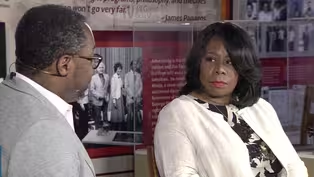
Video has Closed Captions
Clip: Special | 9m 28s | Stephen talks to Cathy Nedd. Roadshow Jan 2018/Seg 2 (9m 28s)
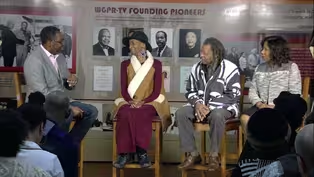
Video has Closed Captions
Clip: Special | 14m 30s | Stephen Talks to NKenge Zola, Cliff Sykes, and Trudy Gallant-Stokes. Roadshow Jan 2018/Seg (14m 30s)
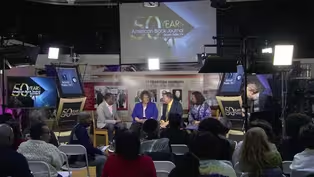
Q & A | Web Exclusive | African Americans: Telling Our Story
Clip: Special | 19m 59s | A Q&A with the panel of guests. Roadshow January 2018/Web Exclusive (19m 59s)
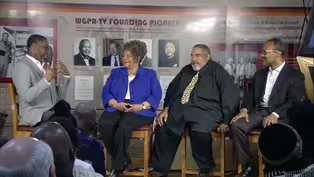
Video has Closed Captions
Clip: Special | 12m 32s | Stephen talks to Karen Hudson Samuels, Herman McKalpain, and Ken Coleman. Roadshow/Seg 4 (12m 32s)
Providing Support for PBS.org
Learn Moreabout PBS online sponsorship
- News and Public Affairs

Top journalists deliver compelling original analysis of the hour's headlines.

- News and Public Affairs

Today's top journalists discuss Washington's current political events and public affairs.











Support for PBS provided by:
American Black Journal is a local public television program presented by Detroit PBS