Keystone Edition
Data Centers: Deal or Dilemma?
2/16/2026 | 54m 59sVideo has Closed Captions
How often have you heard the phrase "data center" lately?
How often have you heard the phrase "data center" lately? They are being talked about in all corners of our area. Data centers are a hot topic right now, but many people don't know exactly what they are, how they're used, and why there is opposition to them. We'll wade through it all on the next edition of Keystone Edition: Data Centers: Deal or Dilemma?
Problems playing video? | Closed Captioning Feedback
Problems playing video? | Closed Captioning Feedback
Keystone Edition is a local public television program presented by WVIA
Keystone Edition
Data Centers: Deal or Dilemma?
2/16/2026 | 54m 59sVideo has Closed Captions
How often have you heard the phrase "data center" lately? They are being talked about in all corners of our area. Data centers are a hot topic right now, but many people don't know exactly what they are, how they're used, and why there is opposition to them. We'll wade through it all on the next edition of Keystone Edition: Data Centers: Deal or Dilemma?
Problems playing video? | Closed Captioning Feedback
How to Watch Keystone Edition
Keystone Edition is available to stream on pbs.org and the free PBS App, available on iPhone, Apple TV, Android TV, Android smartphones, Amazon Fire TV, Amazon Fire Tablet, Roku, Samsung Smart TV, and Vizio.
Providing Support for PBS.org
Learn Moreabout PBS online sponsorship- [Announcer] From your public media studios WVIA, presents "Keystone Edition," a news and public affairs program that goes beyond the headlines to address issues in Northeastern and Central Pennsylvania.
This is "Keystone Edition."
And now moderator, Julie Sidoni.
- One of Public Media's core tenets is to educate and inform our readers, viewers, and listeners.
That's what we're here to do on this edition of "Keystone Edition."
Thank you for joining us, as we dive into a discussion about data centers.
You've heard about them, yes, one of the most talked about and controversial topics in Northeastern and Central Pennsylvania right now.
We know that data center planning and development has exploded in our region.
In this next hour, you're gonna hear from a WVIA news reporter who's covered this issue extensively.
We'll also be hearing from a data center developer, as well as a woman from Lackawanna County, working with the group of residents to keep data centers from overtaking their borough.
We're gonna kick this discussion off right now one-on-one with WVIA News Kat Bolus.
Thank you, Kat, for being here.
- Thank you for having me.
- I know you've gone a lot of reporting on this topic.
- [Kat] Yes.
- And the reason I wanted to have you on solo before we brought the other guests here, is to just give us the who, what, when, where, why, the rundown of what it is we're talking about here.
So we're gonna start very elementary actually.
What is a data center?
- So- - Data?
- I always say data center, data.
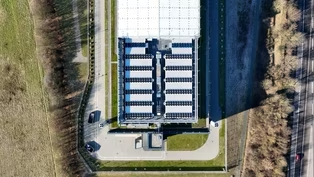
- So a data center is, you know, it's a large building, it's full of servers, and they keep information in them.
So if you are, I always say if you're saving a cat video or a cat photo to the cloud, the cloud actually isn't, you know, just in space somewhere.
It's a server in a data center.
If you wanna watch something on Netflix, it's usually coming from a data center.
But it's not just entertainment.
Hospital records are stored in there, financial information.
You know, when you're transferring money from bank account to bank account, it often runs through a data center.
So it's kind of, we are a more online society than we've ever been before.
And everything we do online kind of processes through a data center.
- You say large.
Large like the size of a church, a university campus, is it a warehouse size?
What's the scale we're talking about?
- So, hyperscale data centers, they kind of, sort of the brains of artificial intelligence, they tend to be large.
So they're very big.
Sometimes they're bigger than football fields.
Sometimes there's multiple data centers in one campus.
But you can have a data center within, you know, a building like ours that just has your servers and stores your information.
So data center isn't necessarily a new thing.
It's the size and the power required that's kind of getting bigger.
- So there's a difference between a data center and an AI data center?
- Yeah.
Well, yeah.
(chuckling) - It would require more, more power, more equipment.
- Yeah.
- So if a data center is in my backyard, is it storing my information, my municipality's information?
Or doesn't it work like that?
- It really depends who the end user is.
So for instance, down next to the Susquehanna Steam electric plant in Salem Township, they're built, Amazon Web Services is building a data center.
So that's gonna be a hub for Amazon web service called AWS for their information, for their, I believe it's for their kind of artificial intelligence chat bot, so that people are connecting with that all over the country.
So some of your information may be in there, but that's really only if you're working with Amazon, it really depends on like who that end user is.
- So hyperscale is what we're talking about for the purposes of tonight, we're talking about a hyperscale data center.
- Yeah.
- Let's talk about some other terms or definitions people might not know off the top of their heads.
I had to learn obsolescence.
Obsolescence is a term that's thrown around here.
- Yeah, so I've been covering a lot of public meetings and hearings about data centers, and a question that residents often have is obsolescence.
So the idea that maybe in five or 10 years, you might not need a data center that's big.
So that's what obsolescence is.
It's essentially, you know, when it becomes obsolete, the size of it at least.
- And what about cloud computing?
Cloud services?
You hear a lot about the cloud.
- Yeah, so the cloud is kind of like, again, it's that cat photo you're storing on the cloud.
Cloud computing is kind of, I think about it a lot with like Google Docs.
You know, you're saving your Google Doc somewhere, but it's not on a hard drive.
It's in the cloud.
- Anything else we should know?
Any other definitions or terms you think we should know?
- I think we're okay for right now.
Yeah.
- I know you took a trip to Loudoun County, Virginia a little while ago where there are data centers there, and we'll talk a little bit more about that later in the show.
But tell me some of your impressions or some of the things that you learned when you went there.
- The one thing that really stuck out to me was I found that Loudoun County was very different than Lackawanna County or even Luzerne County, or Schuylkill or Montour, you know, where a lot of these data centers are proposed in our area.
It was flat agricultural land.
We have a lot of mountains, we have a lot of homes, we have undermining from the coal mining industry.
So I found that just like our geography was very different, and also Pennsylvania's tax base was different than Virginia too.
And also our zoning is much different, specifically in Lackawanna County, we have 40 municipalities all with their own zoning.
We're in Loudoun County, which is roughly the same size as Lackawanna.
There's seven municipalities with their own zoning and everything else is under the county.
- 40 municipalities in Lackawanna County alone.
And each municipality makes its own decision about their zoning.
- Yes.
- So let's get into zoning a little bit because I think that's something that most people probably never had to learn, unless you're a municipal reporter or you're interested in this topic.
- Yes.
- What is it about zoning that you learned that you wanted to share?
- Yeah, so I found out that zoning in the United States goes back to the Revolutionary War.
So the United States still operates under English common law.
So in its most basic form, it's based on court decisions rather than codes or statutes.
So it essentially means that a property owner can do whatever they want, wherever they want.
And then about 150 years ago, the United States Supreme Court determined that common law rights may be regulated by a reasonable exercise of the government's police power, so AKA zoning laws.
So essentially when you have a municipality, you know, we're gonna talk about Archbald a lot tonight, they come up with different zones in their municipality where you can put homes, where you can do industrial, where you can do light industrial, you know, like a business zone.
Like you think of a downtown that's more of a business zone than it is, you know, you're not gonna find a cul-de-sac necessarily with a bunch of houses in a downtown area.
- But so industrial is what a data center needs to be zoned?
Is there anything more specific than that?
Will industrial do it?
- So that's kind of one of the big questions right now is where do data centers fit in within zoning?
So a lot of municipalities are coming up with, they might be taking their industrial zones and making them for data centers or adding that additional layer of data centers, but because it's such a new industry, municipalities are really trying to figure out where the best place is for them in their communities.
- And what about the term overlay zoning amendment?
- Yeah, so you'll hear, I've heard overlay a lot.
So essentially, what it does is it adds like another use onto a property or to a zone.
So like your area could be zoned industrial, and then you can add a data center overlay on the top of it.
So it can be for industry or it could be for data center, or it could be for industry and a data center.
- Alright, thank you.
That has all been very helpful.
We have a story to show, a piece that you worked on about Ransom Township.
Do you wanna give us a little bit of an idea of what we're about to see?
- Yeah, so talking about overlay is actually a good way to get into this.
So there's a stone quarry in Ransom Township.
They applied to have a data center overlay on their property so they could develop a data center there.
And it kind of drew out residents from not just Ransom Township, but from Scranton and Newton, kind of the Abington's area, who didn't think that that was a suitable use for that property.
And it was... So they had a hearing and, I guess, you'll see how the hearing concludes.
- I actually, there, I skipped a question.
A municipality has to make room for every zone, is that correct?
They are required to make room for each zone.
- Yes.
By Pennsylvania law, you have to have, you know, you have to have space for every acceptable use, I think is usually the phrase thrown around a lot.
- Okay.
All right.
Let's take a look at that piece right now from Ransom Township, (graphics swooshing) - [Kat] Lackawanna County residents gathered at the Ransom Township municipal building in January for a hearing about a proposed zoning overlay.
What is a data center in your own words?
- A waste.
Is the new coal mines because in 10 years, are we gonna need all these buildings?
They're gonna, like, in our case, they're gonna blow up the mountain, they're gonna take, what is it, 14 football fields off of the mountain.
And in 10 years, we're not even gonna need the data centers.
It's new coal mines.
- [Kat] The overlay would allow local companies granted materials to build a data center on its property, which is currently not zoned for data center operations.
- Well, my concern is what they're gonna leave when they're done like the call industry.
But that was a way of life.
I mean, that was a little different than now.
Okay.
They had to go where the call was.
Data centers don't have to go where neighbors are.
- Yes.
I lived directly across the street.
I can't believe this is happening in not my backyard, my front yard.
Well, we have two in heavy industrial areas in Ransom Township already.
That's where they should have looked first.
- [Kat] Do you think there's a place for data centers?
- Yes, there is.
There is.
But they shouldn't be in residential areas or natural wildlife areas where they could harm streams and stuff.
- [Kat] Lawyers representing Scranton Materials were present to submit their application to add the overlay.
The meeting was tense from the start.
- That's the one I just referenced to you.
- [Person] That's what I wanted to clarify.
That's the one that you referenced.
- This is the one.
- [Person] Very good.
Thank you.
- Is there a environmental impact report and is it available to the public?
- I don't believe there is.
- [Kat] Attorney Laura McGarry was there to represent her mother, a neighbor who is opposed to the overlay.
- But this is a hearing.
Nothing's been heard.
They haven't presented any evidence.
I think that there's sufficient basis for the board to deny the application without the need for any other testimony or evidence.
- [Kat] Those tensions grew as she made her case against the business' application.
- Additional witnesses to be present for these documents?
(attendees clamoring) (hands banging) All right.
So.
- They didn't bring anybody tonight.
You don't get a second bite at the apple because the quasi-judicial body says you didn't do enough.
This was their opportunity to be heard anymore.
- [Kat] In the end, two of the three Ransom Township supervisors voted to side with McGarry's objections.
They dismissed the application from Scranton Materials after the meeting, lawyers for Scranton Materials declined to speak with WVIA news.
- Okay.
That concludes the hearing.
Thank you.
(attendees applauding) - Of course, that was WVIA news' Kat Bolus with that report.
And now we are really happy to welcome two other panelists here to the WVIA studios.
Please welcome Dave Tolson, who is president and CEO of DBT Data.
Do you say data or data?
- I say data.
- Data, okay.
Data.
From Washington DC but a Wayne County native, we should point out.
- Born in Wayne Memorial.
- All right.
Thank you for being here.
And Madonna Munley, who is an Archbold resident and a member of a group who's working very hard to make sure that your rights in Archbold aren't being trampled.
Welcome here.
- Thank you.
- Anything that the two of you would like to say so far in?
We got it right so far?
Yeah?
Kat did okay?
- So far, so good.
- So far so good.
Okay.
I do wanna sincerely thank both of you for being here, because, as you might understand, this is a difficult topic to get people to stand up and talk about.
So we appreciate your perspective and your time tonight.
We're gonna keep on with the zoning conversation that we started.
Madonna, I'd like to start with you.
You have had to learn a lot about zoning.
- I have.
I first got involved, I'd say late spring, early summer.
And it was through articles that I read in the Scranton Times from Frank Lesnefsky and then later Chris Kelly.
And it was articles about how, Frank wrote, that these land developers were coming in and buying vast amounts of land in Archbald.
And the purpose was for data centers, and I had to learn about it.
One of the problems that we ran into when we found out was that in 2023, Archbald did their zoning ordinance over again, and they did not put a definition for data centers in there.
So that allowed it to be principally permitted use, which is practically anywhere in the town.
So then two years later, in 2025 when all this started to really come about, they said, "Oh, we didn't know what a data center was two years ago."
Well, I'm sure that David, you knew what data centers were more than two years ago.
So, that seemed a little odd.
So when we looked into it, then we found out that they wanna make an overlay, which is really like, just like a transparency.
And you put that over the zoning map and it allows data centers in certain areas.
And one of the biggest concerns for us was that they put the data centers where the developers wanted them.
And the borough manager was quoted in the Scranton Times as saying that the developers came to them and said, "We'd like to have data centers here."
And they were.
So it changes the zoning, the underneath zoning for that purpose.
The biggest one was in a zone that was resource conservation and residential.
And now it's going to be the biggest data center project in the town.
- Do you feel somewhat tricked, left in the dark?
What do people there feel like right now?
- I would say, left in the dark.
We went to council meetings and council work sessions and planning committee meetings, and we never got any answers about why are they put here, what are they, how is this gonna affect our water, our power, our environment?
And it was a long time we had to do all the work ourselves to find out what was going on.
- Dave, actually, you said something earlier on that you think that the zoning is actually fairly strict here in many municipalities in Pennsylvania.
- Yeah, so I am new to the neighborhood, as of about six months ago, have been developing data centers since 2008.
And this is the most restrictive zoning that I've experienced in my career with the conditional use approval process.
- And what does that do for you or your company?
- It creates a lot of ambiguity in terms of, you know, clear direction and it adds a layer to the process.
And there is a big financial risk associated with taking a shot in this jurisdiction that's- - [Julie] It doesn't seem to be keeping anybody away, though?
- The power is available and data centers are about power.
So that's why the industry is here.
- That segues right into the next thing we're gonna talk about here, which is utility usage.
It seems to me utility usage is the part that I hear a lot of possible concerns about, the water, the electricity, air quality, construction noise, the noise of the center itself, et cetera.
So I will let you start with this one.
What does a data center do to be a good neighbor?
- To be a good neighbor, it's actually a low employment facility, so there's not a lot of traffic associated with it.
There is heavy consumption on the part of power itself.
That is the attraction of this jurisdiction.
- I'll stop you there.
Why?
Why here, why now?
Just we have the infrastructure already in place?
- The infrastructure is already in place with transmission lines that are transporting power actually to northern New Jersey.
And so within Archbald borough on those transmission lines, you do have available power, a lot of power.
- Okay.
I'd like to know what the process is.
So I'm a data center developer and I wanna put a thing here.
What do I have to do?
- In this jurisdiction, you would put in an application to PP&L and apply for the power and then it progresses on to actually signing a binding contract for that power itself.
- What are your biggest concerns in Archbald, based on what you're hearing from your group?
- It's the power because one data center alone is going to use 1,600 megawatts of power, which, from what I understand, is enough to power 1,160,000 homes or Miami-Dade County, which has 2.8 million people in it.
And we're afraid that in order to keep producing this and more and more and more, because there's more and more applications coming in in this area all the time, that they're gonna have to do massive build outs of the grid because the grid, PJM doesn't just serve as Pennsylvania, it's also neighboring states all the way down to Washington.
Didn't you say it, David?
- Correct.
- And so if all of these data centers are coming online and they're all gonna need this power, it's going to cost eventually down to us.
I mean, PP&L just added or applied for a rate increase, which adds $12 a month to our bill, which doesn't seem like a lot, but if this keeps going on and on and on, it's gonna be prohibitive.
You know, it's just gonna be your power, your water.
The one center again, that Wildcat Ridge, they're going to use 3.3 million gallons of water a day.
And their plan is to take it from Lake Scranton.
And that again, that's one of six, we have six projects in Archbald right now under consideration.
- We have a map that shows all of the proposed data center sites in Pennsylvania.
I'm not sure if we have that right here, ready to go.
But most of them, yes, there they are, you can see that there are a few in the suburban Pittsburgh area there, Green County, Washington County, but most of them are right smack dab in the middle of our area.
Can you explain that map, Dave?
- The map is based upon the availability of power itself.
It would be fair to say that the country is out of power and the world is out of power.
And a lot of that is being driven by data center use, artificial intelligence, and it's also being driven by the end consumer.
If you have an iPhone, you are participating in this process.
- Does Pennsylvania have excess power?
- Pennsylvania does have excess power.
- Where's it going now?
- Well, specifically the transmission lines, so, you have generation, which is independent, and then you have transmission lines, and then you have local distribution lines.
So the transmission lines that are located in Archbald actually head in northern New Jersey and supplied that market as well.
- We did ask both Pennsylvania American Water and PPL Electric to participate in the conversation, if they wanted to.
They both declined that invitation.
But I do know, Kat, that you've spoken with representatives from those organizations.
What have they told you about this in your reporting?
- Yeah, so I spoke with Shelby Linton-Keddie from PPL, and she says they do a study and analysis for every large load customer, like a data center.
And that helps determine what's needed specifically for that large load customer, and what benefits everybody who uses PPL services.
So a direct quote from her, she said, "The portion of any line or any project that is directly for that customer is paid by that customer.
So that customer could be the data center and then the portion of the line and/or the upgrade that has system-wide benefits is allocated to all customers."
So, you know, if you're a resident, if you're a home benefiting from that line, you could potentially bear the burden of some of that cost for kind of the upgrades.
- I see.
Is it, I'll ask this of any of you, is it a fair comparison when we say it's the new coal industry?
- I personally wouldn't go there, but it is an economic driver for the local region.
- Would you say that this is the new coal industry?
- Well, I think the coal industry is different, because a lot of our ancestors came here to this area with the promise of cool jobs.
They were plentiful and you didn't have to have an education and you could be trained to be a miner, a mule driver or a slate picker, you know, up to a mine inspector.
But that's not what's driving this, I don't think.
And the only comparison I see is the fear of that, when they do become obsolete, that we're gonna be in the same position we were when the mine owners pulled out.
That will be left with abandoned mines, abandoned breakers, coal dumps, and the polluted rivers.
And then we're left to clean up the mess once again.
And that's a fear of ours.
- Another argument I hear a lot is say a computer of old took up an entire room and computers these days are as big as your thumbnail.
Why not wait 1, 2, 5, 10 years to see if data centers could be even smaller and not have to take up that much room?
What would you say to that?
- With the increase in the compute power, there's a correlating need for electricity.
So artificial intelligence is on a graphics processing chip versus CPU and they use seven times the power, but you also need additional infrastructure to support that.
So this is the internet, it is the cloud.
And I have not read any forecasts of obsolescence.
If there was obsolescence, I can tell you that the amount of copper inside the facility to scrap the copper and the other metals within the facility would pay to actually decommission the building.
And then you also have to look at some of the corporate responsibility that you see from some of the hyper hyperscalers where, for example, they already voluntarily do carbon offsets.
They're not regulated, they don't have to do it.
And all of the big hyperscalers do do it.
They buy carbon credits in the open market to mitigate their carbon footprint.
So there is a history of responsibility within the industry itself.
- But we have no real way of knowing, in some cases, who is behind the data center in a lot of these regions.
Right?
- No.
We have yet to identify an end user for any of the projects that are going up in Archbald, any of the six campuses, that is a brilliant term, I must say, whoever came up with that, it sounds so benign.
And it's really this conglomeration of how you described those huge buildings before, you know, you're not gonna go out and have lunch on the quad in the data center campus.
So I think what we're worried about too is that, when that happens, that what do we do with that now?
Because now t, the forests are gone.
They already started cutting down trees for one of the proposals in Archbald.
And then when they talk about the wildlife, if it's not an endangered species, they can go ahead and go there.
But there's other things that are there.
You know, there's animals that live there, there's insects that contribute to the economy, or not the economy, busy insects.
No, the ecology of the area.
But all that's gone after they do that.
When I was talking to David before and I said, "When you come up Betty Street and Nine and you look at what the whole vast area there, it goes on Route 6, where it goes from, there's a law firm down here, and then it goes all the way across, the 347 goes in the middle, and then it goes all the way over pass the shopping, pass, the Rite Aid, what's it, A Dollar Store now, that's another change in ownership.
But anyway, that whole thing, that whole mountain is gorgeous in the fall when you're going up that road and, and it'll be gone.
And how does that not create a water problem?
You know, when we get heavy rains, if all those trees are gone?
I don't know, I guess that's a construction issue, but it just seems that we'll never get that back.
- Governor Shapiro mentioned data centers in his latest address and we would like you to hear what he had to say about that now.
- Amazon chose to invest $20 billion in our Commonwealth, the largest investment in the history of Pennsylvania.
And at the same time, we need to be selective about the projects that get built here.
I know Pennsylvanians have real concerns about these data centers and the impact they could have on our communities, our utility bills and our environment.
And so do I. So today I'm announcing GRID, the Governor's Responsible Infrastructure Development standards developed by my administration in consultation with the community to hold data center developers accountable to strict standards if they want our full support.
(graphics swooshing) - That includes their own power generation, strict transparency standards, hiring and training local workers, and following the highest standards of environmental protection.
What more do you know about GRID?
- So I reached out to the governor's office after the budget address and I believe that they have to work with the state legislature to really put GRID into place.
So it's, I think, something that will come, you know, probably progress over the next couple months.
- Is he asking for the sun, moon and stars here?
Do you think, with those four points?
- No, I would call it best practices.
So supportive of the governor's statement.
- And you'll be watching what happens there in state legislature?
- [Madonna] Yes.
Yes.
- We also have a story that we would like to show, and this also has to do with economic job growth.
Kat, would you like to explain a little bit about what we're going to see here?
- Yes, so we spoke with the president of Luzerne County Community College, John Yudichak and also Bob Durkin, he's president and CEO of the Greater Scranton Chamber of Commerce.
And they both kind of discussed the economic development side of data centers, how they're preparing and what they think they could bring to the region.
- Okay, we'll listen to that now.
(graphics swooshing) - Data centers are part of our everyday lives.
I understand that the average household in the United States has 21 devices.
- The reason data centers are hot here at every place else is not only because of the continuous growth of technology in the world, but it's Ai.
Once AI's doors opened in the last several years, that's where the incredibly rapid exponential need for cloud computing and data centers.
That's where that came from.
There will be a great number of jobs within these facilities themselves because not only are they incredibly highly technologically advanced, but they're security issues.
So if your job is simply to replace the filters in there, a basic maintenance position, it isn't going to pay a basic maintenance position price.
It's gonna be much higher than that, because there's a security issue along with this.
- Luzerne County Community College stands at the ready to deliver that digital infrastructure workforce of the 21st century economy.
We were honored to host AWS building, a data center here in Luzerne County, down in Salem Township.
And it was their headline, Luzerne County Community College is at the center of higher education and the workforce development pipeline for the digital age.
There's really two spaces.
There's the cloud computing, which is the virtual, and that's more of the technical degrees.
We have a cybersecurity degree here.
But then there's the cloud infrastructure.
And I think that is the part of the workforce development where we can have the biggest impact and where folks aren't recognizing the value of the jobs that are created with the data centers.
- In addition to the direct jobs, there are the complimentary or ancillary jobs.
So again, cleaning, HVAC, so it could be plumbing, electrical, - That's a construction manager, that's a fiber splicer, that's a data center technician.
Many of these programs that do not require an associate degree or a bachelor's degree, there's certifications that could be earned in as short as 12 months.
- There are going to be high quality jobs, high paying jobs, family sustaining jobs.
- We are gonna help the United States and Pennsylvania win the AI race and make sure that we are building the workforce to deliver on the digital infrastructure technology of the 21st century.
(graphics swooshing) - So again, we put those two pieces together for a reason.
These are all sort of plans, the area planning around what we think might happen here.
Do you believe there is room for data centers somewhere?
Would your group really like to see them not at all anywhere in Pennsylvania?
Explain a little bit of your perfect world.
- No, we wouldn't want any, but we are realistic and we know that according to Pennsylvania code, we have to allow for every use somewhere in the borough.
But we want them in an industrial area in Archbold.
We don't want them near homes and shops and restaurants and one mile from a school, two miles stretch of road, the (indistinct) German Road, one and a half miles of that is taken by the developments.
Three of the projects that are in already in application, already having public hearings, things like that.
And that is not where we want them.
If we have to have one, we'd like to limit it and we'd like them in an industrial zone.
- As a developer, why would you want to go into an area where, you know, there is so much controversy, I suppose, around you being there?
- We would only apply in an industrial zone and we follow best practices and we follow the rules and regulations.
So we go through the process itself and if we are denied, we are denied.
But we would not try to take a residential zone and convert it to an industrial zone.
We have done that in the past, but it was an municipality that encouraged it for that location.
So we really try to partner with the community and the municipality and the governing bodies as much as we possibly can.
So yeah, we would not try to change a use and we would only go within an identified industrial zone.
- You said earlier, Madonna, that you have lived in Archbold a long time.
You're how many generations have lived there?
- [Madonna] I'm fifth generation.
- Fifth generation.
- And I have two great nephews, which would make it seventh generation that live in Archbald.
And that's not unusual in Archbold or in any of the small towns around here.
- I was gonna say, talk a little bit about that.
It seems as though that, I mean we're talking about zoning and we're talking about environments and all of that, but it seems like your homestead is what the story is really about.
- Yes, it is.
And it's keeping that way of life for a small town.
And we're not the wealthiest borough by any means or municipality in the state, but we have development, there are a lot of new housing developments in Archbald and we wanna encourage residents to come in and we wanna encourage people who, their children moved out of state to get a better job to go to college.
And now they wanna come back here to raise families.
So we wanna make it a place what they remember, not something that the landscape has completely changed since they left, because it's going to take a long time and it's gonna disrupt the borough because it takes from the beginning, it's what, five years to be up and running, three to five years, David?
- Two to five.
- Two to five?
So that's two to five years of construction.
And that one stretch of road alone, that's where the school buses are parked for Valley View School District.
They leave from there to go and get the kids, they bring them back that way.
And we want to have the same amenities.
We have more now.
We have a beautiful walking trail for the Lackawanna County Heritage Trail.
That's the big part of that is in Archbald.
And we wanna have the small town atmosphere that people live for.
You know, like again, I still live in the same house that my parents bought in 1960 and through genealogy I found out that the house has been in the Munley family since 1898.
- [Julie] Wow.
- You know, it's not a picturesque perfect farmhouse that everybody goes, "Ooh," no, it's just an old mining house actually.
- [Julie] But it's roots.
You have deep roots.
- It is, and you know, I everybody knows their neighbors and it's a very helping community.
And I just think we wanna preserve that and not be taken over by, not change the whole complexion.
It's our health, our safety, and our welfare that our group is really worried about.
- You were the host, correct, of the Loudoun County Virginia or one of the hosts that invited people to come see the data center?
- I was, yes, I was the host.
- Kat said earlier that Lackawanna County and Loudoun County, Virginia are very, very different.
Can you explain how?
Why is it working so well there?
- Number one, your topology, it's in this region, it's very challenging, based upon how mountainous it is, where Loudoun County is relatively flat.
and then also in Loudoun County, it's really the home of the internet.
So the internet itself was a government-funded project, and in Loudoun County you have one of the nodes.
So if you think of kind of a rock in a pond or a rock hitting a windshield, it's in Loudoun County, specifically in Ashburn, it's the heart, the lungs, the brain of the global internet.
It's where it started.
So that is really what spurred development there.
The industry has grown, the industry is now in search of power, and that is why the industry is targeting this region.
- Is it safe to say then that data centers came first and then the homes and people followed?
Is that kind of what you're saying?
- I would say that it was a mix.
It was a fair mix, but then with the economic development and the revenue that Loudoun County received, they built world class schools and public safety and then that attracted residents for the school system itself.
So the actual revenue to the county, which then allowed the county to provide services attracted the residents.
So there was a population boom in parallel with the data center boom as a result of the economic, of the tax revenue for the county itself.
- You said, I forget your words there, light employment.
How many people work in a data center after it's built?
- It depends on the size.
They are a 24/7/365 facility, but it's a low employment facility.
And the rule is, you know, "don't touch anything," these are highly automated facilities.
So there is a big component of actually upgrades within the facility itself where you bring in a lot of contractors.
So it does support a lot of contracting employment, but for permanent full-time there's a security team and then you have electrical engineers, mechanical engineers on site itself.
But you know, 20 to 30 jobs for a 200,000 square foot facility.
So it's really minimum permanent employment.
There is a lot of subsequent employment in terms of services to that facility.
- We talked a little bit about at the county level, Kat, I know you've spoken with at least the Lackawanna County Commissioners, what can be done either way at the county level if all of this is happening on the very granular municipal level, - The county really doesn't have much control over, you know, what happens at the municipal level.
I think that's, you know, one of the reasons why, specifically in Lackawanna County, there's 40 municipalities all with their own, you know, zoning laws and things of that nature.
But Lackawanna County commissioner Bill Gaughan is calling for a moratorium on data center development.
And he also asked the state legislature, you know, "We know we're gonna have these developments, can the county at least get an impact fee?"
But again, that would have to take a vote, that would have to pass the state government for anything like that to happen.
- We know you spoke with Commissioner Gaughan maybe a week or two ago.
- Yeah, it was about two weeks.
Yeah.
- And we have this interview to show you.
- [Kat] Why did you come out tonight?
- Because the opposition to the data centers is overwhelming.
I've been hearing from literally hundreds and hundreds of my constituents throughout the county over the last several weeks, and I have serious concerns.
When you look at the specific proposal that's being bandied about tonight, the water consumption, the electricity consumption, it's very, very concerning.
And then when you look at what is happening around the country, specifically Georgia, there are really, really big problems with data centers.
So I'm here to stand with the residents of Archbald and the Valley and for the people of Lackawanna County.
- [Kat] So I know you talked about this a little bit at the commissioner's meeting last week, but there's not too much legally that commissioners can do, but do you see, you know, is there anything you think that you can kind of do to help out the residents of the community?
- Yeah, we can use our position as commissioners in the bully pulpit that we have to speak out against data centers.
What I'm gonna call for tonight, like I called for last Wednesday, is, well, specifically tonight is a moratorium on data center development in Pennsylvania and calling our state legislators and our governor to impose a moratorium to give us more time to study the negative consequences of data centers that we've seen all over the country.
Down in Georgia, there's a bunch of state lawmakers that just got together and they're trying to push legislation now for a moratorium there.
And this is happening in other parts of the country as well.
So I think it's really important.
- [Kat] Do you think there is a place for them in Lackawanna County at all?
- No, I don't.
In the current makeup, the way that they consume water and electricity is gonna leave us in a very, very difficult position.
And you know, I know these developers come in and they talk a good game, but all you have to do is look at what's happened in other parts of the country.
There's a great study that just came out of the University of Michigan that talks about all of the issues with data centers in terms of the environment.
So there's serious, serious concerns.
And I would hate to have the residents of Lackawanna County be sold out just so some developers and some billion dollar corporations could make a buck.
- [Kat] What if you know they're kind of enticed by the economics of it all, you know, "We'll come into your neighborhood and you'll get more taxes"?
- Yeah, I'm not sold on that and here's why.
They often use the comparison between Lackawanna County and Loudoun County, Virginia, but the tax structure is different.
So in Pennsylvania, as I understand it, we don't have the same tax structure as Virginia.
They tax the equipment.
So they have seen a windfall in terms of the revenue from the data centers.
We're not gonna see the same revenue.
Will we see tax dollars?
Yes, but at at the benefit to who?
You know, if you're gonna lose out on the environment and you're gonna lose out on all these other concerns, then how much are you gonna benefit from the tax dollars?
So that's why I called for an impact fee for the governor and the state legislators to give counties the ability to levy an impact fee, so that we can get money from these big corporations, if there are data centers here, and then we can use that money and put it back into the boroughs and the townships for property tax reduction, help with their electricity bills and their water bills, all the things that are gonna be affected from these data centers.
- Lackawanna County Commissioner, Bill Gaughan, I would love to have you go ahead and respond to that, Dave.
- So he is referring to the personal property tax that Virginia has, and that is a big economic driver.
There's also a state incentive that abates part of that as well.
What I can tell you is if you were to use a number, so the total investment cost, if your property tax assessment was 30% of that for a project that I'm aware of, it would be $30 million of economic, of taxes annually.
So if you take 70% of that for the Valley View School District, it's $20 million a year.
So I think that for some of these communities, it can be game changing in terms of public education and public safety, public health.
So there are two sides to the story.
So granted, they do have need to be cited in the right locations as well.
But there is a very promising story in terms of tax revenue.
- I'm kind of like to transition into the idea around transparency here, which is something that I hear a lot from residents, I've heard it from you as well, Madonna, you don't feel as though many developers are being transparent with either you or local government.
Go ahead and state your case there.
- No, I don't know if I said it before, but we have no identified end users for these data centers in Archbald yet.
And every corporation, there's one that changed names like every couple months, and we don't know the person, we just know an alphabet soup of initials, this LLC and this (indistinct) one LLC and this one... And we wanna know who these people are that are coming in.
And I just don't understand why that has to be secretive.
Why can't we know who's behind the corporation?
And also that we, again, when I said when we went to all those meetings, we weren't getting any answers.
All we wanted was an answer and we offered to work with our council and to try to come up with a more restrictive overlay, before they passed it.
The first time they tried to pass, it was in the basement of the St.
Thomas Aquinas church, across the street from the borough building.
There were about 200 people there that night.
It never got a second, the motion never got a second.
But they didn't change anything.
So that was in October.
And then in November they came back with the same exact overlay and it was passed by four to two to one abstention.
And in the meantime, we had offered to work with them or have a panel of people that would just tell them, "This is what we're afraid of.
Why can't you answer our questions?"
And we just got silence.
We got no response from- - I'll ask you, why the NDAs and the secrecy and why does it have to be "shrouded," in Madonna's words?
- So, for starters, I'm a fan of transparency and that's why I'm here.
I think that transparency is a best practice.
I'm well aware that this is the hot seat.
What I can say is that there is a legacy in the industry itself where a data center was a mission critical facility.
And that's why you wouldn't see a name on the side of it.
And it's really only in the last three years that you will see the actual owner operator of the facility see a name on it.
But historically, these were just boxes and they were hidden behind LLCs and that's because it was considered a mission-critical application.
And it's only now become more of, you know, it's a consumer item behind those walls, essentially.
Cloud computing is serving the consumer.
And so now, for the first time, you're starting to see where the company that's actually doing the computing behind the walls is putting their name on the side of the building.
But that has only happened in the last three years.
- Considered mission-critical by whom?
- Mission-critical by the applications themselves that were taking place within the facility.
And that was really how the industry, you know, viewed the application and really this transition to what we now call cloud computing, which is relatively new.
- I'm sorry, but what what does that mean, mission-critical?
- Mission-critical would be a facility delivering a service that's considered, you know, at risk, needs to be highly reliable.
And it's really, it's an industry term.
- Okay.
- [Julie] Like government records.
- Sure.
Government records.
So, you have to think that really computing has gone more to serve the consumer, you know, with the iPhone and all the applications that we have that we can use.
But historically before that, and when I say historically, we're going back 10, 12 years.
So, you know, this industry has grown by leaps and bounds and it's more driven by consumer than it is by really, you know, other applications.
- Do you think the industry, I'll let you ask that in just a second here, but do you think the industry overall would be far better and more successful at what it's trying to do if it were more transparent, if it would say "Here's who's coming in"?
- You know, I sat in a conference in Chicago in September and listened to the head of site selection from Microsoft globally and listened to her speech for an hour and she was very transparent and they do follow best practices.
- So what were you gonna say?
- So, you know, Julie and I had talked before and I said, "Dave, you were the first developer that I was ever able to kind of talk to about what it went into developing a data center."
And I'm finding just in my own reporting, you know, there's an LLC and then you look up the LLC and there's a list of names and you find this person and they're associated with a different company and you try to email them and you try to call them and you don't get anything back.
And then a lawyer shows up and you've never heard of this lawyer before or maybe they're a local lawyer and you're kind of going back and forth through this middleman almost.
And I think, I'm finding that that's what frustrates residents a lot, that's what frustrates me as a reporter is that, you know, I wanna get the information out there and I don't necessarily, I said to a lawyer recently, I'm like, "I would love to know who your end user is.
I know you're not gonna tell me, but I would love to know who it is, but just that you've reached out to me and that you're providing me more information than I've ever been able to have before."
This is, I think, more beneficial and this is what people want.
You know, I understand that there's NDAs with end users and stuff, but like our conversation down loud in county, I felt more enlightened about data center developments than I had before, just because it was so hard to get anyone to talk to you about it.
Or you'd go to, you know, hearings and zoning meetings and you'd be like, "Can I talk to you after this?"
And they'd be like, "Nah."
(chuckles) So yeah, for me, the transparency I've found to be, I think frustrating, and what kind of makes residents scared and nervous because they don't know who their neighbor's gonna be.
- Yeah, I can say that the end user often makes a developer sign an NDA, so then the developer legally cannot disclose who the end user is.
So, there is that.
- But why do you think that is?
I understand that developers have a role, but why do you think the end user wants to be so secretive about it?
- I can't answer that question.
It's just, I think it's corporate legal.
I think it's process itself, but I would say it's an industry practice, but on our part, we try to be as transparent as possible.
- Hearing all of this, Madonna, will it change something that your group does or what comes next for you?
- Well, we're still trying to approach it now, because under the overlay it is a conditional use as opposed to the principle be permitted use.
So we're trying to look at the process, was the process covered correctly?
Did they dot all the i's and cross all the t's when they put the application in?
Because at this point it, the overlay is there and if the planning committee and the zoning and council says that they've made all the requirements, we don't get a vote.
And that's another thing, it's just so frustrating because we feel like we elect these people to watch out for us, and that's not who we think they're looking out for.
And the money is very tempting.
I agree.
I mean, Valley View school district could certainly use $25 million, but at what cost?
And it's hard to explain.
I mean, I taught for 25 years not in Valley View, in a different district, 25 million would definitely have been a game changer for us.
But I can't see that outweighing the benefits of keeping this the way of life, the environment.
Now if they're in an industrial zone and we still get the $25 million, I'm all for it.
- The one point I wanna bring up, just before we are running outta time here, but, so let's say they are built, and I've heard 10 years, I've heard eight years, I've heard 15 years, in Loudoun County, the data centers that were built in 2007 and 2008, are they still in operation?
- They are.
- And how long do you expect a data center to not outlive its usefulness?
- They can do internal updates and also internally in a data center, just for easy round numbers, if you had 100,000 square foot building, it would actually be segmented into 10 10,000-square-foot data halls, so you could actually decommission a 10,000-square-foot data hall and recommission it within that facility.
So there is the ability to repurpose within an existing shell of a building.
- But the building would, yeah, I mean, in most cases stay, it would stand, I would imagine.
- Think of an old home you can go in and you can get the kitchens and bathrooms.
So you can do the same thing in a data center.
- Alright, final points here as we round out our discussion.
Kat, I know in all of your reporting, you've done a wonderful job, and by the way, go to our website and check out the three-part series that we published of Kat's recently.
What is your next step in covering data centers?
- Keep covering them.
(chuckles) I have a list of, I'm keeping track of all the meetings that are happening.
I think leading up to the series, there is 67 public meetings or hearings that had happened up to the series publishing.
But I think for me, I'm going to keep on it.
I would love to get in a data center.
You know, again, I would love to, this is a call to all the end users and developers.
I would love to talk to you about it.
And just keep speaking with residents and hearing what they have to say about what's happening in their communities.
- Well, Dave and Madonna, we very much appreciate that you stood here, you put your faces out there and we very much appreciate your time and your expertise.
And of course, Kat, thank you for all of your wonderful reporting on this.
That's about all the time we have for this episode of "Keystone Edition."
Thank you again for watching this program, and I'll plug it again, if you haven't already, check out Kat's three-part written series that's published at our website, wvi.org.
I'm Julie Sidoni and for all of us here at WVIA, we'll see you next time.
(light music) (light music continues)
Providing Support for PBS.org
Learn Moreabout PBS online sponsorship
- News and Public Affairs

Top journalists deliver compelling original analysis of the hour's headlines.

- News and Public Affairs

FRONTLINE is investigative journalism that questions, explains and changes our world.












Support for PBS provided by:
Keystone Edition is a local public television program presented by WVIA