
U.S.-Saudi nuclear deal faces pushback over weapons risks
Clip: 9/18/2026 | 8m 46sVideo has Closed Captions
U.S.-Saudi nuclear power deal faces pushback over potential weapons risks
This week, Democratic representatives introduced a resolution to block the Trump administration’s new civilian nuclear agreement with Saudi Arabia. The deal paves the way for the U.S. to help Saudi Arabia build a nuclear power program for peaceful purposes. But critics fear it doesn’t have sufficient safeguards and could allow Saudi Arabia to pursue nuclear weapons. Nick Schifrin reports.
Problems playing video? | Closed Captioning Feedback
Problems playing video? | Closed Captioning Feedback
Major corporate funding for the PBS News Hour is provided by BDO, BNSF, Consumer Cellular, American Cruise Lines, and Raymond James. Funding for the PBS NewsHour Weekend is provided by...
U.S.-Saudi nuclear deal faces pushback over weapons risks
Clip: 9/18/2026 | 8m 46sVideo has Closed Captions
This week, Democratic representatives introduced a resolution to block the Trump administration’s new civilian nuclear agreement with Saudi Arabia. The deal paves the way for the U.S. to help Saudi Arabia build a nuclear power program for peaceful purposes. But critics fear it doesn’t have sufficient safeguards and could allow Saudi Arabia to pursue nuclear weapons. Nick Schifrin reports.
Problems playing video? | Closed Captioning Feedback
Where to Watch PBS News Hour
PBS News Hour is available to stream on pbs.org and the PBS app.
Providing Support for PBS.org
Learn Moreabout PBS online sponsorshipGEOFF BENNETT: This week, congressional Democrats introduced resolutions aimed at blocking the Trump administration's new civilian nuclear agreement with Saudi Arabia, while a bipartisan group of senators called on the administration to declassify key details of the deal.
The agreement would open the door for the U.S.
to help Saudi Arabia develop a civilian nuclear power program, but critics say it lacks key safeguards that could restrict Saudi Arabia's ability to eventually pursue a nuclear weapon.
Nick Schifrin is back with more.
NICK SCHIFRIN: Saudi Arabia is the world's largest oil exporter, but in its effort to diversify away from fossil fuels has long wanted nuclear power.
The U.S.
and the kingdom began discussing a civil nuclear agreement more than a decade ago.
And, last month, Energy Secretary Chris Wright and Saudi Energy Minister Abdulaziz bin Salman signed what's commonly referred to as a 1-2-3 agreement.
The U.S.
will help Saudi Arabia build nuclear power plants and provide the kingdom nuclear fuel only through companies that the U.S.
and the kingdom select.
The U.S.
and Saudi Arabia will conduct a study of the -- quote -- "economic viability" of Saudi Arabia enriching uranium domestically to fuel their own plants.
That's a change from a recent agreement with United Arab Emirates, which prohibited domestic enrichment, and that's referred to as the gold standard.
And Saudi Arabia submits to nuclear inspections, but is not required to sign the U.N.
nuclear agency's additional protocol of verification measures.
The agreement now sits with Congress, which can try to block the deal with a joint resolution of disapproval.
One of the congressmen who has introduced that resolution is California Democrat Brad Sherman, a member of the House Foreign Affairs Committee.
And to debate him, we're also joined by Dan Poneman, deputy secretary of energy during the Obama administration, who was later president and CEO of Centrus Energy Corp., which produces fuel for nuclear power plants.
He's now a distinguished fellow at the Atlantic Council.
Thanks very much, both of you.
Welcome to the "News Hour."
Representative Sherman, let me start with you.
Why have you introduced legislation this week to try and stop this deal from going forward?
REP.
BRAD SHERMAN (D-CA): The Saudis want a green light to move forward with the nuclear weapons program.
MBS has made it plain that he wants to have the option of having a nuclear weapon.
The vast majority of the hijackers on 9/11 came from Saudi Arabia, and that element of politics is still there in Saudi Arabia.
We don't know whether it will be the royal family in control five or 10 years from now.
The only reason he wants this is, he wants a green light to go forward with a nuclear power program that barely conceals a nuclear weapons program.
He doesn't dare do this without an agreement with the United States.
And this is a very woefully inadequate agreement.
NICK SCHIFRIN: So, Dan Poneman, we're going to go through a few of the arguments here.
What Representative Sherman is raising is concern about Mohammed bin Salman himself, the crown prince of Saudi Arabia, a comment that he made in 2018 back on "60 Minutes."
NORAH O'DONNELL, "60 Minutes": Does Saudi Arabia need nuclear weapons to counter Iran?
MOHAMMED BIN SALMAN, Saudi Arabian Crown Prince (through translator): Saudi Arabia does not want to acquire any nuclear bombs.
But without a doubt, if Iran developed a nuclear bomb, we will follow suit as soon as possible.
NICK SCHIFRIN: So, Dan Poneman, take this argument on first.
Should the United States trust Mohammed bin Salman, given what he just said?
DANIEL PONEMAN, Former U.S.
Deputy Secretary of Energy: I think you have to distinguish, Nick, between nuclear weapons programs and nuclear energy programs.
They don't always intersect.
So what this program would do would be to provide more transparency into the Saudi nuclear energy program.
They pledge to be transparent.
They have signed up in this so-called 1-2-3 agreement to all of the onerous conditions that U.S.
law since the 19 -- 1978 Nonproliferation Act, no explosive, prior consent to enrichment reprocessing, retransfer rights, all of that, plus a bilateral safeguards agreement that Director-General Rafael Grossi of the International Atomic Energy Agency has said is very, very similar to the additional protections of the additional protocol.
I think it's clear that, if the United States does not do this deal, the deal is going to go to somebody else, and whoever it's going to be, be it Russia or China or somebody else, will not have nearly the level of transparency and protection against the weapons proliferation that we're all concerned about.
NICK SCHIFRIN: So, Congressman Sherman, let us go through some of the arguments that Dan Poneman just made.
Let's focus in on verification.
As I said at the top, right, Saudi Arabia is not submitting to the U.N.
nuclear agency's additional protocol.
That's a list of requirements that essentially allows the U.N.
nuclear agency to go wherever it wants whenever it wants.
Is -- how much of a concern is that, even if the U.S.
and Saudi have their own verifications inspections agreement?
REP.
BRAD SHERMAN: When they want to hide it, you know it's not good.
And the agreement with the United States allows us only to look at declared sites.
Their nuclear program will be at undeclared sites.
What they're asking to do is have far less inspections than was called for by the Iran nuclear deal.
And we know that that deal is totally unacceptable to Donald Trump.
But when you buy -- when you do a $10 billion deal with Trump in real estate, when Kushner gets $2 billion for his fund, all of a sudden, Trump is just fine with having a nuclear program in a Middle East state.
We should know that, when they say they don't want inspections, there's a reason.
NICK SCHIFRIN: Dan Poneman, take that on.
The language from the U.S.-Saudi agreement does allow for short-notice access to the agency during regular working hours.
So is your argument that that's just simply strong enough and the best we can get if Saudi Arabia won't sign the U.N.
nuclear agency's version?
DANIEL PONEMAN: My argument, Nick, is that the deal provides for exclusivity.
So the United States will be the exclusive partner.
Anything that they do under that agreement is supposed to be at a covered site, and the U.S.
has robust inspection rights, which are not implemented by the United States, but by International Atomic Energy Agency inspectors.
Anything that were covert that Saudi were to do elsewhere would be a violation of their full scope safeguards agreement with the International Atomic Energy Agency and could be subject to a request by the International Atomic Energy Agency for a special inspection.
NICK SCHIFRIN: Congressman Sherman, let me now focus on the concerns about enrichment that you and others have had.
We have been talking about verification.
Let's talk about enrichment.
This deal allows for the possibility that, after a two-year study, Saudi Arabia would be allowed to enrich domestically.
Why does that particular part of this deal concern you?
REP.
BRAD SHERMAN: Well, first, they will need permission from the United States, but only from the president, in order to go forward with enrichment.
Saudi Arabia was the home to the vast majority of 9/11 hijackers.
We don't know who's going to be running Saudi Arabia in the future.
We do know that the guy who's running it now wants a nuclear weapon.
NICK SCHIFRIN: Dan Poneman, do you have faith that the United States could have what some people in the Biden administration designed as a kind of black box, that they would be able to control enrichment, make sure it was by Americans, even if it was in Saudi Arabia?
DANIEL PONEMAN: I actually do, Nick.
And that mean would mean that Saudi Arabia would have no access to the technology.
It would be, as the name implies, excluded from their access.
NICK SCHIFRIN: Congressman, bottom line, do you think you can block this?
REP.
BRAD SHERMAN: We can block it only if we get the support of the American people.
It is true that, under this -- if Saudi Arabia complies with this agreement, they're not allowed to develop a nuclear weapon.
But, then again, North Korea promised to never develop a nuclear weapon.
Iran promised.
And a mere promise that's easy to cheat on is not in America's interest.
DANIEL PONEMAN: The deal that has been struck by the United States government with the Saudi Arabians is the strongest nonproliferation deal that you are going to get, and that it is deeply in the U.S.
long-term strategic interest that they partner with us and not with China or Russia or anyone else.
You start with what's good and you keep trying to build us something better.
I think the U.S.
is the partner of choice purely on nonproliferation grounds.
NICK SCHIFRIN: Dan Poneman, Congressman Brad Sherman, thank you very much to you both.
REP.
BRAD SHERMAN: Thank you.
DANIEL PONEMAN: Thank you, Nick.
Capehart and Ponnuru on Trump's attacks on press freedom
Video has Closed Captions
Capehart and Ponnuru on Trump's attacks on press freedom (9m 32s)
'Shadow surge' pushes immigration arrests to record highs
Video has Closed Captions
'Shadow surge' pushes immigration arrests to highs as Trump administration shifts tactics (5m 45s)
'The Last Free Women' follows Afghans rebuilding their lives
Video has Closed Captions
'The Last Free Women' follows 4 Afghans rebuilding their lives after escaping the Taliban (9m 57s)
Trump bans news outlets in latest attack on press freedom
Video has Closed Captions
Trump says he's banning 3 outlets from White House in his latest attack on press freedom (2m 48s)

What's in the Greenland agreement between U.S. and Denmark
Video has Closed Captions
What's in the Greenland agreement between U.S. and Denmark (2m 49s)
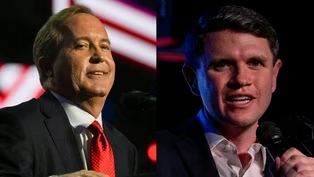
What's making the Texas Senate race so competitive
Video has Closed Captions
What's making the Texas Senate race so competitive (6m 23s)
Providing Support for PBS.org
Learn Moreabout PBS online sponsorship New Episode
- News and Public Affairs

Today's top journalists discuss Washington's current political events and public affairs.
 New Episode
- News and Public Affairs

FRONTLINE is investigative journalism that questions, explains and changes our world.
 New Episode
 New Episode
 New Episode


 New Episode
 New Episode

 New Episode
Support for PBS provided by:
Major corporate funding for the PBS News Hour is provided by BDO, BNSF, Consumer Cellular, American Cruise Lines, and Raymond James. Funding for the PBS NewsHour Weekend is provided by...