
How culinary medicine fights diseases through better food
Clip: 1/4/2026 | 5m 53sVideo has Closed Captions
Emerging field of culinary medicine helps fight diseases through better food
As the saying goes, we are what we eat. That age-old wisdom is behind the emergence of a new field in medicine. Ali Rogin brings us this report for our ongoing coverage of the intersection of arts and health, part of our CANVAS series.
Problems playing video? | Closed Captioning Feedback
Problems playing video? | Closed Captioning Feedback
Major corporate funding for the PBS News Hour is provided by BDO, BNSF, Consumer Cellular, American Cruise Lines, and Raymond James. Funding for the PBS NewsHour Weekend is provided by...
Support provided by:

How culinary medicine fights diseases through better food
Clip: 1/4/2026 | 5m 53sVideo has Closed Captions
As the saying goes, we are what we eat. That age-old wisdom is behind the emergence of a new field in medicine. Ali Rogin brings us this report for our ongoing coverage of the intersection of arts and health, part of our CANVAS series.
Problems playing video? | Closed Captioning Feedback
How to Watch PBS News Hour
PBS News Hour is available to stream on pbs.org and the free PBS App, available on iPhone, Apple TV, Android TV, Android smartphones, Amazon Fire TV, Amazon Fire Tablet, Roku, Samsung Smart TV, and Vizio.
Providing Support for PBS.org
Learn Moreabout PBS online sponsorshipLISA DESJARDINS: We are what we eat, so the saying goes.
That age old wisdom is behind the emergence of a new field in medicine.
Ali Rogin brings us this report at the intersection of arts and health as part of our Canvas Series.
WOMAN: Today we are going to be cutting a whole bunch of things.
ALI ROGIN (voice-over): In this professional grade kitchen, class is in session but it's not culinary school and these students aren't chefs in training.
In fact, some say they hardly cook at all.
WOMAN: We have a few squashes.
This is a spaghetti squash.
ALI ROGIN (voice-over): They are third and fourth year medical students taking the Culinary Medicine Elective at George Washington University.
It's a growing field that combines the art of cooking and the science of medicine with the goal of improving patients' health through food.
TIMOTHY HARLAN, GWU Culinary Medicine Program Executive Director: We take all of that information that we learn in the first two years, the pre-clinical years of medicine, biochemistry, physiology, metabolism, et cetera, and translate that into the conversation that you can have in the examination room with your patient about food.
ALI ROGIN (voice-over): Dr.
Timothy Harlan is the Executive Director of the Culinary Medicine Program here.
TIMOTHY HARLAN: Come on, I'll show you.
ALI ROGIN (voice-over): As a med student he wrote about the link between food and health for cardiovascular patients.
Later, while working at Tulane Medical School, he set up a teaching kitchen.
TIMOTHY HARLAN: For a while we worked out of an ad hoc kitchen at Tulane and we would go out to community centers, but then dean's offices and universities see how valuable it is.
ALI ROGIN (voice-over): He says, the value is in empowering doctors to talk to their patients about food.
Only a small percentage of physicians say they feel comfortable doing that, even though diet related illnesses like heart disease and diabetes are among the leading causes of death in the United States.
Now, the idea Dr.
Harlan first started thinking about as a med student is taking off.
Culinary medicine programs are spreading across the country.
There are more than 60 medical schools, residency programs and nursing schools adopting Harlan's Health Meets Food curriculum.
He believes it's essential, especially as there's a growing recognition that the tools for fighting and preventing disease are not always found in the medicine cabinet.
TIMOTHY HARLAN: Pharmaceuticals, medical devices, surgery interventions are phenomenal, absolutely phenomenal.
But there's been a concomitant rise in calorie dense nutrient poor food that has led to food related illness at a very high rate.
ALI ROGIN (voice-over): Right now food is also on the political front burner Health and Human Services Secretary Robert F. Kennedy Jr.
says he wants all medical schools to provide nutrition education.
ROBERT F. KENNEDY JR, Health and Human Services Secretary: We can reverse the chronic disease epidemic simply by changing our diets and lifestyles.
But to do that, we need nutrition to be a basic part of every doctor's training.
ALICIA TUCKER, GWU Culinary Medicine Education Director: All of this is very pertinent to diet and nutrition, right?
ALI ROGIN: Dr.
Alicia Tucker is George Washington University's Director of Culinary Medicine Education.
She believes this program can play a critical role in educating the next generation of doctors.
ALICIA TUCKER: These students have a lot of really important basic science to put in their brains.
But we also know that historically nutrition has sort of fallen by the wayside in a lot of curriculum development.
I think culinary medicine provides a really unique opportunity to not only increase that fundamental nutrition knowledge, but do it in a really practical hands on and fun way.
ALI ROGIN: What are you making today?
MAN: We're making a spaghetti squash pasta and our friend Alex over here is making a healthy smoothie and banana rolls.
ALI ROGIN: Do you think everything you've learned in this class is going to help you in your medical career?
MAN: Everyone eats food, so I think this can be a conversation held with every single patient that we see in the future.
We're plating our hidden veggie burgers right now.
ALI ROGIN (voice-over): Charles Cobbs is a 4th year medical student training to be a surgeon.
CHARLES COBBS, Medical Student: I think that this class has so much value fun with my friends, get to cook every day, get a free meal, but also just gaining skills of learning about what's going into my patients bodies.
ALI ROGIN (voice-over): That awareness alone can enhance a patient's experience, says Chief Instructor and Dietitian Jennifer Leon.
JENNIFER LEON, GWU Culinary Medicine Program Chief Instructor: So when patients come in and get their lab results at their primary care appointments and they don't know what to do next, it's not super helpful to hand a diet and say, here, do this.
And it's much better to relate to your patients and say, I understand how hard it might be to make whatever changes.
This is how I learned it.
ALI ROGIN (voice-over): We saw how they learned it first through cooking and then through eating and talking.
JENNIFER LEON: Can you take a look and see how much fiber was added to that cauliflower mac and cheese?
ALI ROGIN (voice-over): Making connections between ingredients and preparation, and health benefits that one day they might share with patients.
(on camera): This is culinary medicine on a plate.
Everything here was prepared from scratch using simple fresh ingredients.
Super nourishing and everything tastes delicious.
(voice-over): But it's also clear that for these students, this class isn't just a diversion.
It's a chance to think differently about their chosen profession in medicine.
CHARLES COBBS: Of course, you can prescribe so many different things, but there's so much that goes into someone's health that is outside of the hospital.
And so as a doctor, understanding what people are putting into their bodies and how it can affect their health just makes you a much more well-rounded physician.
I think that's something that I really aspire to be.
So, yes, a lot of value in this class, that's for sure.
ALI ROGIN (voice-over): Because the cure to what ails us isn't always found in the hospital, sometimes it's right in the kitchen.
For PBS NEWS WEEKEND, I'm Ali Rogin.

News Wrap: Heavy rains, king tides threaten California
Video has Closed Captions
Clip: 1/4/2026 | 2m 2s | News Wrap: Heavy rains, king tides create dangerous conditions in northern California (2m 2s)

U.S. intervention in Venezuela sparks mixed views worldwide
Video has Closed Captions
Clip: 1/4/2026 | 6m 37s | Trump’s intervention in Venezuela sparks mixed views of U.S. around the world (6m 37s)
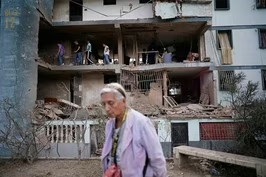
Venezuelans face uncertainty while awaiting next U.S. moves
Video has Closed Captions
Clip: 1/4/2026 | 4m 30s | Venezuelans face uncertainty while awaiting Trump’s next moves with the country (4m 30s)
Providing Support for PBS.org
Learn Moreabout PBS online sponsorship
- News and Public Affairs

FRONTLINE is investigative journalism that questions, explains and changes our world.

- News and Public Affairs

Amanpour and Company features conversations with leaders and decision makers.












Support for PBS provided by:
Major corporate funding for the PBS News Hour is provided by BDO, BNSF, Consumer Cellular, American Cruise Lines, and Raymond James. Funding for the PBS NewsHour Weekend is provided by...