
Fossils: Fossil or Mummy?
Clip: Special | 1m 4sVideo has Closed Captions
Fossils trapped in amber have a fun alternative name: Mummy. Why?
Amber is an ancient sticky tree tar that holds a type of fossil called inclusions or mummies. Find out why this type of fossil is so special.
Problems playing video? | Closed Captioning Feedback
Problems playing video? | Closed Captioning Feedback
Science Trek is a local public television program presented by IdahoPTV
Major Funding by the Laura Moore Cunningham Foundation and the Idaho National Laboratory. Additional Funding by the Friends of Idaho Public Television and the Corporation for Public Broadcasting.
Fossils: Fossil or Mummy?
Clip: Special | 1m 4sVideo has Closed Captions
Amber is an ancient sticky tree tar that holds a type of fossil called inclusions or mummies. Find out why this type of fossil is so special.
Problems playing video? | Closed Captioning Feedback
How to Watch Science Trek
Science Trek is available to stream on pbs.org and the free PBS App, available on iPhone, Apple TV, Android TV, Android smartphones, Amazon Fire TV, Amazon Fire Tablet, Roku, Samsung Smart TV, and Vizio.
Science Trek
Science Trek is a place where parents, kids, and educators can watch short, educational videos on a variety of science topics. Every Monday Science Trek releases a new video that introduces children to math, science, technology, engineering, and math (STEM) career potentials in a fun, informative way.[MUSIC] Joan Cartan-Hansen, Host: Why is something stuck in amber considered to be a fossil?
Well, first you have to know what amber is.
Amber is a sticky resin produced by trees.
Living things get trapped in the amber.
Then, over millions of years, the amber hardens with the things inside preserved intact.
These trapped things are called inclusions.
They're also called mummies because they were preserved as they were initially.
That's different than traditional fossils.
In regular fossils, the living parts of the remains are replaced over time by minerals.
More than a thousand extinct species have been preserved in amber.
Things like plant leaves, bugs, even a 99-million-year-old dinosaur tail with feathers.
So, these inclusions are still considered to be fossils.
Amber has one other claim in the scientific world.
The Greek word for amber is elektron.
Ancient Greeks discovered that if you rub amber against a cloth, it produces sparks.
That force was given the name electricity.
For more information about fossils, check out the science trek website.
You'll find it at science trek dot org.
 New
NewVideo has Closed Captions
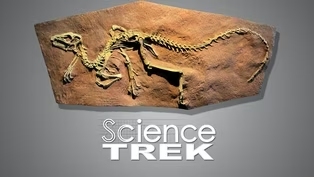
Clip: Special | 1m 4s | Find out more about Body Fossils and Trace Fossils. (1m 4s)
Providing Support for PBS.org
Learn Moreabout PBS online sponsorship
- Science and Nature

Explore scientific discoveries on television's most acclaimed science documentary series.

- Science and Nature

Capturing the splendor of the natural world, from the African plains to the Antarctic ice.










Support for PBS provided by:
Science Trek is a local public television program presented by IdahoPTV
Major Funding by the Laura Moore Cunningham Foundation and the Idaho National Laboratory. Additional Funding by the Friends of Idaho Public Television and the Corporation for Public Broadcasting.