
Fossils: Body Parts and Poop
Clip: Special | 1m 4sVideo has Closed Captions
Find out more about Body Fossils and Trace Fossils.
Fossils can be categorized in two basic types: body fossils and trace fossils. Body fossils help scientists learn what plants and animals looked like. Trace fossils are clues left behind.
Problems playing video? | Closed Captioning Feedback
Problems playing video? | Closed Captioning Feedback
Science Trek is a local public television program presented by IdahoPTV
Major Funding by the Laura Moore Cunningham Foundation and the Idaho National Laboratory. Additional Funding by the Friends of Idaho Public Television and the Corporation for Public Broadcasting.
Fossils: Body Parts and Poop
Clip: Special | 1m 4sVideo has Closed Captions
Fossils can be categorized in two basic types: body fossils and trace fossils. Body fossils help scientists learn what plants and animals looked like. Trace fossils are clues left behind.
Problems playing video? | Closed Captioning Feedback
How to Watch Science Trek
Science Trek is available to stream on pbs.org and the free PBS App, available on iPhone, Apple TV, Android TV, Android smartphones, Amazon Fire TV, Amazon Fire Tablet, Roku, Samsung Smart TV, and Vizio.
Science Trek
Science Trek is a place where parents, kids, and educators can watch short, educational videos on a variety of science topics. Every Monday Science Trek releases a new video that introduces children to math, science, technology, engineering, and math (STEM) career potentials in a fun, informative way.[MUSIC] Joan Cartan-Hansen, Host: Did you know that there are two basic categories of fossils?
The first are called body fossils.
These are parts of a living thing's body, Like bones, teeth, shells or leaves.
Body fossils help scientists learn what ancient plants and animals looked like.
Usually, only the hardest parts of an animal survive, but paleontologists have found fossilized fur, feathers and skin.
Plant fossils can sometimes tell scientists more than animal fossils.
Plant fossils can give us a more complete picture of their ancient ecosystem.
That allows scientists to reconstruct the temperature and rainfall of different geologic times.
The second type of fossils are called trace fossils.
Trace fossils aren't body parts, They're clues left behind by living things, Like footprints, bite marks, even fossilized poop called coprolite.
Fossils, either body or trace help us learn more about our past.
For more information about fossils, check out the science trek website.
You'll find it at science trek dot org
 New
NewVideo has Closed Captions
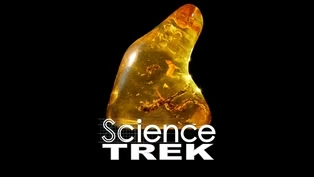
Clip: Special | 1m 4s | Fossils trapped in amber have a fun alternative name: Mummy. Why? (1m 4s)
Providing Support for PBS.org
Learn Moreabout PBS online sponsorship
- Science and Nature

Explore scientific discoveries on television's most acclaimed science documentary series.

- Science and Nature

Capturing the splendor of the natural world, from the African plains to the Antarctic ice.










Support for PBS provided by:
Science Trek is a local public television program presented by IdahoPTV
Major Funding by the Laura Moore Cunningham Foundation and the Idaho National Laboratory. Additional Funding by the Friends of Idaho Public Television and the Corporation for Public Broadcasting.