
McGurk chronicles talks to free Oct. 7 hostages in 'Brink'
Clip: 10/6/2026 | 8m 34sVideo has Closed Captions
Brett McGurk chronicles negotiations to free Oct. 7 hostages in 'Brink'
Brett McGurk served under four presidential administrations, ultimately working as President Biden’s lead on foreign policy in the Middle East. During that time, Hamas attacked Israel, killing over a thousand people and taking hundreds hostage. Amna Nawaz sat down with McGurk to discuss the negotiations he led to secure the hostages' release and new book, "Brink."
Problems playing video? | Closed Captioning Feedback
Problems playing video? | Closed Captioning Feedback
Major corporate funding for the PBS News Hour is provided by BDO, BNSF, Consumer Cellular, American Cruise Lines, and Raymond James. Funding for the PBS NewsHour Weekend is provided by...
McGurk chronicles talks to free Oct. 7 hostages in 'Brink'
Clip: 10/6/2026 | 8m 34sVideo has Closed Captions
Brett McGurk served under four presidential administrations, ultimately working as President Biden’s lead on foreign policy in the Middle East. During that time, Hamas attacked Israel, killing over a thousand people and taking hundreds hostage. Amna Nawaz sat down with McGurk to discuss the negotiations he led to secure the hostages' release and new book, "Brink."
Problems playing video? | Closed Captioning Feedback
Where to Watch PBS News Hour
PBS News Hour is available to stream on pbs.org and the PBS app.
Providing Support for PBS.org
Learn Moreabout PBS online sponsorshipGEOFF BENNETT: Brett McGurk served under four presidential administrations, ultimately working as President Biden's lead on foreign policy in the Middle East.
During that time, the terrorist group Hamas attacked Israel, killing over 1,000 people and taking hundreds hostage, including several Americans.
McGurk chronicles the high-stakes negotiations he led to secure the hostages' release in his new book, "Brink: Inside the Race to Free the October 7th Hostages."
Amna Nawaz spoke with him recently.
AMNA NAWAZ: Brett McGurk, welcome to the "News Hour."
Thanks for being here.
BRETT MCGURK, Author: Thanks so much for having me.
AMNA NAWAZ: Most of your book focuses on efforts to secure the hostages after that October 7 Hamas attack.
That day in 2023, as you lay out, more than 1,000 Israelis killed, nearly 250 taken hostage, the largest mass hostage event in modern history, and you're in the room with President Biden and when others as he's speaking to those hostage families.
Many of them are frustrated and upset.
What do you remember about that?
What stands out to you?
BRETT MCGURK: Well, it was a few days after the attack.
He had a call with the families of American missing, and - - because we didn't know who was alive, who was dead.
It was very -- I describe it as this all comes together.
We see little jagged pieces as the whole picture comes together.
And parents, loved ones, like, wailing into the screen at the president to do something, to bring their loved ones home, and, in the middle of that call, because it's about three days into the crisis, one of the -- I remember one of the family members left the screen, came back, and she had learned that her loved one was killed.
And that call was scheduled on the president's calendar for half-hour or so.
It went on for I think almost an hour-and-a-half.
And it was after that he said to me, "Do whatever you can to get these guys home."
AMNA NAWAZ: You write specifically in the book, "Inside the Biden administration, this caught us completely by surprise," when you're talking about the October 7 attack.
You said: "We had no clear warnings, nor did the Israelis, from what they told us.
There'd been no advance warning of Hamas' attacks."
And I'm sure you have seen the reporting in recent weeks, right... AMNA NAWAZ: ... both from Haaretz and from The New York Times, that UAE's leader had gone to Netanyahu and said Hamas was planning a major attack.
Vivian Salama at "The Atlantic" reported that Egypt's intelligence chief days before October 7 went and told Netanyahu that Hamas appeared to be mobilizing for a major attack.
Were those reports the first time you learned about those meetings and what Netanyahu knew?
BRETT MCGURK: Yes, well, I know the Egyptian intelligence chief quite well.
He's a character in the book, Mohammed Bin Zayed, the president of UAE, I also know quite well.
So I was -- we were not aware of those meetings.
And we did not -- and we looked through all of our intelligence information.
We did not have a -- what you call a warning or indicator.
AMNA NAWAZ: You describe a near breaking point between President Biden and Prime Minister Netanyahu, which is the spring of 2024, and on a call with Netanyahu, Biden says: "Bibi, man, what the eff are you doing?"
What led him to that point?
BRETT MCGURK: Well, that was on April 4.
The president is just frustrated.
He's running for president now.
He's in his reelection.
The hostage talks have broken down, and I describe in the book why.
And we had a horrific Israeli drone strike, killed a number of aid workers with World Central Kitchen, Jose Andres' organization.
And Biden was just fed up.
We all want this to somehow stop.
But also on that call -- that's why it's so important -- and we had intelligence information that Iran was preparing to launch the largest ballistic missile attack almost in history.
At the same time, the frustration is boiling over because we can't find a way to get the hostages out.
And Biden is taking criticism from the right that we're not supporting Israel enough and putting enough pressure on Hamas and from the left that we're not restraining Israel enough.
And what he did in that call, which is very important, was, yes, he said that.
He also said to Netanyahu: "I'm going to help defend Israel from this Iranian attack.
I'm going to deploy military assets.
And after I help defend you, we're going to get a hostage deal on the table, bring this war to a close."
And as it played out, I think that was the right message at that time.
AMNA NAWAZ: But also on that call, you mention, at that time, that Biden threatened to cut off military aid... AMNA NAWAZ: ... that he said he would go so far.
And he did not.
You were among those arguing against it.
Why?
What do you think would have happened if he'd actually cut off military aid to Israel?
BRETT MCGURK: Well, I think the private -- the private messaging was very effective.
And President Biden used some more colorful language than that, that you just mentioned.
He did very selectively curtail munitions after this period.
AMNA NAWAZ: If there was a real threat to cut off military aid, could that have changed Israel's war conduct?
BRETT MCGURK: Well... AMNA NAWAZ: Could it have saved thousands of Palestinian lives?
At this point in the war, tens of thousands of Palestinians had been killed, over 30,000, by some estimates.
BRETT MCGURK: So how do you stop it?
That's right.
So how do you stop it?
This is what was the consuming question.
There's a complete disconnect between the view that we could have made a decision like that at that period at that time, and somehow the war would have stopped, lives would have been saved, hostages would have come home.
AMNA NAWAZ: You don't believe it would have had an impact?
BRETT MCGURK: No, and I think the record reflects that.
But I reflect in the book, if there was a shortcut, Biden would have taken it.
If there was a shortcut, Biden would have taken it.
We all would have taken it.
AMNA NAWAZ: You do get to a cease-fire and hostage release deal, one that you reach alongside president-elect Trump and his adviser Steve Witkoff.
I'm just curious because you have seen Steve Witkoff in his negotiating mode.
AMNA NAWAZ: He's now negotiating, trying to negotiate the end to two other conflicts.
What do you think he brought to the table as a negotiator, given his background and skill, and will he succeed in Iran and Russia's war in Ukraine?
BRETT MCGURK: At that moment, so many things in the region had changed.
So the table was set.
I thought, being so close to this, now's the time to push for a deal.
And I knew we could not push for a deal without having the incoming Trump administration working hand in glove with us, because the nature of a transition, as time goes by, the incumbent president who's leaving, the power just wanes.
I have felt this before.
So I called Jared Kushner after the election.
I eventually met Steve Witkoff.
And I just -- we described the situation, that we think we can stop this war and get the hostages home.
And Steve, I can't give the direct quote here because there's some colorful language, but he says: "I'm here to save lives.
Let's save lives."
And Steve and I worked hand in glove in those final weeks to close that deal.
AMNA NAWAZ: You document in the book how hard you worked to avoid a wider regional war, in addition to trying to get the hostages released and a cease-fire in Gaza.
Has this new war, U.S.
and Israeli war in Iran, has that undone that ability to stop a regional war?
BRETT MCGURK: I think, if you go through the book, and there's a number of moments in which we're debating the use of American military power in the middle of this broader regional crisis.
And President Biden was always very clear, the American people understand the use of American military power to protect American personnel, protect American interests.
They would not understand being dragged into a broader Middle East war.
And I think, in President Trump's term here, the campaign that began February of this year, I think, suffered from the same fatal flaws that I have seen in the past, with an infinite, unclear objective, which looked to be a regime change objective early on, and without articulating to the American people exactly what we're trying to do.
However, once you're engaged in this, there's always the bit of a trap.
How do you actually find your way out of it without getting drawn into another major military confrontation, tit for tat, which I think plays into Iran's hands?
We will see.
AMNA NAWAZ: The book is "Brink: Inside the Race to Free the October 7th Hostages."
The author is Brett McGurk.
Brett, thank you so much.
Good to see you.
BRETT MCGURK: Thank you so much for having me.
Thank you.
 New
NewAs Afghans try to flee Taliban, some are forced to return
Video has Closed Captions
As some Afghans escape the Taliban, other refugees are forced to return (10m 50s)
 New
NewDOJ ramps effort to prosecute non-citizens accused of voting
Video has Closed Captions
Examining the DOJ's effort to prosecute non-citizens accused of voting (4m 54s)
 New
NewFrench students lead massive protests across country
Video has Closed Captions
French students lead massive protests against education policies (2m 40s)
 New
NewHaitian's suicide shows human toll of immigration crackdown
Video has Closed Captions
Haitian student's suicide reveals human toll of immigration crackdown (6m 3s)
 New
NewHigh cost of GLP-1s push some to seek unregulated versions
Video has Closed Captions
High cost of GLP-1s drives some to seek cheaper, unregulated versions (8m 48s)
 New
NewNews Wrap: Yates to review Cornell sexual assault reports
Video has Closed Captions
News Wrap: Cornell says Sally Yates will review handling of sexual assault reports (6m 52s)
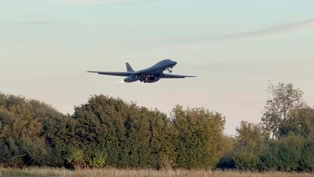 New
NewSuspected Iranian plot pushed U.S. to move bombers from UK
Video has Closed Captions
Suspected Iranian drone plot pushed U.S. to evacuate bombers from British air base (3m 12s)
Providing Support for PBS.org
Learn Moreabout PBS online sponsorship New Episode
- News and Public Affairs

Today's top journalists discuss Washington's current political events and public affairs.

- News and Public Affairs

FRONTLINE is investigative journalism that questions, explains and changes our world.
 New Season
 New Episode
 New Episode
 New Episode
 New Episode
 New Episode

 New Episode
 New Episode
Support for PBS provided by:
Major corporate funding for the PBS News Hour is provided by BDO, BNSF, Consumer Cellular, American Cruise Lines, and Raymond James. Funding for the PBS NewsHour Weekend is provided by...