
Washington Week with The Atlantic full episode, 8/14/26
8/14/2026 | 26m 46sVideo has Closed Captions
Full Washington Week with the Atlantic broadcast from August 14, 2026.
Full Washington Week with the Atlantic broadcast from August 14, 2026.
Problems playing video? | Closed Captioning Feedback
Problems playing video? | Closed Captioning Feedback
Major funding for “Washington Week with The Atlantic” is provided by Consumer Cellular, Otsuka, Kaiser Permanente, the Yuen Foundation, and the Corporation for Public Broadcasting.
Washington Week with The Atlantic full episode, 8/14/26
8/14/2026 | 26m 46sVideo has Closed Captions
Full Washington Week with the Atlantic broadcast from August 14, 2026.
Problems playing video? | Closed Captioning Feedback
Where to Watch Washington Week with The Atlantic
Washington Week with The Atlantic is available to stream on pbs.org and the PBS app.
Buy Now
10 big stories Washington Week covered
Washington Week came on the air February 23, 1967. In the 50 years that followed, we covered a lot of history-making events. Read up on 10 of the biggest stories Washington Week covered in its first 50 years.Providing Support for PBS.org
Learn Moreabout PBS online sponsorshipJeffrey Goldberg: Secretary of Defense Pete Hegseth said this week that the U.S.
could maintain a blockade of Iran indefinitely.
This suggests that President Trump is trapped in another forever war.
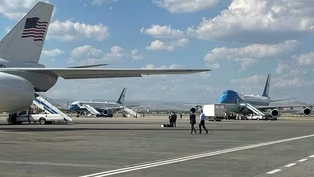
And as if Trump needed reminding that Iran now shadows his presidency, we learned this week that he had to be secretly moved, by catering truck no less, off of Air Force One, which was allegedly being targeted by Iranian agents.
While Trump was smuggled back into America, Air Force One, packed with staffers, military personnel, and reporters, was allowed to fly as a decoy, strange times, next.
Good evening, and welcome to Washington Week.
It's a strange story, certainly, this Air Force One business, though the Trump administration does manufacture plenty of strange storylines.
It's also a deadly serious story, one that raises questions not only about the dubious decision-making that led to this Air Force One caper, but about Iran's continued ability to wreak havoc on the U.S.
and its friends months after the president promised that the threat of the Islamic Republic would be neutralized.
Iran is a shadow over the White House and over the Republican Party.
Something that could help the Republicans out of their predicament, the Democratic Socialists of America.
I'll discuss this tonight with my guests, Elisabeth Bumiller, writer-at-large at The New York Times, Adam Harris is a staff writer at The Atlantic, and a co-host of the Radio Atlantic podcast, Dan Lamothe is a national security reporter for The Washington Post, and Liz Landers is the White House correspondent for PBS NewsHour.
Thank you, Liz, for doing double duty tonight.
We appreciate it.
Dan, let's start with you.
You broke the story.
Explain what happened on Air Force One and why it happened.
Dan Lamothe, National Security Reporter, The Washington Post: Yes.
Thank you for having me.
Just an extraordinary tip that I received, and, you know, just running it down.
I mean, the idea that President Trump, leaving a NATO summit with the -- you know, the world's eyes on him, moves -- tells the world that he's sending his new plane back to Britain, tells the world he's taking the old Air Force One instead.
Jeffrey Goldberg: The new plane being the one given to him by Qatar.
Dan Lamothe: Yes.
Jeffrey Goldberg: Yes.
Dan Lamothe: Only to learn that he took neither of those planes, and in fact, moved by catering truck secretly to the third, smaller plane, the C32, without telling anyone, and then not telling anyone for the next calendar month until we reported that story out.
Jeffrey Goldberg: Yes.
And why do they say they did it?
And who knew and who didn't know?
Dan Lamothe: Yes.
So, I mean, obviously there is legitimate concerns about the president's life.
Iran has made efforts in the past.
They received a tip from Israel saying that they thought the president's life was in danger that there could've been a threat on him or the aircraft.
So, that threat was assessed later to be not high confidence, but in the moment, without a lot of time to act, they chose to put this all in motion.
Jeffrey Goldberg: Right.
Liz, not unusual to protect the president, obviously, a worthy cause.
Not telling the people who got on Air Force One that they believed they had intelligence or the suspicion that Air Force One was going to be targeted, that's the truly unusual aspect of this story.
Liz Landers, White House Correspondent, PBS NewsHour: Right.
There were White House staffers aboard the plane that was apparently what was going to be targeted, also Secret Service.
There are also military officers on board that plane, too, and press as well.
And I think as a reporter, when you travel with the president, you have an expectation that he is a target at any given time.
But for the actual circumstances to be so real that the president is then moved off the plane, I don't think that that's something that most White House press are thinking about when they're traveling with him.
And, in fact, the White House Correspondence Association, this was reported by a number of media outlets, has apparently sat down with the White House press shop to have a conversation about the future of keeping the press corps that travels with the president safe and informed of where he is.
Jeffrey Goldberg: Yes, what would be the normal way of doing this?
Dan Lamothe: Decoys are not uncommon.
But typically it's a short duration thing where, from the outside world, you wouldn't necessarily be sure which plane he was on.
You know, a common example, when you watch the Marine Corps helicopters roll in with the president, they usually come in group of, groups of three.
From the ground, you can't really tell which one, and then at some point it becomes apparent.
Jeffrey Goldberg: Right.
Dan Lamothe: When they've done this overseas in the past, you know, one example that came up a lot this week was President Clinton in 2000 landing in Pakistan.
That was immediately apparent once he stepped out of the other aircraft.
And there was at least some amount of White House staffers and certainly a member of the White House press corps who had been briefed in advance, hey, we need to do this.
Here's why.
In this case, no one knew, outside of a very select amount of senior White House staff, Secret Service, and it was just kept quiet really from then on.
Jeffrey Goldberg: Right.
Elisabeth, you've supervised coverage of many White Houses, you've covered many White Houses.
What strikes you about this as -- what's the larger meaning of this very strange episode?
Elisabeth Bumiller, Writer at Large, The New York Times: Just the way the -- the civilians on the plane were potential sacrificial lambs, and that they were so unaware of it.
Our colleague, Peter Baker, wrote a great story this week about it.
He quoted Andrew Marlowe, who was the screenwriter for Air Force One, the 1997 thriller starring Harrison Ford.
In it, the president's plane is hijacked, and Marlowe told Peter that, you know, I don't think I could've written that as a -- you know, movies are not real life, but I don't think I could've written that into a movie because you want the president to be heroic, and that kind of action would not be perceived, he felt by an audience as a heroic action.
So, that was interesting.
And I would not have liked to have been on that plane and not been aware of the risk that I was taking.
Jeffrey Goldberg: If you were a member of the press corps, you would have gone on the plane had you known, or would you have said, wait a second, what's going on here?
Elisabeth Bumiller: I don't know.
I don't know.
I don't think I would've -- I would've thought long and hard about it.
Jeffrey Goldberg: Right.
What about you, Adam?
Just say yes.
Be heroic.
Adam Harris, Staff Writer, The Atlantic: I'll have to say yes.
I'll sacrifice.
But it is.
There's a -- having the knowledge of it as opposed to sort of being left in the dark about it, you're able to make an informed decision, right?
Jeffrey Goldberg: Right.
Adam Harris: And they were sort of told to close their window shades as opposed to actually even having the ability to know.
Jeffrey Goldberg: Dan, the real story here is transparency.
If you did not find this out, we would not be talking about this.
It's very odd to see this story just emerge a month later.
You've been dealing with the administration for some time.
Is this what you have come to expect in terms of transparency and accountability?
Dan Lamothe: Short answer is yes.
I mean, who knows how many things we don't know?
I would say when this tip was brought to me, initially, it sounded pretty surreal even for kind of current events.
So, it took a lot to kind of grow the confidence that, hey, we really had this right.
And the fact that we initially got a straight no comment and then the statement that kind of half explained, it was like, we got this.
Let's go.
Jeffrey Goldberg: Right.
The larger context of this is Iran and its shadow over American foreign policy, over this administration, even over the midterms, which we'll get to in a second.
I want you to listen, Elisabeth, to something that the president just said earlier today to get a sense of how he's ostensibly seeing this war.
Why don't we just listen?
Donald Trump, U.S.
President: Pretty soon, I'll be declaring the Hormuz Strait a territory of the United States.
Essentially, that's what it -- we have the blockade.
No ships get through unless we want them to.
Jeffrey Goldberg: So, this comes after the president said that his new approach to Iran, this week's new approach, would be to low-key it.
Not not entirely clear what that means.
It's been a while.
Elisabeth Bumiller: Six months.
Jeffrey Goldberg: Six months.
The Strait of Hormuz was opened before the war.
Now, he's talking about owning it.
Give us your sense right now of where this war is.
It seems as if the White House is desperate to tell the American people, and the American voter, we won.
You don't have to think about Iran anymore, and we're not going to think about Iran anymore.
Is that fair?
Elisabeth Bumiller: No, because I think that Iran -- you know, again, this is a little premature, but it reminds me of Jimmy Carter.
I think Iran wants this to keep going certainly through the midterms and potentially into 2028.
I mean, right now, I think what we've been seeing the last six months, I think we'll see more of, that Trump makes some statement, there seems to be some movement towards negotiations.
The stock market goes up, you know, and then the Iranians say, we're not negotiating, there's exchange of fire, and we're back at it.
That's what has been going on for six months.
I don't see how this changes.
And I don't - - I think Trump must've been trolling people when he said that he was going to annex the Strait of Hormuz.
That's -- Jeffrey Goldberg: Yes, I couldn't tell if he was joking or coming to a spontaneous policy realization.
Adam Harris: Yes.
I mean, you never really necessarily know with him.
But what you've seen from the administration in the last week, you have Scott Bessent saying that, you know, they're going to have economic sanctions unlike anything that we've seen before.
You have Pete Hegseth saying that they can keep the blockade going sort of indefinitely.
So, they're trying to project this confidence.
But at the same time, you have Republicans on Capitol Hill saying that, well, the enemy gets a vote, too, and when this war is over and when they say they're done with the fighting.
And I think that that is really starting to weigh on the administration, which has continuously tried to project confidence over the last six months, even as it's been quite clear that their control or lack thereof is the sort of central factor in this.
Jeffrey Goldberg: Dan, you're an expert on these sorts of things.
What are the chances that the blockade achieves Trump's goals?
I mean, the Navy is a powerful navy.
Possible?
Dan Lamothe: I mean, the blockade is causing pain.
I mean, there's a fair amount of reporting out there to that extent.
But I think the blockade also comes with an opportunity cost.
The longer you do this, the more strain you put on the U.S.
Navy, the sailors, the ships.
You know, the fact that you have nowhere to take a quick port stop, which is a problem for both the delivery of food, any kind of repairs, there's nothing easy about doing this blockade long-term.
Jeffrey Goldberg: Right.
Liz, let's go to that because you've been reporting on the situation with the aircraft carrier, the Abraham Lincoln.
You know, it's become a very big story.
Again, part of the possible miscalculation or series of miscalculations made by the U.S., Trump wanted a quick war, this is not a quick war.
Tell us what you're hearing about the situation on the Lincoln, and how it relates to what Dan is talking about right now in terms of long-term stress.
Liz Landers: Well, we spoke earlier today with the former chief of Naval Operations, Admiral Gary Roughead, who was explaining basically what Dan was saying, which is that part of the reason that the U.S.S Abraham Lincoln has been there for so long, and these sailors are so desperate, some of them, not all of them, there are 5,000 people on that boat, of course, but some of them are trying to go overboard there.
And he said that it's become a logistical problem because, typically, what happens is that these aircraft carriers can go to port, and some of these ports that they would typically go to, he pointed to Bahrain in the past had been a place that the U.S.
could go dock.
That's not accessible anymore because Iran has a stranglehold on these passageways.
So, he was saying that part of the blockade has created this own problem now that the U.S.
military is dealing with in a very acute way.
And I think that this news in particular this week about the USS Lincoln really has broken through.
And we've seen Secretary Hegseth was a bit, I would say, dismissive when he was asked about this on an official visit in Panama.
The president was too today.
It seems like Hegseth is kind of walking back those comments.
Jeffrey Goldberg: Yes.
Let's just listen to what the president said just earlier today actually.
Reporter: Has the deployment gone on too long?
Trump: No.
Reporter: Are you worried about the mental health concerns?
Trump: Not nearly long enough.
Jeffrey Goldberg: You cover the man.
That just seems like one of his sort of oppositional answers.
Liz Landers: Yes, it's kind of a throwaway comment for him, but it's already enraging, according to several news outlets that have spoken just in the last few hours with these family members of these men and women who are deployed on the ship, that they're already upset about these comments and it's insensitive, I think.
Jeffrey Goldberg: Right.
Elisabeth, you have a situation that they're describing in which the blockade is being enforced by Navy ships that can't go to the ports in the Gulf that are set up for American Navy ships to be repaired, resupplied, obviously R&R for sailors.
Again, it comes back to this idea that when they're sitting there in the Pentagon and choosing, or sitting in the White House and choosing to launch this latest round of attacks on Iran starting six months ago, that the second order, third order, fourth order consequences were not contemplated.
Elisabeth Bumiller: Well, as we know, the president thought this was going to be Venezuela, that he was going to do a massive bombing campaign and that Iran would say, give up and come to the negotiating table, and it was a total miscalculation as we have seen.
And it is the reason that previous presidents did not do what Donald Trump did, which because of the inevitable consequences of basically igniting a regional war in the Middle East, and closing the Strait of Hormuz, which was always any kind of battle top exercises always predicted that was to be the first thing the Iranians did.
Jeffrey Goldberg: Right.
Dan, one more question for you on this, and you cover the Pentagon.
Obviously, it's much harder to cover the Pentagon these days because they've sealed it off from members of the press, but, nevertheless, you seem to get a lot of good stories.
Are people inside the Pentagon talking about all of these miscalculations made by the White House?
What are you picking up on that?
Dan Lamothe: Yes.
I mean, I think, especially on the military side, the officer corps and so forth, there are folks who are thrilled with the amount of money they're looking to put into the military.
They see some benefit to the Trump administration and changes they've made.
But when it comes to thing like, how do you get into this war, how do you get out of this war, yes, there's growing frustration and concern, I think, on what this means long-term, how long does it take, how do you get out of this, and how do you prepare for the next thing?
Jeffrey Goldberg: Right.
Let me turn to domestic politics, although this also shadows domestic politics.
The Republicans don't have necessarily a lot going for them leading up to the midterms, but as is often the case, they can sort of wait and hope that the Democrats mess up.
One possible way the Democrats are messing up is by nominating people who come from the far left spectrum of the Democratic Party.
We saw this in Wisconsin, the apparent limits of DSA kind of politics when a seemingly popular candidate was defeated, a more mainstream Democrat came in.
Obviously, the Republicans in Wisconsin wanted the DSA -- wanted to run against a hard left DSA candidate.
We see this now in Michigan with the Democratic nominee being the preferred choice of the Republicans of Michigan.
That's a much closer race than what Wisconsin looked like.
Adam, is there a -- are we discovering this week the ceiling that the DSA has created for the Democrats?
Adam Harris: Well, I think it's hard to know for sure just based on this week, right, because Francesca Hong lost by about 4,000 votes in this race in which she did not run a single television ad.
Jeffrey Goldberg: She was the Wisconsin DSA insurgent.
Adam Harris: DSA insurgent candidate.
And meanwhile, right, you have several folks who've dropped out in recent weeks.
And so the polling that actually sort of reflected her at like a ceiling of around 39, 40 percent was effectively what she landed on.
There were about 34, 35 percent of undecided voters in that race, and they did they.
They went towards the more established candidate once he received the endorsement from Governor Evers.
But I think the, the thing that we are seeing out of this in part because if somebody had argued in 2015 that the Republicans were making a mistake by nominating Donald Trump as the far -- the further right candidate, right?
So, I think that there's a sort of we want to better understand what the middle wants but those polls are actually pulling American politics in a really strong direction.
And politics is not a science.
It can be studied as one, but the sort of electability argument is floundering in a lot of ways.
Jeffrey Goldberg: Did you just invent political science?
Adam Harris: You know, I tried.
I tried.
Jeffrey Goldberg: The -- no, but you make a -- you make a very obvious point for any reporter, which is this Trump asterisk on everything that will ever happen in American politics, which is, on the one hand, that doesn't make sense, on the other hand, Donald Trump has won the presidency twice.
So, all the rules are -- one question I have for you, you cover this very closely, the DSA is having trouble convincing blue collar, and not blue collar, black voters to come on board.
Adam Harris: That's -- I mean, historically you have a lot of Black voters who are, if not sort of, conservative in the most general sense but more traditional Democratic candidates, right?
There's this belief that a candidate needs to be proven.
There's -- if you think about Barack Obama, he benefited from winning Iowa.
And then you move towards South Carolina, it's like, well, he has shown that he can - - that white people will vote for him, right?
And so there, there has to be a belief that other people will vote for you.
And this has been kind of across campaigns, the ones that I've covered, where you have voters starting to talk like talking heads.
You interview them and they're like, well, I just don't know if this person is electable.
I don't know if they will vote for them.
Jeffrey Goldberg: We've all had that weird experience.
Adam Harris: Exactly.
And so when you hear it and when you see it, they're going into the polling booth sort of thinking about what everyone else is thinking as opposed to what they're thinking themselves.
Jeffrey Goldberg: Right.
One other problem, and to put a finer point on it, the party has developed something of a Hasan Piker problem.
This is a popular hard left Twitch streamer who has said that America deserved 9/11, that Jews are inbred.
He's praised Mao.
He's praised Houthi terrorists and so on.
Democrats are extremely worried about the presence of people like this who are no longer at the margin, who are creating, let's say, loads of new ads, if nothing else, for Republicans.
Elisabeth Bumiller: Yes.
No, it's a problem for Democrats.
There's no question, and it's been a problem for El-Sayed in Michigan, who was associated with him.
Jeffrey Goldberg: Right.
Elisabeth Bumiller: It's a big problem.
I do think, though, that in Wisconsin, it show - - it does -- at least in that state, it shows the limits of the Democratic socialists because Francesca Hong, as we all know, in the last weeks of the race, you know, earlier, you know, post media -- a social media post came out that she was, you know, opposed to Thanksgiving.
It was all about colonialism.
This did not help in Wisconsin.
And I think there, it was a bridge too far, even in Wisconsin for an ultra-liberal candidate.
Jeffrey Goldberg: It is a truism that really just don't attack Thanksgiving.
Elisabeth Bumiller: Yes, or Valentine's Day.
She was not big on that, either.
So -- Jeffrey Goldberg: I could see that one.
That I'm a little divided on.
Go ahead, Liz, last word to you.
Liz Landers: Can I just say too about what Adam was mentioning about just the appeal of the DSA, in general, and why people are looking at this?
I spoke with Jeff Weaver, who was the campaign manager for Bernie Sanders, America's best known Democratic socialist, and was asking Jeff what he thought of this race.
And he said, look, Francesca Hong wasn't that well known in Wisconsin, so that obviously played a factor, too.
But he also made the point to me that he said the Democrats are not fighting back against Trump enough, according to a lot of the party and the base, and Republicans are not doing anything at all.
So, he said that's why he thinks this moment is appealing, and DSA candidates are appealing to people who feel like they are politically unmoored.
Jeffrey Goldberg: Right.
Well, we are going to track this issue, among other issues, very closely, but we are going to have to leave it there for now.
I want to thank our guests for joining me, and thank you at home for watching us.
For a look at the Republican Party's evolution, please listen to Adam's interview with former Republican Senator Jeff Flake at Radio Atlantic.
I'm Jeffrey Goldberg.
Good night from Washington.
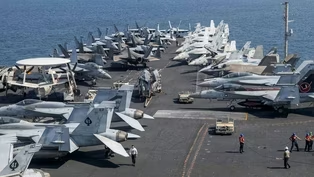
Carrier conditions become symbol of Iran war miscalculation
Video has Closed Captions
Poor conditions on U.S. carrier become symbol of Iran war miscalculation (10m 42s)
Providing Support for PBS.org
Learn Moreabout PBS online sponsorship New Episode
- News and Public Affairs

Top journalists deliver compelling original analysis of the hour's headlines.
 New Episode
- News and Public Affairs

FRONTLINE is investigative journalism that questions, explains and changes our world.

 New Episode
 New Episode
 New Episode


 New Episode
 New Episode

 New Episode
Support for PBS provided by:
Major funding for “Washington Week with The Atlantic” is provided by Consumer Cellular, Otsuka, Kaiser Permanente, the Yuen Foundation, and the Corporation for Public Broadcasting.