
August 14, 2026 - PBS News Hour full episode
8/14/2026 | 57m 46sVideo has Closed Captions
August 14, 2026 - PBS News Hour full episode
August 14, 2026 - PBS News Hour full episode
Problems playing video? | Closed Captioning Feedback
Problems playing video? | Closed Captioning Feedback
Major corporate funding for the PBS News Hour is provided by BDO, BNSF, Consumer Cellular, American Cruise Lines, and Raymond James. Funding for the PBS NewsHour Weekend is provided by...
August 14, 2026 - PBS News Hour full episode
8/14/2026 | 57m 46sVideo has Closed Captions
August 14, 2026 - PBS News Hour full episode
Problems playing video? | Closed Captioning Feedback
Where to Watch PBS News Hour
PBS News Hour is available to stream on pbs.org and the PBS app.
Providing Support for PBS.org
Learn Moreabout PBS online sponsorshipWILLIAM BRANGHAM: Good evening.
I'm William Brangham.
Amna Nawaz and Geoff Bennett are away.
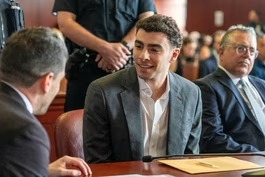
On the "News Hour" tonight: Luigi Mangione pleads guilty in the shooting death of the CEO of UnitedHealthcare.
The president dismisses concerns over the conditions on a long-deployed aircraft carrier, including reports that some of its sailors have tried to jump overboard.
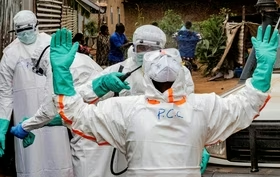
The death toll from Ebola rises in Congo as it threatens to become the disease's deadliest outbreak in history.
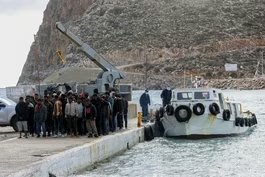
And as the debate over immigration divides Europe, Greece tries to stem the flow of migrants by sending them to other countries.
SPYROS OIKONOMOU, Greek Council For Refugees: What we see in practice is practically that the safeguards of the asylum process are increasingly demolished.
(BREAK) WILLIAM BRANGHAM: Welcome to the "News Hour."
In a surprise turn, Luigi Mangione pleaded guilty today in the shooting death of UnitedHealthcare CEO Brian Thompson.
Mangione admitted he stalked and shot Thompson in 2024 outside the Hilton Hotel in Manhattan.
He potentially faces life in prison.
The 28-year-old is also still facing murder charges for Thompson's death in New York state.
Our justice correspondent, Ali Rogin, is here with more.
Ali, so this is a somewhat surprised turn in this horrendous murder that got so much attention nationally.
Walk us through what happened in court today.
ALI ROGIN: William, we heard from Luigi Mangione today say for the first time in a short, but chilling statement -- quote -- "I shot Mr.
Thompson and he died.
I knew that what I was doing was illegal."
He expressed no contrition, no remorse.
And even though, William, there were no cameras in the courtroom, reporters in the room really conveyed this palpable sense of drama and tension.
The family of the late Brian Thompson was sitting in the front row, and they reportedly began crying as Mangione detailed some of the planning and execution of this crime.
WILLIAM BRANGHAM: There was so much evidence against Mangione, the video of the shooting, the weapon, his diary that laid out some of this plot.
But do we know, was that the principal reason why he made this plea?
What else did we learn?
ALI ROGIN: It may have been to avoid trial, but it was clearly also setting up, hopefully for him and his defense team, a cancellation of a state case that is also being -- proceeding at the same time.
He pleaded guilty today.
There were two counts of stalking resulting in the death of Brian Thompson.
But it wasn't a murder charge, because, in federal court, murder charges are very, very rare and specific.
But he is charged with murder in that second concurrent case, which is playing out on the state level in New York.
His defense has long maintained that these two cases proceeding at the same time represents double jeopardy, violating the constitutional protection against being tried twice for the same crime.
And New York's state law's double jeopardy restrictions are even stricter.
They say a defendant cannot be separately prosecuted for two offenses arising from the same action.
So, in this case, that would be the killing of Brian Thompson.
Mangione's defense argues that, now that he's pleaded guilty to the federal offense, he cannot under New York state law be prosecuted for state offenses arising from that state crime.
The state trial is scheduled to begin in early September, but, today, Mangione's defense filed a motion to have it dismissed.
WILLIAM BRANGHAM: Did we learn anything else about this notorious case?
ALI ROGIN: We did.
He detailed some of his planning leading up to the murder.
He said that he was motivated by years of back pain and what he believed was a health insurance system working against him.
He said that, once he learned that the UnitedHealthcare Company was holding an investor summit in Manhattan, he e-mailed company leadership posing as an investor to get information about where and when this meeting was taking place.
And that's how he was able to confront Brian Thompson.
Mangione also shared an observation with the judge that had clearly made an impression on him.
He talked about how, while he was posing as a wealthy investor, leadership e-mailed him back within an hour, and he said that was in stark contrast to his interactions with insurers as a patient.
WILLIAM BRANGHAM: Ali Rogin, thank you so much.
ALI ROGIN: You bet.
WILLIAM BRANGHAM: Now to our other top story, the conditions aboard the USS Abraham Lincoln, which is operating in the Middle East.
The aircraft carrier has been at sea since last November, which is beyond the normal six-month deployment.
Reports from sailors and their families describe appalling conditions, a lack of food and hygiene products, and declining mental health.
White House correspondent Liz Landers joins me now to break this down.
So, Liz, President Trump was asked about this, and he spoke about this today, and seemed almost dismissive of any of the concerns raised by family members about what's going on, on that ship.
What happened?
LIZ LANDERS: William, he was asked about this while he was on his way to New York earlier this afternoon for a law enforcement event, and a reporter asked about the conditions on the ship there, and this was his response on the tarmac here in Washington.
QUESTION: Family members of U.S.
service members are concerned about the conditions on board the USS Lincoln.
DONALD TRUMP, President of the United States: Well, no, that ship is moving.
No, they're not.
That ship is moving right now, or very shortly, and it's being replaced with another very similar ship.
QUESTION: Have the deployments gone on too long?
(CROSSTALK) DONALD TRUMP: No, no, no, not nearly long enough.
Thank you, everybody.
LIZ LANDERS: This was the first time we have heard President Trump react to these stories, which have really popped up and dominated the headlines in the last few days, William.
The defense secretary, Pete Hegseth, was also asked about this and was also rather dismissive of these claims when he was on an official trip yesterday in Panama.
PETE HEGSETH, U.S.
Defense Secretary: Completely misrepresented.
Listen, we make sure that every ship, every crew, every captain has everything we can provide them at every single moment.
Some deployments are longer than others, and I have more respect and gratitude for those sailors than anybody.
LIZ LANDERS: I will add that Secretary Hegseth posted a few hours ago on social media praising the American troops, including those on the USS Abraham Lincoln.
But, as you can imagine, William, there has been swift backlash to this, especially from lawmakers here in Washington reacting to the news.
Senator Richard Blumenthal of Connecticut wrote to Hegseth and the acting Navy secretary laying out some of his concerns, writing, in part -- quote -- "There have been widespread reports of shortages of basic supplies, water contamination, plumbing issues, deteriorating mental health, deck safety concerns, and disruptions in the mail system, which have caused many care packages en route to the ship to be lost in transit for months."
Blumenthal asked the military leadership in particular to explain what rotations were anticipated for this carrier strike group and other questions about how the military is assessing the mental health and readiness of the crew.
WILLIAM BRANGHAM: So, I mean, given all of these complaints that have surfaced, this seemed a fairly extraordinary response from the president.
I mean, do we have a sense as to what elicited that?
LIZ LANDERS: Well, we have seen several news outlets, in particular, military-focused news outlets, report on this in the last few days.
Military Times spoke with the wife of a Navy shipman on the USS Lincoln who tried to go overboard recently.
And this woman also described a separate incident of other shipmen attempting to jump overboard, but were stopped by other sailors.
Additionally, Stars and Stripes, another military publication, reported that family members of the sailors of the USS Lincoln pressed military leadership about the mental health concerns that they were hearing from their family members in a town hall recently in San Diego.
The publication says that one spouse told military leadership in this town hall that her husband didn't want to wake up anymore, and said that the military officials did not directly address those concerns, but said that there was mental health support and doctors on board those ships.
Now, the acting secretary of the Navy, Hung Cao, wrote in a statement this afternoon in part -- quote -- "Sailors and Marines are expected to dig deep, and they always do.
A leader's responsibility is to take care of their people the best they can while balancing mission requirements.
During this deployment, we have seen both.
The job is getting done, and our leaders are taking care of their people."
I will also say, William, that Cao did acknowledge in that statement that there have been several mental health cases that were treated with no loss of life.
And he also did acknowledge that there have been shortages of fresh food on that boat.
WILLIAM BRANGHAM: I mean, on that last point, though, this is a modern American military, extremely well-funded.
How is it that they are having trouble getting supplies to an aircraft carrier?
LIZ LANDERS: Well, one of our colleagues spoke earlier today with the former chief of Naval operations Admiral Gary Roughead, who said that the logistics involved in resupplying the ships in the Middle East right now is extremely challenging because the ports that the U.S.
typically would rely on for restocking and just going back on land for a period of time are not available because of the Iranian stranglehold in that area.
Listen to what he said.
ADM.
GARY ROUGHEAD (RET.
), Former Chief of U.S.
Naval Operations: For decades, we have had a logistics model in the Middle East that allowed our ships to be supplied and replenished and indeed even repaired in the ports on the Gulf, whether it was Jebel Ali for the larger ships or Bahrain.
And that has gone away.
I think it was assumed that we would be able to control the Gulf and the areas around it and the ports.
And that has proven not to be the case.
LIZ LANDERS: Roughead also explained that the Navy tries to limit these deployments on these carriers to six months.
And this is something that they have found over the years that anything longer weighs on the attitudes of the service members and also their families, understandably.
He said that there have been many times in the past where tours were extended past six months, like during the Iraq War.
But he said that what makes the situation with the Abraham Lincoln different is that, in the past cases, the Navy has had the logistical infrastructure to be able to support them over time there, which is something they're obviously lacking right now, William.
WILLIAM BRANGHAM: Liz Landers, thank you so much.
LIZ LANDERS: Of course.
WILLIAM BRANGHAM: We begin the day's other headlines across the Atlantic, where a heat wave driven in part by human-caused climate change is breaking records across Europe.
Today, Belgium hit its highest temperature this summer, baking fields along the Semois that are normally some of the greenest in the country.
Now they are scorched from a brutal drought.
The conditions pose a challenge for fire crews who are battling blazes across the continent.
Fast-spreading flames engulfed several homes in the U.K.
And in Croatia, authorities say one person was killed after an inferno ignited overnight.
SLAVKO TUCAKOVIC, Croatia Chief Fire Commander (through translator): It's a firestorm, ash, smoke and embers flying and burning everything in their path.
Unfortunately, a large number of houses were damaged.
A large number of vehicles burned on the road.
It will take many years for all of this to be restored.
WILLIAM BRANGHAM: Meanwhile, it's heating up here at home as well.
The National Weather Service warns that dangerous temperatures will last through the weekend.
Parts of the Southern Plains and Lower Mississippi Valley with humidity will feel as hot as 115 degrees Fahrenheit.
In Japan, record-breaking rainfall triggered flooding across several cities east of Tokyo, killing at least five people and stranding thousands more.
Stormwater cascaded through buildings and submerged cars and railway tracks.
With travel snarled, many people spent the night sleeping in airports and train stations.
Authorities say three months' worth of rain fell in just 12 hours.
Floodwaters receded somewhat today, but weather officials warned more rain is in the forecast.
And roughly 20 million Americans also remain under flood watches in parts of the Midwest.
A number of communities in Indiana, Illinois, and Ohio have been evacuated as floodwaters there only slowly start to recede.
Some parts of the Midwest have been drenched by heavy rains for six straight days.
There's similar concern for Americans out in the Pacific.
Hawaii is now preparing for significant rain and strong winds from Tropical Storm Lala, which is expected to strengthen into a hurricane as it approaches the island this weekend.
The National Hurricane Center has issued hurricane warnings for Hawaii's Big Island.
The storm could dump as much as 25 inches of rain across parts of that island, along with the threat of mudslides and rip currents.
Ukrainian officials say a wave of Russian drones overnight and today killed at least three people and left more than two dozen injured across the country.
Local authorities said one such strike on a home in Sumy region killed a mother and her 9-year-old son.
They are the latest attacks after the United Nations said July was the deadliest for Ukrainian civilians since 2022, when Russia's full invasion of Ukraine began.
Moscow has stepped up its bombardment in recent months, as Ukraine has also struck targets deeper inside Russia.
In Britain, far right Reform U.K.
Party leader Nigel Farage has regained his seat in Parliament after winning a special election that he triggered by quitting last month.
Farage, who is widely seen as a potential candidate for prime minister, defeated a slew of unorthodox candidates, including a political satirist who wears a trash can on his head.
Farage left the House of Commons last month after facing investigations over campaign finances and millions in undisclosed donations.
Farage said he would rather let the voters judge him than Parliament.
NIGEL FARAGE, Reform Party Leader: Because I wanted the people of Clacton, the voters of this constituency, to be my judge, not the mainstream media in Britain... (CHEERING) NIGEL FARAGE: ... and the political establishment, who paint us out to be criminals and bad people every day.
WILLIAM BRANGHAM: Farage will still face investigations into the gifts and donations he received.
The U.K.
's parliamentary watchdog today called the inquiries active once again.
Farage has denied all wrongdoing.
An American missionary who was kidnapped in West Africa back in October has now been released.
Kevin Rideout is in good health and in the care of U.S.
officials, according to his Christian mission organization.
He'd been working in Niger for 19 years.
President Trump celebrated Rideout's release on social media today.
No armed group has claimed responsibility for the abduction.
Historically, Niger has seen frequent attacks from armed groups with links to both al-Qaida and the Islamic State.
Authorities in Italy have recovered a trio of stolen artworks by Renoir, Cezanne and Matisse altogether worth millions.
Five people were detained for the robbery.
Back in March, a group of masked burglars broke into a private museum near Parma and in just three minutes stole the treasured paintings.
An investigation into that heist is ongoing.
This all follows another high-profile heist that saw some of the French crown jewels stolen from the Louvre in Paris last year.
Those stolen jewels have not been found.
And momentum slowed on Wall Street, ending the week with modest losses.
The Dow Jones industrial average slipped by 0.2 percent.
The Nasdaq fell nearly 0.3 percent.
And the S&P 500 edged back from its recent all-time high.
Still to come on the "News Hour": how Greece is trying to stem the flow of migrants onto its shores; and David Brooks and Kimberly Atkins Stohr weigh in on the week's political headlines.
The Ebola outbreak in the Democratic Republic of Congo continues to worsen, with the number of confirmed cases climbing to over 4,500.
Over 2,100 people have already been killed by the virus, a death toll that was reached almost three times faster than the outbreak over a decade ago.
As Ebola speeds through the Democratic Republic of Congo, even those who are still healthy are struggling.
CLAUDE STEVEN KATO, Motorcycle Taxi Manager (through translator): We used to carry two passengers on a motorcycle.
But, with the Ebola outbreak, the authorities are only allowing us to carry one passenger per motorcycle, which is having a huge impact on our finances.
We're barely making any money.
WILLIAM BRANGHAM: Sellers at this market in Bunia are trying to make a living, but the outbreak is impossible to ignore.
This is considered the fastest growing Ebola outbreak yet, reminding experts of the one more than a decade ago that killed over 11,000 people.
Director General of the World Health Organization Dr.
Tedros Adhanom Ghebreyesus continues to sound the alarm.
TEDROS ADHANOM GHEBREYESUS, Director General, World Health Organization: It's already the second biggest Ebola epidemic on record.
And it's moving faster than any previous Ebola outbreak.
At its current pace, it's on track to eclipse the West African Ebola outbreak of 2014 to 2016.
WILLIAM BRANGHAM: The rare Bundibugyo strain is what's driving this current outbreak.
There are currently no approved vaccines or therapeutics.
And this strain kills anywhere from a quarter to half of those who are infected.
Complicating all of this is a fragmented medical system, short of people and protective gear, but with ample amounts of fear and misinformation.
BIENVENU KAMBALE VAYILANDA, Director, Tokobika Medical and Surgical Center (through translator): We must continue to focus our awareness efforts on the outskirts of Bunia and on those within the city who are unable to accept the existence of Ebola and who are dying in the community until they come to accept that the disease is already here.
We must step up these awareness efforts so that everyone can receive care as soon as possible.
WILLIAM BRANGHAM: Some frontline health workers say they haven't been paid in three months, and they're walking off the job in protest.
CHADRACK RILEGO, Nurse, Elikya Ebola Treatment Center (through translator): Without the effort of nurses, doctors, and hygienists, there is nothing.
You can't defeat Ebola.
They are fighting this with someone you don't even acknowledge.
We put our lives in danger, even our families as well, because, if I am hit by the epidemic, I go home.
My wife, my children, my parents would also be infected.
WILLIAM BRANGHAM: The United Nations says, on top of it all, ongoing violence over Congo's lucrative minerals between Rwandan-backed groups and the Congolese military prevents those who need medical care from getting to it.
FARHAN HAQ, United Nations Deputy Spokesman: The World Health Organization reports that between 60 and 70 percent of Ebola-related deaths occur in communities, with many patients reaching health facilities too late or unable to access care in time.
We, along with our partners, continue to support the response, but our work is hindered by insecurity.
We reiterate our call on all parties to the conflict to protect civilians and facilitate safe and sustained humanitarian access to communities impacted by both violence and the outbreak.
WILLIAM BRANGHAM: Yesterday, the head of the African CDC said the outbreak had now spread to a new province.
For more on this crisis, we turn to epidemiologist Anne Rimoin.
Among her other work, she's led decades of work on Ebola in the Democratic Republic of Congo.
She's the director of the Center for Global Health Security at the University of California, Los Angeles.
Anne, thank you so much for being here.
It seems like we have got exponential growth of cases in the DRC right now.
What is your reading, your best sense of how things are going on the ground right now?
DR.
ANNE RIMOIN, UCLA Epidemiologist: Well you have an outbreak that's occurring on top of already a series of emergencies in a place like the DRC.
You have conflict, you have poor health care infrastructure, you have poor infrastructure in general, and so it's not surprising to see that this outbreak is continuing to spiral out of control, given all of the things that are happening at the same time.
WILLIAM BRANGHAM: I mentioned a few of the challenges in that tape piece, but, from your perspective, what are the biggest challenges to getting our arms around this outbreak?
DR.
ANNE RIMOIN: Well, I could give you an entire list of challenges, but I will focus on a few of them.
The first one, I would say, is that just like the nurse in your reel just said, the health care workers are the cornerstone of this outbreak response.
And if they are not being supported, if they don't have the equipment that they need to protect themselves, it's going to be a major problem.
You cannot expect people to be putting themselves constantly in danger without the support they need.
Another problem that you have is diagnostics.
This is a different species of Ebola.
And, as a result, the tests have not been as readily available.
You know, we have been prepared for another Ebola Zaire outbreak, the strain that has been responsible for the vast majority of Ebola outbreaks, but this is Bundibugyo.
It's different, and the tests have not worked.
So being able to roll out new tests has very been very important.
You have to identify people who are actually sick with Ebola, and then you have to be able to isolate them, treat them, and find the contacts.
That brings me to the next thing.
Contact tracing means you have to have good surveillance infrastructure, and you also have to have trust of the community.
And all of these things are very complicated.
And all of these things together just bring what I have been saying from the beginning.
It's an emergency on top of emergency in a very complex situation.
WILLIAM BRANGHAM: I want to loop back to one of the things that you mentioned here, which is the work force, the medical work force.
I was reading the WHO's dispatch most recently about this, and noting how many health workers themselves are getting sick.
Is that -- in your sense, is that because how contagious this strain is?
Is that a function of training?
Is that a function of access to protective equipment?
What is that?
DR.
ANNE RIMOIN: I think it's a number of things.
First and foremost, health care workers are the ones that are right there on the front line.
They're doing all of the things that put people at greatest risk of exposure of Ebola, which is primarily spread through close contact with bodily fluids, like vomit and urine and all of the bodily fluids that exist.
So that's number one.
They are right in the line of fire.
Second of all, protective equipment is not as readily available as it should be.
And, third, people come in with a wide variety of symptoms.
And so if you don't know that somebody has Ebola, it's very hard to know exactly how you're supposed to protect yourself.
And so because there's such a wide range of symptoms that can be from mild to very acute, at this point, everybody has to be treated like a suspected Ebola case.
WILLIAM BRANGHAM: The WHO also reported that the outbreak seemed to have started back in February, not, as it was officially declared an outbreak, in May.
Do you have a sense as to why that gap occurred?
And does that gap also mean this is partly why we have had such a hard time controlling it?
DR.
ANNE RIMOIN: Ebola is something that can mimic other things.
And so you need good surveillance, but you also need really good diagnostic tests.
And the tests that were available were, again, these tests that were targeting Ebola Zaire, not Ebola Bundibugyo.
And, in fact, there had been several people tested for Ebola in the local laboratories using the Ebola Zaire test.
And it wasn't until it was -- those samples were actually brought to another laboratory in Kinshasa, where they actually had the assay that could detect Ebola Bundibugyo, that we -- they where they were able to determine what it was.
So there was this huge lag in time in terms of being able to detect what it was.
And, with Ebola, you have got to get in front of it.
And the longer that this virus has to spread, the more transmission chains you are going to have to be tracking down.
So Ebola spreads exponentially, and if you're not in front of it right away, you're going to be exactly where we can expect to be right now, chasing behind so many different chains.
WILLIAM BRANGHAM: Anne Rimoin, always great to hear from you.
Thank you so much for being here.
DR.
ANNE RIMOIN: It's my pleasure.
Thanks for having me.
WILLIAM BRANGHAM: Five European Union countries have made a breakthrough in their efforts to deport illegal migrants crossing the Mediterranean Sea.
Uganda in East Africa has agreed to accept them, although the deal has yet to be signed.
And now, 11 years into the migration crisis there, Greece is trying to stop boats crossing from North Africa to the Greek island of Crete.
From Athens, special correspondent Malcolm Brabant reports.
MALCOLM BRABANT: Accompanied by stirring soundtracks, videos of young men crossing the Mediterranean from Libya to Crete are inundating social media.
Most don't mention the perils of the 200-mile-long journey, which has claimed an estimated 250 lives this year.
Instead, they post self-congratulatory messages and thank God for safe deliverance.
MAN: We are going in, man.
It was a hard struggle from Libya, man.
It wasn't easy to make it, man.
But that's what we are doing right now.
We are going direct to Europe, man.
MALCOLM BRABANT: We showed some of these reels to Dimitris Kairidis, Greece's former migration minister and parliamentary spokesman for the governing center-right party.
His verdict?
Propaganda.
DIMITRIS KAIRIDIS, Parliamentary Spokesperson, New Democracy Party: It's basically first and foremost the smugglers themselves who advertise through social media in all the countries: Come here.
It works.
And then there are enemies of Europe.
So think, who wants disuniting Europe?
And there is nothing more flammable, nothing more explosive than migration.
This is the fight of my generation.
MALCOLM BRABANT: The E.U.
wants social media companies to take down misleading videos which encourage illegal migration.
These reels frequently show triumphant young men swiping fingers beneath their noses, a sign of machismo and possibly gang affiliation, according to Greek Coast Guards.
But not everyone who makes it to Greece is full of bravado.
SAM MOCHAR, Refugee From South Sudan: For me, it was -- it's a long journey, because, when we was in the sea, like, in a minute, you can die.
You could lose your soul.
But you pray sometimes and say, God, if you want to take my soul, please take it peacefully.
MALCOLM BRABANT: Sam Mochar was granted political asylum in Greece after escaping civil strife in South Sudan.
And now he works in an Athenian hotel.
SAM MOCHAR: There's a lot of war there.
And it's a good choice to cross the sea to come here, because, if you are there, you're going to die.
MALCOLM BRABANT: Eleven years after Europe's migration crisis began, the boats are still coming, albeit in smaller numbers.
The E.U.
has yet to come up with a suitable deterrent to keep the boats at bay.
But Greece believes that it can succeed by sending illegal migrants back to third countries, into camps, where asylum claims can be processed.
According to officials here in Athens, Greece, Germany, Austria, Denmark, and the Netherlands have persuaded Uganda to accept deportees.
If a final deal is signed, the first irregular migrants could be sent to East Africa next year.
Proclaiming their Muslim faith en route to Crete, these men mostly appear to be South Asian from countries like Pakistan and Bangladesh.
As far as the Greek government is concerned, they are economic migrants and prime candidates for deportation.
DIMITRIS KAIRIDIS: The operating world here is returns, returns, returns, returns.
We are anti-illegal.
And there is nothing more distractive, politically distractive, than the spectacle of a boat coming to a Greek beach.
The picture of a boat is totally destabilizing and disorienting for Greek citizens, European citizens.
SPYROS OIKONOMOU, Greek Council For Refugees: What we see in practice is practically that the safeguards of the asylum process are increasingly demolished.
MALCOLM BRABANT: Spyros Oikonomou is spokesman for the Greek Refugee Council, and he accuses the Athens government of copying America's example.
SPYROS OIKONOMOU: I would say that President Trump's policies have been probably an inspiration for various governments, including the European Union.
When you have people being beaten at the borders, stripped of their belongings, and pushed back illegally to other countries, I wouldn't say this is a suitable policy.
For starters, it's not respectful of fundamental rights.
It's not respectful of the rule of law.
And I don't think it's respectful of European values.
MALCOLM BRABANT: Pushbacks are where migrants are forced back across international borders before they can apply for asylum.
Almost all the alleged incidents have taken place in the Aegean Sea, where Greek islands nestle against the Turkish coast.
This silent video posted on July 6 on the Turkish Coast Guard's pushback Web page purportedly shows eight would-be asylum seekers floating in the Aegean Sea in a life raft without an engine.
The implication is that the Greeks set them adrift to float back to Turkish territorial waters.
DIMITRIS KAIRIDIS: If they have not crossed into Greek territorial waters, there is cooperation with the Turkish Coast Guard to be apprehended and to be returned to the Turkish coast.
MALCOLM BRABANT: But Spyros Oikonomou says the Greek government's action undermines the nation's reputation as a rule-based democracy.
SPYROS OIKONOMOU: No one says that borders should not be controlled.
No one says that people that do not have a right to asylum should not be returned.
But all of this should be done based on our legal culture and the legal framework that is in place, not based on policies that try to flagrantly violate these obligations and rights.
MALCOLM BRABANT: While Greece's government acknowledges its hostility towards irregular migrants, it accepts the need for legal immigration; 170,000 people were granted asylum in the period 2020 to 2025.
The Greeks approved the asylum request of Ayesha Kamara from Sierra Leone and the mother of 2-year-old Christian.
She now finds herself homeless.
AYESHA KAMARA, Refugee From Sierra Leone: They forced me on early marriage.
Because I refused on that one, that early marriage, they suppressed me and my stepdad raped me.
MALCOLM BRABANT: Christian is the product of the rape by Ayesha's stepfather.
AYESHA KAMARA: Greece has treated me fine because, I came, they gave me documents.
So they offer me documents.
I really appreciate that one.
They treat me well, just because of this situation, and I know this is just the beginning.
As time goes on, I know things will be much better, because I'm just from the camp now.
I don't expect everything will go easy like this.
But, really, I want to stay in Greece.
SAM MOCHAR: For me, I'm staying in Greece.
I'm happy in Greece here, but if I got a chance to go back to home and try to motivate the family and people that are doing the work there, it will be better.
But anyplace I got peace and can eat, I'm there.
MALCOLM BRABANT: Greece may be convinced that large-scale deportations will dissuade would-be migrants from setting sail, but the history of the migration crisis shows that, if one route is blocked, another opens up.
Such is the determination of the poor, the disadvantaged and the persecuted.
For the "PBS News Hour," I'm Malcolm Brabant in Athens.
WILLIAM BRANGHAM: To discuss the major upset in Wisconsin's Democratic primary this week, as well as the stalemate between the U.S.
and Iran, and more, we turn to Brooks and Atkins Stohr.
That's "The Atlantic"'s David Brooks and Kimberly Atkins Stohr of The Boston Globe.
Jonathan Capehart is away.
Happy Friday.
Welcome to you both.
KIMBERLY ATKINS STOHR, The Boston Globe: Hi.
Thanks.
WILLIAM BRANGHAM: David, let's talk a little bit about what happened in Wisconsin.
The Democratic primary for governor there had this big upset, where David Crowley went into this race, in this election looking like he was going to get trounced.
And he ekes out a win over Democratic Socialist Francesca Hong.
Was this simply your sense that voters simply thought Hong is not a great candidate to run statewide, or was something else afoot?
DAVID BROOKS: It's worth mentioning David Crowley dropped out of the race like a month ago.
WILLIAM BRANGHAM: Right.
DAVID BROOKS: He only reentered it a month ago.
WILLIAM BRANGHAM: Right.
DAVID BROOKS: So never give up, kids.
(LAUGHTER) DAVID BROOKS: I -- people are saying, is this the end of the DSA moment?
WILLIAM BRANGHAM: Democratic Socialists of America.
DAVID BROOKS: The Democratic Socialists of America moment, the leftward surge.
I think probably not.
I think Francesca Hong was a uniquely bad candidate, not only because of some positions she had that would be considered extreme by people like me, but because of all the personal stuff, all the stuff that was on Twitter during the woke era, and attacking Thanksgiving.
She had a thing for holidays.
Valentine's Day, she was against it, one after another, and they were bizarre, sometimes bizarre positions.
And then when she was asked during the campaign, she looked terrible on TV on those big TV interviews.
And she couldn't just say, I have changed my mind, which is what she should have said.
What Mamdani has said, that's what you should say.
And so I don't think this is a big indictment of the socialists, though I wish it was.
I think she was just a uniquely bad candidate that caused this polling collapse at the end.
WILLIAM BRANGHAM: I mean, Kimberly, the Republicans clearly relished the idea of running against Hong, and now they don't have that as a as a foil in this election.
Again, do you think this is just pragmatism on their part, or, as Alexandria Ocasio-Cortez, one of the more famous of the socialists, Democratic socialists out there, recently said, the woke point 1.0 era is over, and I'm glad for it?
KIMBERLY ATKINS STOHR: Yes, so I think a couple things are at play here.
I agree with you that candidates matter, and you have to have a good candidate running, and that will trump anything in a race.
I also think that gubernatorial races are precise things, that you can't always draw national implications out of them.
I mean, a state like Massachusetts for many, many years had the -- blue as the sky, but loved elect Republican governors because they like those checks and balances.
So they do like different ideologies for different positions.
I don't think that you can extrapolate on congressional races, for example, there.
But I also think in terms of is woke 2.0 better than woke 1.0, I think what we are seeing and what voters are responding to are candidates that respond to the needs of the moment.
2020, there were different needs.
We were in a pandemic.
We were locked down.
We were seeing police brutality right before us.
We were seeing the Trump administration completely fall apart, and there was a different urgency there.
Right now, the biggest urgency is economic.
And you are seeing people who are excelling where they can make voters understand, look, I understand that affordability is an issue for you, that housing affordability, that gas prices are rising, and I want to get into office to work for you.
That message seems to be just on fire at this moment.
And it's something that Republicans are having a really difficult time responding to.
WILLIAM BRANGHAM: David, do you think that that's right, I mean, that, one, that it's all about where you are trying to run?
Like, Mamdani is not going to win an election in Iowa.
But do you believe what AOC was saying, that that era is over, as Kimberly is saying, and that the Democrats are responding to the moment appropriately?
DAVID BROOKS: Well, I agree with her when she said it was crazy.
I think it was a crazy period to live through.
I think many, many hundreds of people lost their jobs because they said something that was supposedly offensive or had a thought that was supposedly offensive.
The range of public debate, especially on college campuses, was permanently chilled.
We're still living with the effects of that, because students have, 70 or 80 percent, say, I don't feel I can say what I believe in public.
And, third, it elected Donald Trump.
I mean, his devastating ad in 2024 was he's for you, she's for they/them.
WILLIAM BRANGHAM: This was the trans issue.
DAVID BROOKS: Yes.
And it was an ad that - - a line that summarized the whole woke period and showed how some Democrats, especially privileged Democrats at highly competitive colleges, were way out of touch with America.
The period has slowed down, so people are much more free to have conversations which they were not four years ago.
And the focus has shifted to economics.
But the DSA still comes with some pretty extreme views.
Should we eliminate the prison system?
Should we completely open the borders?
These are somewhat views that I don't think you could get elected, but a lot of people are willing to look past them in order to get the angriest Democrat who's out there, and those tend to be the DSA people.
WILLIAM BRANGHAM: I mean, Kimberly, the -- some Democratic critics of the president say that, yes, the Republicans do like to fetish the woke era, but they argue you also have a Republican Party that is in virtual lockstep with Donald Trump.
And what they argue is his very open war on all of the democratic norms of our society, and that that is a much bigger liability.
Do you think that that's true?
KIMBERLY ATKINS STOHR: I think multiple things can be true at once.
That's certainly a big liability.
People -- Donald Trump's approval ratings on all the things he ran on, affordability, two to three down in the polls.
Immigration, more than half of Americans are disagreeing with his policies and the way that immigration policy is going.
So you have that.
But at the same time, to push back against your point about how what a disaster woke 1.0 was, we are seeing the results of what people were talking about then.
We are seeing a work force where the federal work force is -- was decimated, including Black women disproportionately hit.
You are seeing Republicans vilify trans people and LGBTQ people with zest and zeal.
You are seeing DEI, whatever they call DEI, being eliminated in a way that even the president is putting up signs on Smithsonian saying that it's a lie if it talks about the plight of Black or brown Americans, which is factual.
You're seeing such a backlash against all of those things, which is in part because Democrats were walking away from it.
I think Democrats have to build a big tent that focuses on all of the things that are happening as a result of the Trump administration, both economically and otherwise.
And I think that's what Democrats are trying to do at this point.
They need a big tent.
They need to make the big case to Americans that you can -- if you want to keep with all of -- everything that's going on, keep voting Republican.
If you want that to end, give someone else a shot.
DAVID BROOKS: Just one quick thing.
I think we lived through the era of what we will call neoliberalism, Clinton, Obama, Bush.
That may have died, much as I would lament that fact.
But it's been replaced by two successor ideologies, one on the left, which Ibram Kendi, Robin DiAngelo, one on the right, which is MAGA.
I think both those successor ideologies are now in the process of cracking up.
And the question would becomes, what's next?
How -- is there a new moderate?
Is there something else, something?
One has a sense of a succession of belief systems that we're now on the end of.
And I wish I knew what came next.
WILLIAM BRANGHAM: I'd like to pivot to Iran just because it seems -- I know we keep talking about it here on Fridays, but that war does now seem to be in this incredible stalemate, where you have the richest, most powerful military on the planet has been forced into a stalemate by what was already an economically struggling smaller nation.
How do you see this unfolding, Kimberly?
KIMBERLY ATKINS STOHR: Yes, it's a disaster, not only for Americans in the pocketbooks that -- being hit in the pocketbook every time they go get gas, but also for our military.
We have depleted our military arsenal.
You have reports about sailors on the USS Abraham Lincoln who are -- the morale is so low, there are reported suicide attempts on it happening on it.
And you have family members of those folks who are absolutely gutted and terrified.
And you have the president today just dismissing those concerns.
It's beyond a political problem.
It's a massive problem.
I don't feel safer knowing that Iran no longer fears what the U.S.
president says, and they can ignore it, as they have been.
WILLIAM BRANGHAM: I mean, the president today -- again, there have been reports that he's going to say, I'm going to declare victory with the Strait of Hormuz and back out.
Today, he said maybe I will just declare that the Strait of Hormuz is a piece of American territory.
Obviously, it is a piece of another nation's territory.
DAVID BROOKS: Or no nation's territory.
WILLIAM BRANGHAM: How do -- do you think that Trump could actually just -- quote, unquote -- "declare victory" and get out of this?
DAVID BROOKS: Yes, it's -- tell that to a guy driving an oil tanker.
He can say whatever he wants, but the raw facts are there was like 130 tankers going through the strait every day before the war.
And now that's down to, what, a dozen or so.
So it's -- you just can't argue with reality.
WILLIAM BRANGHAM: As much as he tries.
DAVID BROOKS: And it's -- the whole battlefield has shifted against us.
The U.S.
forces, in order to keep the strait open, has to protect everything all the time.
All Iran has to do is send a drone into one tanker, and no company's going to want to risk their tankers.
And so it's all on the -- all the advantage is on their side, and I don't see this ending any time soon.
Finally, I have been reminded this week, two days before Russia invaded Ukraine, I went to the Pentagon, had a senior briefing from a senior figure there, and they said Ukraine's going to lose in five days.
Their military is just weak.
Well, we have lived through the 21st century, where the U.S.
military, the strongest in the world, has become enemies with a lot of much smaller and weaker militaries, and we have lost every time.
So that suggests we're in a different period as we think about military strength.
And the Iranians have certainly mastered asymmetric warfare, so we're running out of all our supplies, and we're feeling the domestic effects that Kimberly talked about.
And as I said on this program before, I really think this is going to go on and on and on and on, because nobody -- Iran has no incentive to let the straits go.
WILLIAM BRANGHAM: David Brooks, Kimberly Atkins Stohr, so nice to see you both.
Thank you.
DAVID BROOKS: Thank you.
KIMBERLY ATKINS STOHR: Thanks for having us.
WILLIAM BRANGHAM: We will be back shortly.
But, first, please take a moment to hear from your local PBS station.
It's a chance to offer your support, which helps keep programs like the "News Hour" on the air.
For those staying with us, we take a second look at how therapists in Boston have found a unique way to reach people who are trying to overcome trauma.
Senior arts correspondent Jeffrey Brown reports on one group using music therapy.
This story is part of our ongoing coverage of the intersection of health and arts for our Canvas series.
(SINGING) JEFFREY BROWN: The morning sing-along at the Greater Boston Chinatown Golden Age Center, popular Chinese songs mostly from the 1960s to '80s, formative years for the participants, older immigrants, now retired, most with little to no English, in many cases without family nearby.
Time for fun and, says Ming Yuan Low, an important form of therapy.
MING YUAN LOW, Assistant Professor, Berklee College of Music: There's a lot of value to Western medicine, but there's also the arts that brings us life.
What is life when you are living to 100 years old, but without enjoyment or without connection to one another?
That's also a form of health.
So, in that way, yes, music therapy can provide health.
JEFFREY BROWN: Low is a music therapist and assistant professor at Boston's Berklee College of Music, known for educating and training top musicians, but also for 30 years for offering a different kind of training for a growing profession that uses music to address physical, emotional, cognitive and other forms of health through a variety of clinical techniques, for this population, Low says, reaching people in unexpected ways.
MING YUAN LOW: Using music in a way to guide our conversations towards things that they don't usually talk about.
JEFFREY BROWN: And you find that that works?
MING YUAN LOW: That works very well because the music experience helps lower their defenses.
They don't know that they're actually processing their past experiences and actually sharing those similar experiences with one another.
They assume that each other has that, but they don't name it.
Music therapy is a chance for them to name it.
JEFFREY BROWN: The Chinatown Golden Age Center, founded in 1972 and now comprising three locations, offers a wide variety of services to Chinese elders, including legal aid, food banks and exercise classes at a drop-in center.
Health services, including mental health, are another big area, especially for an aging population of people who often find themselves linguistically and culturally isolated and alienated and for whom there remains a large stigma to expressing their feelings.
Megan Cheung is the center's associate director and herself a licensed social worker and nurse.
MEGAN CHEUNG: We see a lot of anxiety disorder.
We see a lot of depression.
For Asian American, we don't tell you that we are depressed.
We only physically exhibit some of the symptoms.
JEFFREY BROWN: Ninety-three-year-old Situ Pin comes to the Golden Age Center every weekday, picked up on a shuttle van.
He's lost his wife and his daughter lives on the West Coast.
The sessions here have helped him speak more openly of his feelings.
SITU PIN, Participant (through translator): I feel lonely and isolated.
I feel that life is meaningless and dull.
There's no joy or purpose in it.
JEFFREY BROWN: So coming here, you get to experience some joy and fun?
SITU PIN (through translator): Music makes me happy.
It helps me forget the things that happened in the past.
JEFFREY BROWN: In fact, Ming Yuan Low believes music is also helping Situ Pin and others in this group, all suffering dementia, with their cognitive memory.
JEFFREY BROWN: The aim here, to build connections and sociability.
MING YUAN LOW: Mr.
and Mrs.
Mai.
MAI HUI RONG, Participant (through translator): If friends come to Guangzhou, I'm going to host them with... MAI YAO QUAN, Participant (through translator): Crispy roast succulent cake.
JEFFREY BROWN: In this group, the Mais, Hui Rong Lu (ph) and Yao Quan, both 71 and self-described high school sweethearts.
They have been in the U.S.
since 1999 and worked hard in blue-collar jobs before retiring and moving into senior low-income subsidized housing.
And they clearly enjoy these music sessions.
MAI HUI RONG (through translator): Singing makes me happy.
It lifts my mood and keeps me from feeling depressed.
I enjoy meeting elders and talking about our life experiences and singing together.
It's good for my breathing, and it makes me feel cheerful and happy.
JEFFREY BROWN: The Mais have now started singing at home as well.
MAI HUI RONG (through translator): The two of us sing together while following karaoke tracks on the TV.
JEFFREY BROWN: Do you get up and dance?
MAI HUI RONG: No, no dancing.
MAI YAO QUAN: No dancing.
MAI HUI RONG (through translator): Just sing.
(LAUGHTER) JEFFREY BROWN: Just how much this kind of therapy impacts the rest of participants' lives and overall health is an area of continuing study; 21-year-old Jie Wen Ong from Hong Kong and Singapore studies music therapy, as well as voice, at Berklee.
She helps lead these sessions as part of her clinical training.
JIE WEN ORG, Student, Berklee College of Music: A lot of music therapy goals, we aim to make them transferable.
What that means is that we design goals in the session, for example, preventing cognitive decline, or engaging with participants, or increasing happy emotions.
And through that, we hope that participants would transfer those skills into their own life.
JEFFREY BROWN: As for Ming Yuan Low, one of their Berklee College of Music professors, he cites continuing studies in the field of neuroscience, as well as what he and other music therapists are experiencing in the field.
MING YUAN LOW: There's so much we are working on right now to understand what is happening to us physiologically as human beings when we're experiencing music, and we haven't even scratched the surface yet.
What Berklee is focused on in right now is, what do our patients want from us?
What do our communities want from us?
How do we evaluate that?
And how can we deliver services that patients want?
JEFFREY BROWN: A small program centered on one specific community, a growing field finding new ways to impact and enrich lives.
For the "PBS News Hour," I'm Jeffrey Brown at the Greater Boston Chinatown Golden Age Center.
WILLIAM BRANGHAM: Remember, there is a lot more online, including what Medicare recipients need to know about the prescription drug subsidy that the government is ending a year early.
That's at PBS.org/NewsHour.
Be sure to tune into "Washington Week With The Atlantic" tonight here on PBS.
Jeffrey Goldberg and his panel discuss what Secretary Hegseth says could be America's indefinite blockade of the Strait of Hormuz.
And join me for "Horizons" and "Compass Points" with Nick Schifrin this weekend.
You can find both on our YouTube channel or wherever you get your podcasts, and, of course, on your local PBS stations.
Check your local listings.
And that is the "News Hour" for tonight.
I'm William Brangham.
On behalf of our entire "News Hour" team, thank you so much for joining us.
Have a great weekend.

Brooks and Atkins Stohr on 'woke' politics in America
Video has Closed Captions
Brooks and Atkins Stohr on 'woke' politics in America (10m 49s)
Congo Ebola outbreak on track to become deadliest in history
Video has Closed Captions
Congo Ebola outbreak on track to become deadliest in history (9m 7s)
Greece toughens stance on illegal migration
Video has Closed Captions
Greece toughens stance on illegal migration with new deportation plan (8m 1s)
Mangione reveals motive for CEO's killing after guilty plea
Video has Closed Captions
Luigi Mangione reveals motive for CEO's killing after pleading guilty in federal case (3m 57s)

News Wrap: Record-breaking heat wave grips Europe
Video has Closed Captions
News Wrap: Record-breaking heat wave grips Europe (6m 21s)

Trump dismisses concerns over long-deployed carrier
Video has Closed Captions
Trump dismisses concerns over conditions on long-deployed USS Abraham Lincoln (6m 17s)
Providing Support for PBS.org
Learn Moreabout PBS online sponsorship New Episode
- News and Public Affairs

Today's top journalists discuss Washington's current political events and public affairs.

- News and Public Affairs

FRONTLINE is investigative journalism that questions, explains and changes our world.

 New Episode
 New Episode
 New Episode
 New Episode
 New Episode

 New Episode
 New Episode
 New Episode
 New Episode
Support for PBS provided by:
Major corporate funding for the PBS News Hour is provided by BDO, BNSF, Consumer Cellular, American Cruise Lines, and Raymond James. Funding for the PBS NewsHour Weekend is provided by...